Short answer. Search “study abroad without IELTS” and you will find a hundred pages shouting the same thing: no test, no problem, apply now. Most of them are written by agents who earn a commission when you enrol, and the cheerful version they tell you leaves out the part that actually matters.
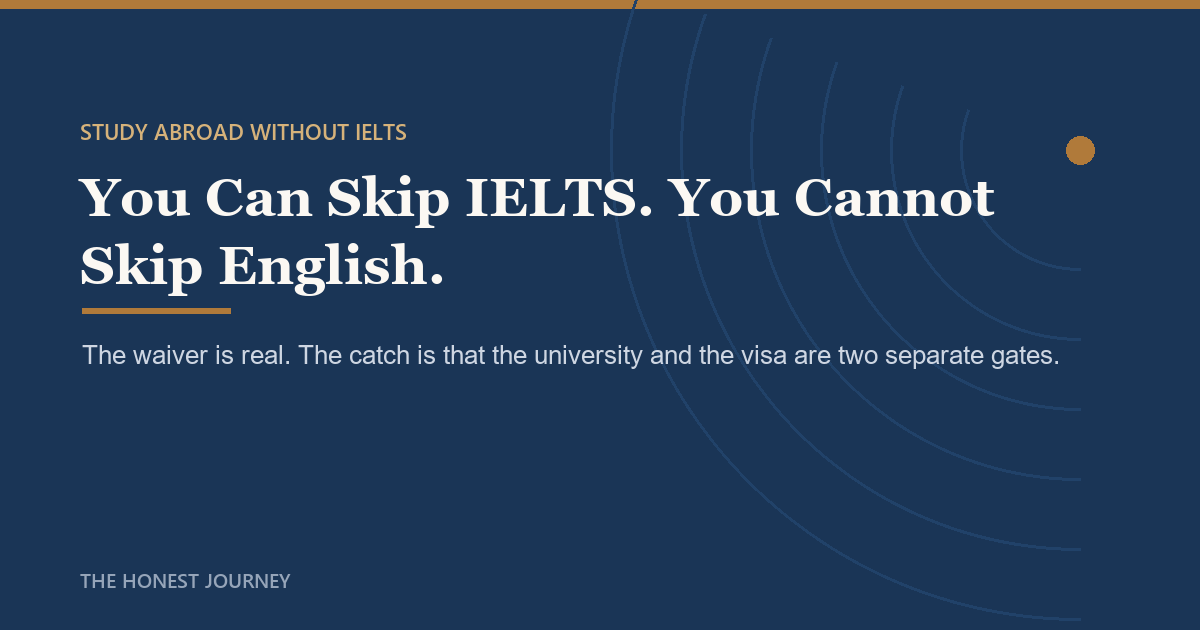
Here is the honest version. Yes, you can study abroad without IELTS. Waivers are real and common. But “without IELTS” almost never means “without proving English”, and the university waiving the test is not the same as the visa officer waiving it. Those are two separate gates, and the pages selling you the dream tend to mention only the first.
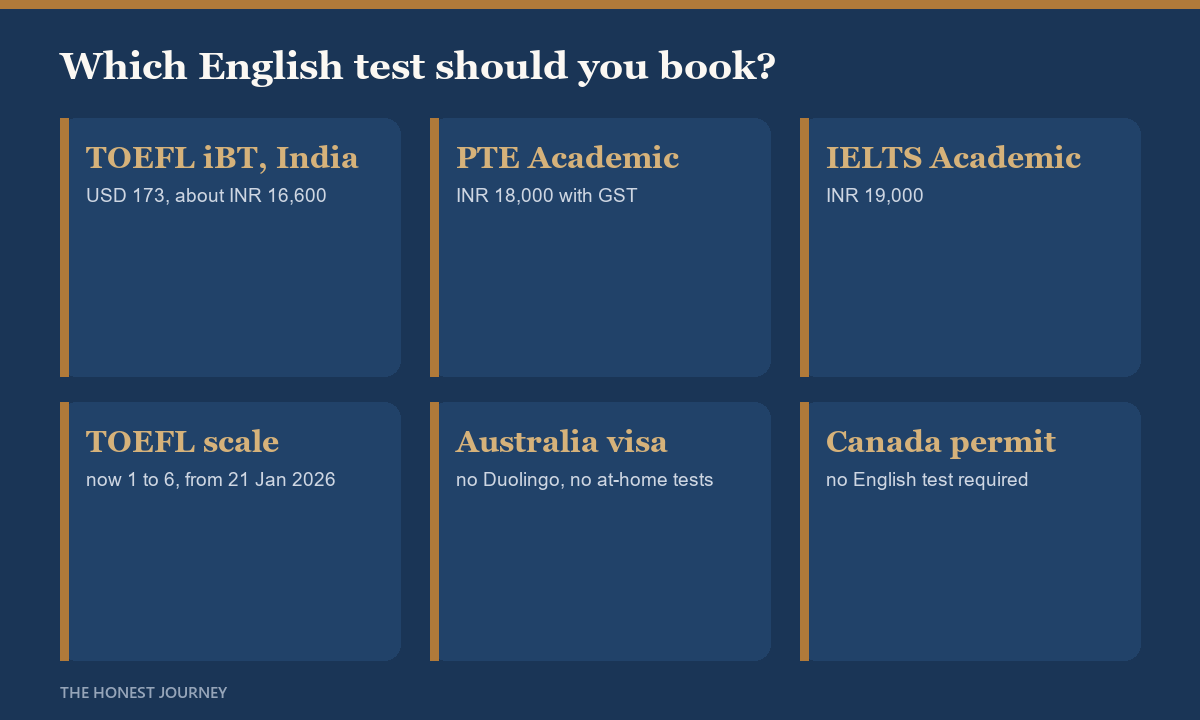
If you do have to sit a test, see which English test each country and university accepts.
This page covers what a waiver actually is, the alternatives that genuinely work, the specific catch in each major country, and the one mistake that turns a no-IELTS plan into a visa refusal.
The one thing to understand first
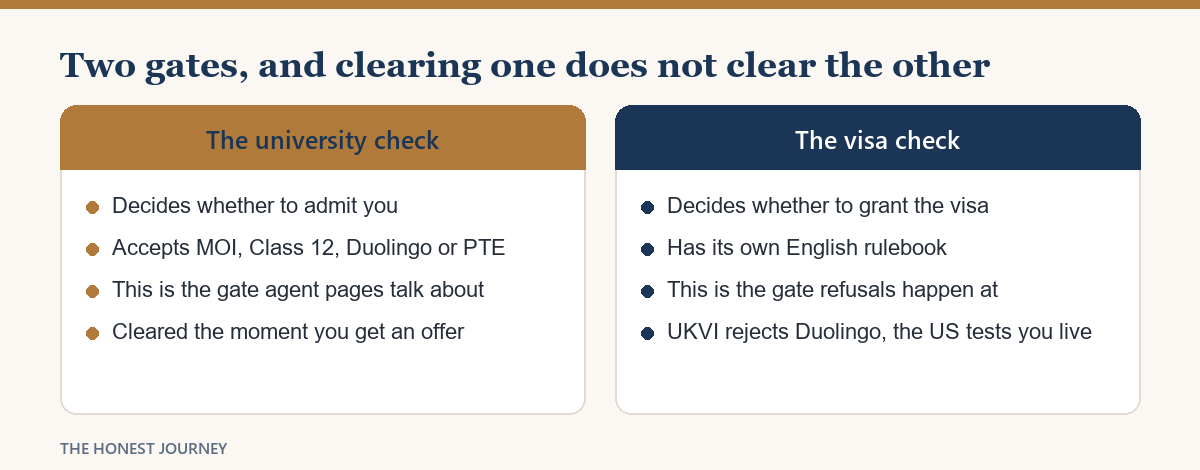
There are two separate checks on your English, and clearing one does not clear the other.
The university check. The admissions office decides whether to admit you. Many will accept a Medium of Instruction letter, your Class 12 marks, a Duolingo score, or their own English test instead of IELTS.
The visa check. The immigration authority decides whether to grant your student visa, and it has its own rules about English that do not always match the university’s.
The pages promising “no IELTS” are almost always talking about the first gate. The refusals happen at the second. If you take nothing else from this page, take this: confirm both before you celebrate.
Faz's ruleThe university waiving IELTS is not the visa officer waiving it. Those are two different people applying two different rulebooks, and the second one is the one that can send you home.
Every agent page conflates these on purpose, because the admission is what they get paid for. The visa is your problem, and it is where the no-IELTS plans fall apart.
What actually counts as an IELTS alternative
“Without IELTS” is a headline, not a category. What it means in practice is one of these.
Medium of Instruction letter. An MOI is an official letter from your school or college stating that your education was taught in English. Most Indian degrees from AICTE or UGC approved institutions qualify. This is the most common route and the cleanest, because it costs nothing and many universities accept it. The catch is that acceptance varies by university and is increasingly scrutinised, and it does not always satisfy the visa authority.
Class 12 English marks. Many universities, especially in the UK, accept 70 to 75% in English in Class 12 in place of a test. Straightforward if your marks clear the bar.
Duolingo English Test or PTE. These are cheaper and faster than IELTS. Duolingo runs around ₹4,900, takes an hour from home, and results arrive in about 48 hours. Acceptance is growing fast. But note this is still a test. “Without IELTS” here means “a different test”, not “no test”, and crucially some visa authorities accept Duolingo while others do not.
The university’s own English assessment. Some universities run a short online interview or test of their own. Convenient, but it only satisfies that university.
An intensive English programme. Some US universities admit you conditionally and require you to complete an English course on arrival. This is a real path but it adds time and cost.
The catch is different in every country
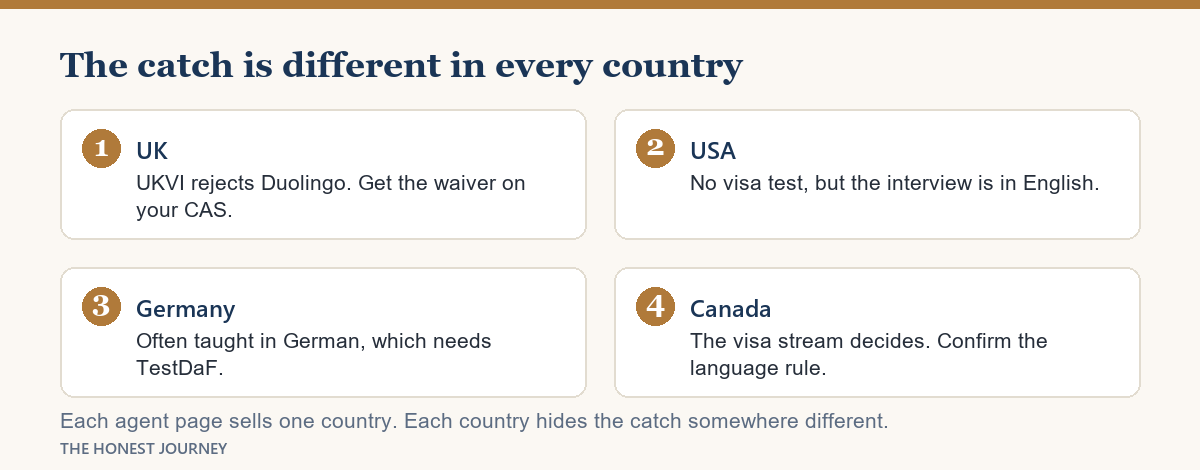
This is the part no single agent page tells you, because each one is selling one country. The waiver works differently in each, and the difference is exactly what causes refusals.
| Country | University waiver | The real catch |
|---|---|---|
| UK | 80+ universities accept MOI or Class 12 | UKVI does not accept Duolingo. The waiver must be endorsed on your CAS. |
| USA | 150+ universities accept MOI or Duolingo | The F-1 visa needs no test, but the interview is conducted in English and is the real test. |
| Germany | 200+ universities accept MOI for English-taught programmes | Many “no IELTS” programmes are taught in German and need TestDaF, a harder test. |
| Canada | Many universities accept MOI or Duolingo | The visa route matters. Confirm your specific stream’s language rule before applying. |
UK: the Duolingo trap
Over 80 UK universities accept a Medium of Instruction letter or strong Class 12 English marks, usually 70 to 75%, instead of IELTS. That part is genuinely easy.
The trap is Duolingo. More than 50 UK universities accept the Duolingo English Test, so applicants assume it covers everything. It does not. UK Visas and Immigration requires a Secure English Language Test, a SELT, and Duolingo is not on the approved list. So you can be admitted on a Duolingo score and then be unable to prove English for the visa.
The clean route is the MOI or Class 12 waiver endorsed directly on your CAS. When the university confirms your English that way, they note it on the CAS and no separate test is requested at the visa stage. Medicine, nursing, dentistry and law are exceptions and almost always require IELTS regardless. Full detail on the UK universities without IELTS page.
USA: the interview is the test
Over 150 US universities admit Indian students without IELTS or TOEFL, usually on an MOI letter, a Duolingo score of around 100 to 115, or a conditional intensive English programme. For engineering and science graduates from AICTE or UGC approved institutions, the MOI route is usually straightforward.
The F-1 visa itself needs no English test. The US embassy does not ask for IELTS. But the visa interview is conducted entirely in English, and a candidate who cannot hold that conversation is refused, test or no test. So the US does not remove the English requirement, it moves it to a five minute conversation with a visa officer. If your spoken English is weak, no waiver saves you here. See the USA universities without IELTS page.
Germany: without IELTS often means in German
Over 200 German universities accept an MOI for English-taught programmes, and tuition at public universities is close to zero, so the appeal is obvious.
The catch is specific to Germany and it is a big one. A large share of “study in Germany without IELTS” results are German-taught programmes, which need no English test because they are not in English. They need German, proven through TestDaF or DSH, which is a harder qualification to earn than IELTS. So “without IELTS” can quietly mean “with TestDaF”, which is the opposite of easier. Confirm the language of instruction before you get excited. The Germany without IELTS page covers which programmes are genuinely in English.
Canada: check the visa stream
Many Canadian universities accept an MOI or a Duolingo score. The variable that catches people is the visa route, since language rules differ by stream and have changed in recent years. Confirm the current requirement for your specific application before assuming a test-free path, because the university admitting you does not settle the visa question.
The alternatives, by cost and speed
If your goal is really to save money and time rather than to avoid English entirely, it helps to see what each route actually costs, because “without IELTS” often just means picking a cheaper test.
| Route | Rough cost | Speed | Honest note |
|---|---|---|---|
| MOI letter | Free | Depends on your college | Cleanest if the university endorses it, but not always visa-valid |
| Class 12 marks | Free | Instant | Only if your English marks clear the bar, usually 70 to 75% |
| Duolingo English Test | Around ₹4,900 | Results in about 48 hours | Cheap and fast, but rejected by some visa authorities including UKVI |
| PTE Academic | Around ₹15,000 to 17,000 | Results in a few days | Widely accepted, faster than IELTS, a real alternative |
| IELTS | Around ₹17,000 | Results in days to two weeks | The safe default that clears both gates almost everywhere |
Costs are approximate for India in 2026 and move. The point is the shape: the free routes carry a visa risk, the cheap test carries a visa risk in some countries, and the two safe options cost about the same as each other. If your English is genuinely strong, an MOI endorsed on your admission is the best of both. If it is not, paying for a widely accepted test is cheap insurance against a refused visa.
Why the honest answer matters for your money
This is not just an admissions detail. It is a financial one.
A “no IELTS” offer is often a signal, not just a convenience. The most selective universities rarely need to waive English tests to fill seats. A university that heavily markets a no-test, easy-admission route is frequently a less selective one, and a degree from a weak overseas university can be worth less than the loan you took to fund it. This ties directly into the honest maths for tier-2 college students and applicants with an average academic record, where the temptation to chase the easiest admit is strongest and most expensive.
And the refusal risk is the sharper cost. If you build your plan on a Duolingo score that your visa authority will not accept, you can lose application fees, a tuition deposit and a year, all of which matter more if the whole thing is loan funded. Our page on student visa rejection reasons covers where these plans actually break.
Faz's ruleA university that has to advertise easy admission with no test is telling you something about how selective it is. The best schools do not need to.
Skipping IELTS to save a few weeks is fine. Choosing a weak university because it skips IELTS is how people end up with a degree worth less than the loan. Keep those two decisions separate.
How to actually do this
Four steps, in order.
1. Confirm the waiver in writing from the university. Not from an agent, not from a blog. Get the admissions office to state which alternative they accept for your specific programme.
2. Confirm the visa authority accepts the same thing. This is the step everyone skips. Check that your country’s immigration rules accept the route the university offered, before you commit.
3. Keep a test in reserve if your spoken English is weak. Especially for the US interview. A waiver on paper does not help you in a live English conversation.
4. Do not let the waiver choose your university. Pick the school on its merits and the outcome it buys, then find the English route that works for it. Never the other way around.
Frequently asked questions
Can I really study abroad without IELTS?
Yes. Many universities accept a Medium of Instruction letter, Class 12 English marks, Duolingo, PTE or their own assessment instead of IELTS. But “without IELTS” usually means a different form of English proof, not none, and the visa authority may have separate rules from the university.
Is a Medium of Instruction letter enough?
Often for the university, not always for the visa. An MOI is widely accepted by universities, especially for degrees from AICTE or UGC approved Indian institutions, but acceptance varies and it does not always satisfy the immigration authority. Confirm both gates.
Does Duolingo work instead of IELTS?
For many universities, yes. For visas it depends on the country. The UK does not accept Duolingo for the student visa, since UKVI requires an approved SELT. Confirm your specific visa route before relying on a Duolingo score.
Which country is easiest to study in without IELTS?
Each has a different catch. The UK is easy at the university stage but Duolingo fails at the visa stage. The US needs no test but the visa interview is in English. Germany accepts MOI but many no-IELTS programmes are in German. There is no free lunch, only different trade-offs.
Will skipping IELTS hurt my application?
Not at a good university that accepts an alternative. But if you choose a university mainly because it waives the test, you may be choosing a less selective school, which is a much bigger and more expensive decision than the test itself.
Do I still need English for the visa if my university waived IELTS?
Sometimes yes. The visa authority applies its own English rules. In the UK the waiver must be endorsed on your CAS. In the US the visa interview tests your spoken English directly. Never assume the university’s waiver carries over to the visa automatically.
The honest closing
Studying abroad without IELTS is a real option, not a scam, and for a lot of Indian students it is a sensible way to save a few weeks and a few thousand rupees. The scam is not the waiver. The scam is the framing.
The pages promising a frictionless no-test route are selling admissions, and they go quiet exactly where the risk lives: the gap between what your university accepts and what your visa authority accepts, and the quiet signal that a university with no standards for English may have low standards generally.
Get the waiver confirmed in writing, check the visa rule separately, keep a test in reserve if your spoken English is shaky, and never let the absence of a test decide where you study. Do that and skipping IELTS is a small, smart convenience. Skip those checks and it is how a year and a loan get wasted.