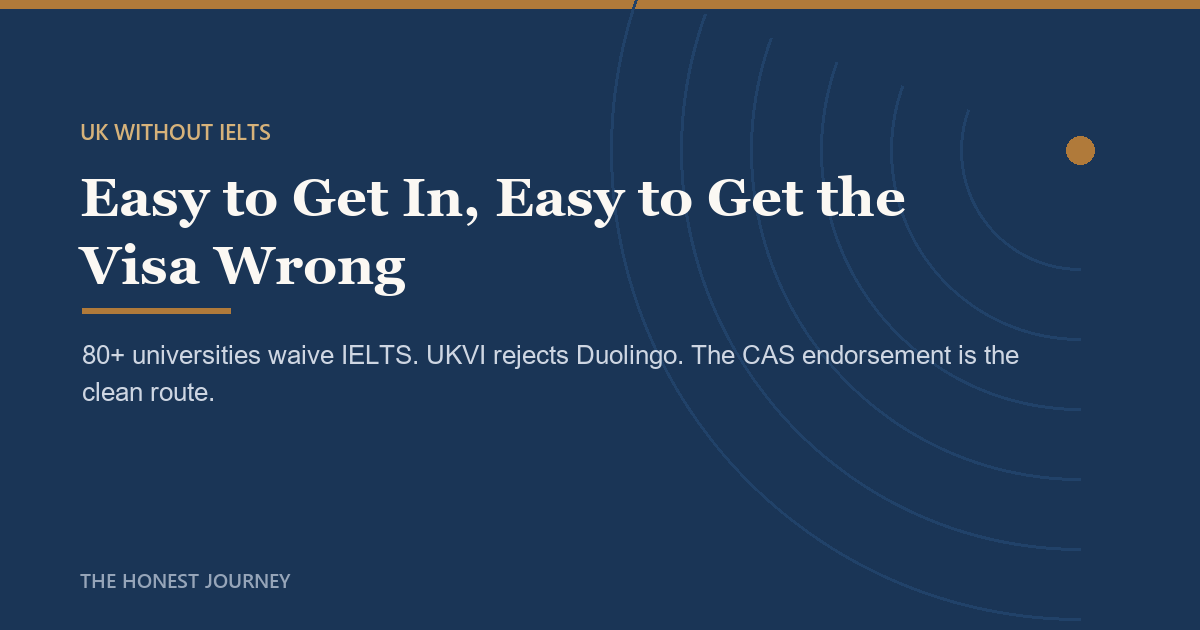
Short answer. The UK is the most searched destination for studying without IELTS, and it is genuinely one of the easiest at the admissions stage. Over 80 UK universities will accept a Medium of Instruction letter or your Class 12 English marks instead of the test.
It is also the country where the no-IELTS plan most often falls apart, and for a reason almost nobody spells out: the university and the visa office follow different rulebooks. You can be admitted without IELTS and then discover you still cannot prove English for the visa. This page is the honest version, including the exact trap to avoid.
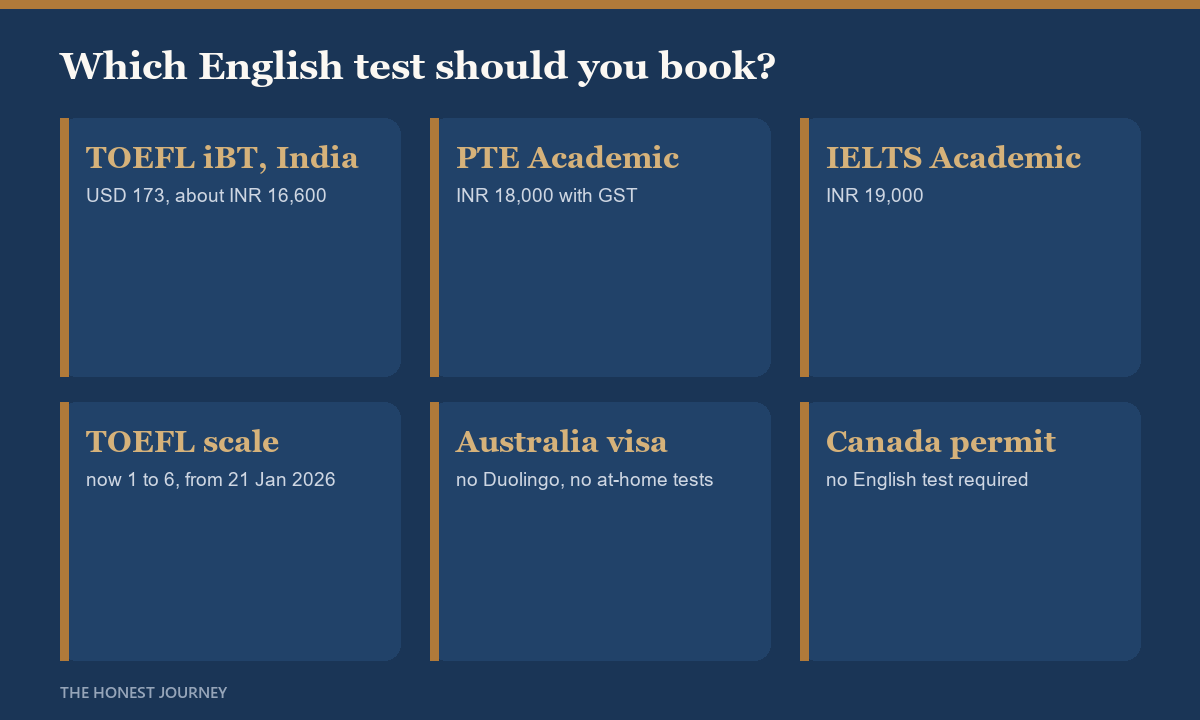
Taking a test after all? Note that Duolingo and TOEFL are not UK SELTs: IELTS vs TOEFL vs PTE vs Duolingo.
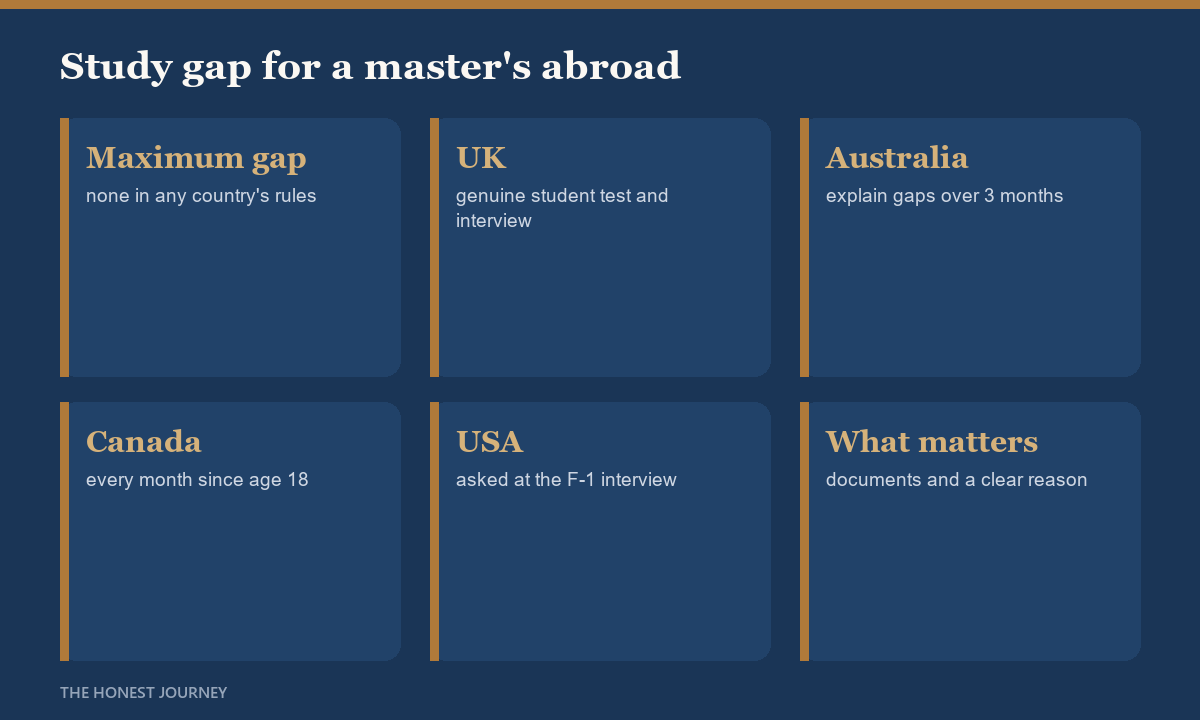
The same question, by country
The waiver is easy everywhere and the catch is different everywhere. If another country is on your list, start there, or see the study abroad without IELTS hub.
What UK universities actually accept
At the admissions stage the UK is applicant-friendly. The common alternatives to IELTS are:
- A Medium of Instruction letter, confirming your previous education was taught in English. Most degrees from AICTE or UGC approved Indian institutions qualify.
- Class 12 English marks, typically 70 to 75%, though the exact bar varies by university and course.
- The Duolingo English Test, accepted by more than 50 UK universities for admission.
- The university’s own English assessment, at some institutions.
Any of these can get you an offer without sitting IELTS. So far, so easy. The problem is the next gate.
The Duolingo trap, in detail
This is the single most important thing on this page, so read it twice.
More than 50 UK universities accept Duolingo for admission. So a natural assumption is that a Duolingo score covers your English for the whole process. It does not.
The UK student visa requires a Secure English Language Test, known as a SELT. As of the current UKVI guidance, the approved SELT providers are the IELTS SELT Consortium, LanguageCert, Pearson and Trinity College London. Duolingo is not a SELT. UK Visas and Immigration does not accept it for the student visa.
So here is the failure mode. You get admitted on a Duolingo score. You feel done with English. Then at the visa stage you find UKVI will not accept that score, and now you are scrambling to book a SELT or an approved test weeks before your course starts. People miss intakes this way.
Faz's ruleFifty UK universities accept Duolingo. UKVI accepts none. Being admitted on Duolingo and assuming the visa is covered is the most common no-IELTS mistake for the UK.
The university and the visa office are not the same gate. A Duolingo score can clear the first and fail the second, and you find out with weeks to spare.
The route that actually works
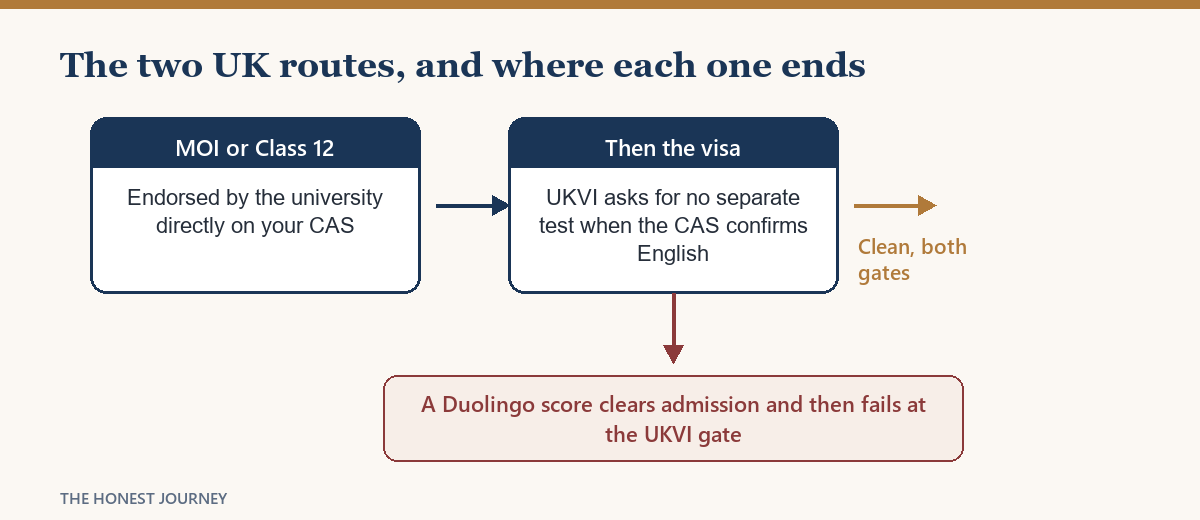
The clean UK path is not a cheaper test. It is the waiver endorsed on your CAS.
When a UK university confirms your English through an approved alternative, most commonly your MOI or Class 12 marks, they record it directly on your Confirmation of Acceptance for Studies, the CAS. When the CAS carries that confirmation, UKVI does not request a separate English test at the visa stage. No SELT, no IELTS, nothing further.
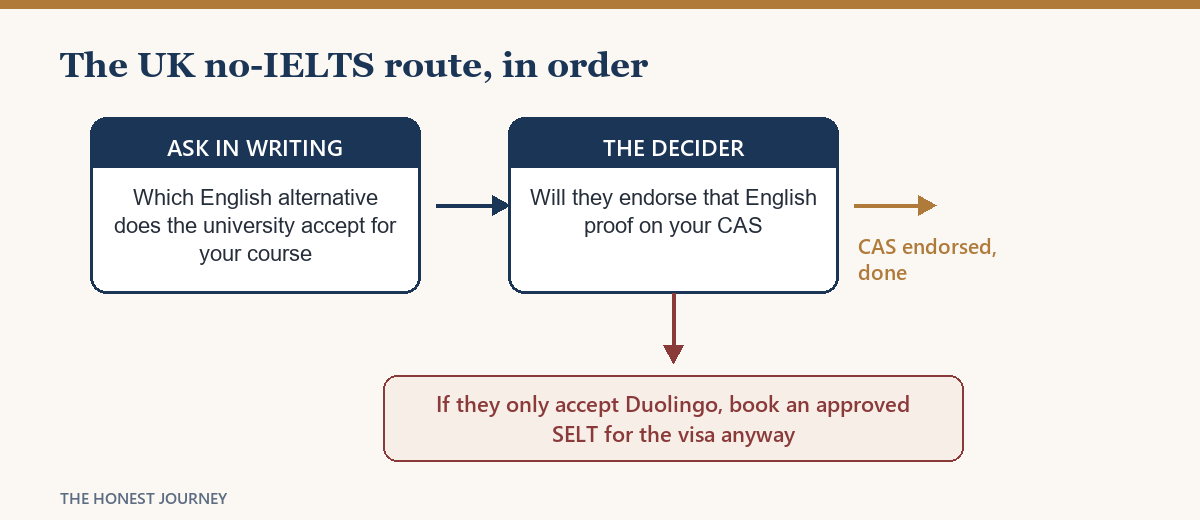
That is the genuine no-IELTS route for the UK, and it hinges entirely on one question you must ask the university in writing: will you endorse my English proficiency on the CAS. If yes, you are clear. If they only accept Duolingo, you are not, and you will still need an approved test for the visa.
What an MOI letter actually has to contain
Since the MOI route is the one that clears both gates, it is worth getting right, because a weak or vague letter gets rejected and sends you back to a test anyway.
A Medium of Instruction letter is issued by your previous university or college, on official letterhead, and it should state clearly that the language of instruction and examination for your degree was English. The strong versions name the specific degree, the years attended, and confirm both teaching and assessment were in English. The weak versions are a single generic sentence, and those are the ones increasingly questioned.
Three things get MOI letters rejected. First, it is on plain paper rather than official letterhead with a verifiable signatory. Second, it says teaching was in English but is silent on examinations, which reads as evasive. Third, it comes from an institution the university cannot verify. Degrees from AICTE or UGC approved institutions clear that last one easily, which is why the MOI route is smooth for most Indian applicants but not all.
Request it early. Indian institutions can be slow to issue these, and a letter that arrives after your CAS deadline is worth nothing.
The timing trap nobody mentions
The Duolingo problem is not only a rulebook problem. It is a calendar problem, and the calendar is unforgiving.
Picture the common sequence. You apply in the spring, get admitted over the summer on a Duolingo score, and turn your attention to funding and flights. In August, weeks before a September intake, you start the visa application and discover UKVI will not accept the Duolingo score. Now you need to book an approved SELT, sit it, wait for results, and only then apply for the visa, which itself takes time to process.
That is how people miss intakes. Not because the rule is hidden, it is on gov.uk, but because they discover it too late in the sequence to recover cleanly. The fix costs nothing: settle the visa-side English question in the same week you accept the offer, not in the same week you book flights.
Faz's ruleThe Duolingo trap is really a timing trap. You find out in August, with a September intake, that the score you were admitted on does not work for the visa.
Settle the visa English question the week you accept the offer. By the time you are booking flights, there is no room left to sit a fresh test and still make the intake.
The subjects that never waive it
Some courses require IELTS almost regardless of the university’s general policy. Medicine, nursing, dentistry and law are the main ones. These are fields where professional registration and patient or client safety depend on language, so the regulators, not just the university, set the bar.
If you are applying to one of these, assume you will need IELTS and plan for it. A general university waiver rarely reaches these programmes.
How to do it, step by step
| Step | What to do |
|---|---|
| 1 | Ask the university, in writing, which English alternative they accept for your course. |
| 2 | Ask specifically whether they will endorse your English on the CAS. |
| 3 | If yes via MOI or Class 12, you are clear for the visa. Get it in writing. |
| 4 | If they only accept Duolingo, book an approved SELT for the visa anyway. |
| 5 | For medicine, nursing, dentistry or law, assume IELTS is required. |
What a no-IELTS offer can signal
Worth saying plainly, because it interacts with the money.
A waiver at a strong university is just administrative convenience. But a university that heavily markets an easy, no-test, fast-admission route is often doing so because it needs to fill seats, and that is a different kind of signal. The most selective UK universities do not build their marketing around skipping IELTS.
This matters because a UK master’s is typically a ₹30 lakh or more decision once you count tuition and a year of London or big-city living. A degree from a weak university, chosen partly because it waived a language test, can be worth less than the loan that funded it. If a modest academic record is part of why the no-test route appeals, our page on studying abroad with an average academic record covers that trade honestly, and the UK student visa guide covers the rest of the process.
Frequently asked questions
Which UK universities accept students without IELTS?
Over 80 UK universities accept a Medium of Instruction letter or Class 12 English marks in place of IELTS, and more than 50 accept Duolingo for admission. Acceptance and the exact marks required vary by university and course, so confirm with the specific institution.
Can I get a UK student visa without IELTS?
Yes, if your university endorses your English proficiency on your CAS, usually via MOI or Class 12 marks. Then UKVI does not request a separate test. If the university only accepted Duolingo, you will still need an approved SELT for the visa.
Does UKVI accept Duolingo for the student visa?
No. The UK student visa requires a Secure English Language Test. Approved providers include the IELTS SELT Consortium, LanguageCert, Pearson and Trinity College London. Duolingo is not among them, even though many universities accept it for admission.
Is a Medium of Instruction letter enough for the UK?
For many universities, yes, especially for degrees from AICTE or UGC approved institutions. The key is whether the university will endorse it on your CAS. If they do, it satisfies the visa too. If they do not, you need an approved test for the visa.
Which UK courses always need IELTS?
Medicine, nursing, dentistry and law almost always require IELTS regardless of the university’s general waiver policy, because professional regulators set the language bar for these fields.
Is studying in the UK without IELTS a bad idea?
Not in itself. Skipping the test at a strong university that accepts an alternative is fine. The risk is choosing a weak university mainly because it waives the test, which is a far bigger and more expensive decision than the test itself.
The honest closing
The UK is easy to get into without IELTS and easy to get the visa wrong. Both of those are true at once, and the gap between them is where careful applicants win and rushed ones lose.
The whole thing comes down to one question asked in writing: will the university endorse your English on the CAS. If yes through MOI or Class 12, you have a clean no-IELTS route through both gates. If the answer is Duolingo, you have an admission and a visa problem waiting for you.
Ask that question early, keep the answer in writing, and never let the fact that a university skips IELTS be the reason you choose it. For the full picture of the destination, see the study abroad without IELTS hub and the cost of studying in the UK.