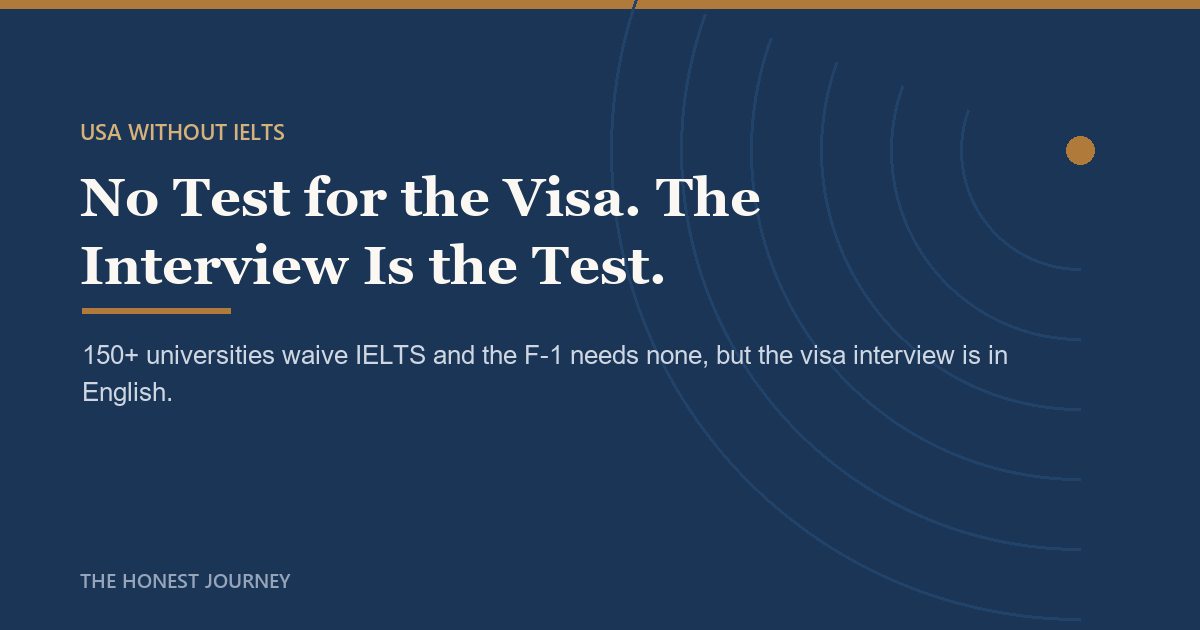
Short answer. Over 150 US universities admit Indian students without IELTS or TOEFL, and the F-1 visa itself asks for no English test at all. On paper, the US is the easiest major destination to reach without sitting a language exam.
In practice, the US does not remove the English requirement. It moves it. Instead of a test you can prepare for over weeks, it becomes a five minute conversation with a visa officer that decides your entire application, and that conversation is unforgiving of weak spoken English. This page is the honest version, including who this route genuinely suits and who it quietly catches out.
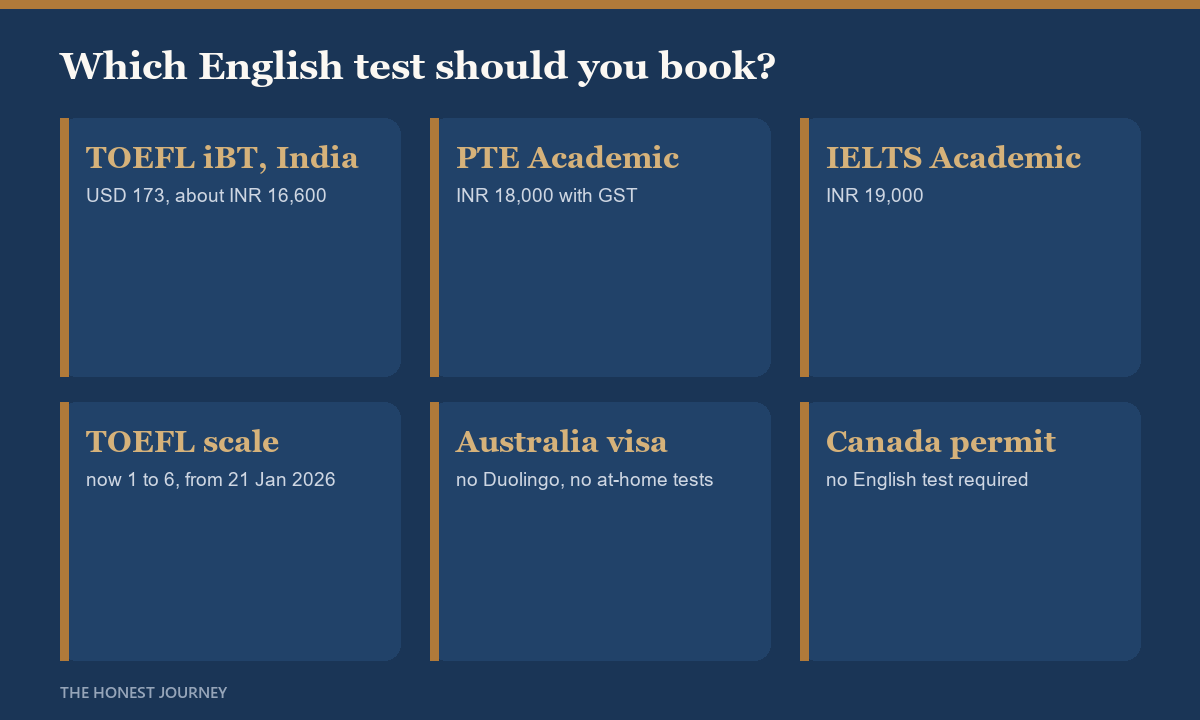
Some US graduate schools accept only two tests. See which English test to book for a US shortlist.
Skipping IELTS is one question. The other is the GRE: see whether US programmes still require the GRE.
Check the three-year degree rule before you apply. See how to shortlist universities for an MS abroad.
The same question, by country
The waiver is easy everywhere and the catch is different everywhere. If another country is on your list, start there, or see the study abroad without IELTS hub.
What US universities accept instead of IELTS
At the admissions stage the US is flexible, and there are three real routes.
A Medium of Instruction letter. Most US universities accept an MOI confirming your degree was taught in English. For engineering and science graduates from AICTE or UGC approved institutions, this is usually straightforward, since your bachelor’s was in English and the transcripts show it.
The Duolingo English Test or PTE. Widely accepted, with many MS programmes taking a Duolingo score in the region of 100 to 115. Cheaper and faster than IELTS, and increasingly the default for Indian applicants.
A conditional intensive English programme. Some universities admit you on condition that you complete an English course on arrival before starting your degree. A real path, but it adds time and cost, so read the condition carefully.
Any of these can get you admitted without IELTS or TOEFL. The admission is genuinely the easy part in the US.
The visa interview is the real English test
This is the part that matters, and it is where the honest version diverges sharply from the agent version.
The US embassy does not require IELTS for an F-1 visa. What decides your F-1 application is your I-20, your financial documents, and your performance in the visa interview. That interview is conducted entirely in English.
So the English requirement did not disappear. It relocated to a live, unscripted conversation with a consular officer who is, among other things, forming a judgement about whether you can genuinely cope with study and life in the US. A candidate who cannot follow the officer’s questions or answer clearly can be refused, and no waiver on your admission file changes that.
This is why the no-IELTS route in the US is not a way to avoid English. It is a way to swap a test you can drill for a test you cannot, because you never see the questions in advance.
Faz's ruleThe US does not waive English. It moves the test to the visa interview, where you cannot prepare the answers and a weak conversation gets you refused.
IELTS you can practise for. The visa officer you cannot. If your spoken English is shaky, skipping the test does not remove the problem, it just moves it to the worst possible place to face it.
The three routes, compared
At the admission stage you are choosing between three ways to skip IELTS, and they are not equal.
| Route | Cost and effort | The honest note |
|---|---|---|
| Medium of Instruction letter | Free, if your college issues it | Smooth for engineering and science grads from English-medium institutions |
| Duolingo or PTE | Around ₹4,900 for Duolingo, more for PTE | Widely accepted for MS, often a score near 100 to 115 for Duolingo |
| Conditional intensive English programme | Adds time and tuition on arrival | A real path, but read the condition, it delays your degree |
Whichever you pick, none of them touches the visa interview, which is the same for all three. The route decides how you get admitted. Your spoken English decides how the interview goes.
Who this route genuinely suits
The no-IELTS path in the US is a good fit for a specific profile and a poor one for another.
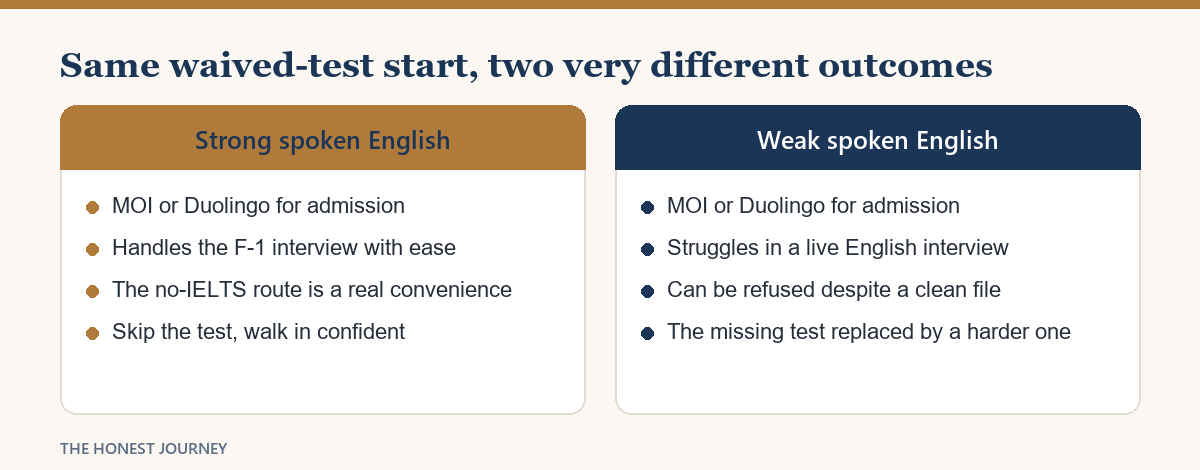
It suits engineering and science graduates from English-medium Indian institutions who are comfortable speaking English. For an MS in computer science, data science, or any engineering field, the MOI or Duolingo route is smooth, and a candidate who studied in English for four years usually handles the interview without difficulty.
It catches out applicants whose written English is fine but whose spoken English is weak, which is a very common combination. A polished application and a good Duolingo reading score do not guarantee you can hold a live conversation under pressure. If that is you, sitting a test is not the risk. The interview is.
The MS-in-USA case specifically
Because most Indian demand here is for a master’s, it is worth being concrete.
For an MS, the sequence is usually: MOI letter or Duolingo score for admission, then the F-1 interview. Key MS fields that run this way include computer science, data science, artificial intelligence, electrical, mechanical and civil engineering, and business analytics. Universities including several large public systems and well known private institutions accept Duolingo for MS admission.
The financial documents matter more than the language paperwork at the visa stage. The officer is checking that you can fund the degree, that your intent is genuine study, and that you can communicate. For the funding side, which is usually the real decision, see the USA education loan guide, and for whether the MS pays at all, the honest maths for engineering graduates.
Why this matters for your money
A US master’s is among the largest bets an Indian student makes, frequently ₹40 lakh or more once tuition and living costs are counted, and usually loan funded. The English question sits upstream of all of it.
A visa refusal on weak interview English does not just cost the visa fee. It can cost a tuition deposit, a deferred or lost intake, and the momentum of a plan that a loan is already committed to. And a refusal record complicates future attempts. Our page on student visa rejection reasons covers where F-1 applications actually break, and communication is on that list more often than applicants expect.
Set against a ₹40 lakh decision, spending a few weeks getting comfortable speaking English before the interview, whether or not you sit a formal test, is the cheapest insurance available.
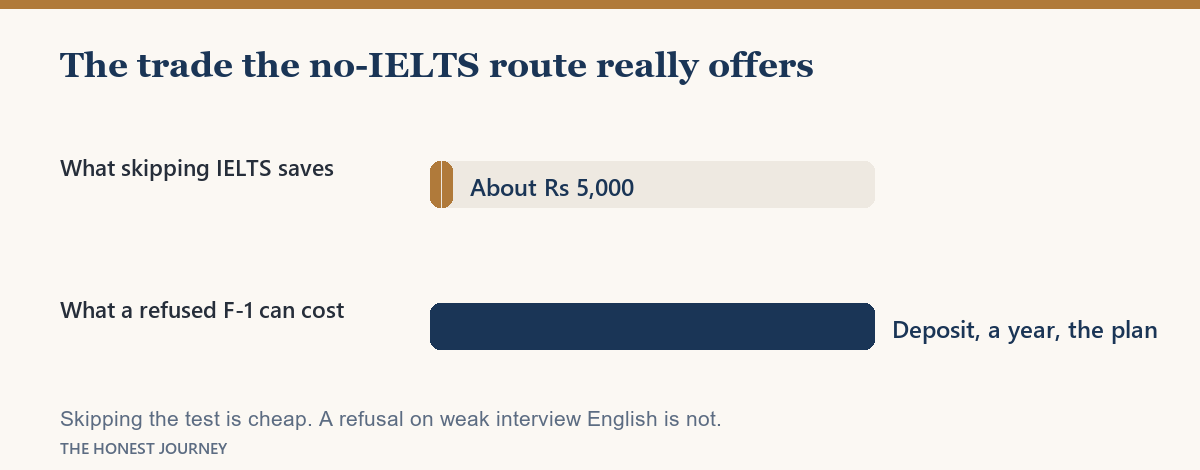
Faz's ruleSkipping the test saves you about five thousand rupees. A refused F-1 on weak interview English can cost a deposit, a year, and the whole loan-funded plan. That is not a close trade.
The no-IELTS route is a real convenience for confident speakers and a quiet trap for nervous ones. Know which you are before you decide the test was the thing standing in your way.
Frequently asked questions
Can I study in the USA without IELTS?
Yes. Over 150 US universities admit Indian students without IELTS or TOEFL, using a Medium of Instruction letter, a Duolingo or PTE score, or a conditional intensive English programme. The F-1 visa itself requires no English test.
Do I need IELTS for a US student visa?
No. The US embassy does not require IELTS for an F-1 visa. Your I-20, financial documents and visa interview decide the application. The interview is conducted in English, so spoken English still matters even though no test is required.
Does Duolingo work for US universities?
For many, yes. A large number of MS programmes accept a Duolingo English Test score, often around 100 to 115. It is cheaper and faster than IELTS and widely used by Indian applicants for US admissions.
Is a Medium of Instruction letter enough for the USA?
For most universities, yes, especially for engineering and science graduates from AICTE or UGC approved institutions whose degrees were taught in English. It handles the admission. The visa interview is a separate check of your spoken English.
Can I get an F-1 visa refused for weak English?
Effectively, yes. The interview is in English, and an applicant who cannot follow or answer the officer’s questions can be refused, regardless of a waived test on the admission file. Communication is a genuine factor in F-1 decisions.
Which MS programmes are available without IELTS?
Common fields include computer science, data science, artificial intelligence, electrical, mechanical and civil engineering, and business analytics, at a wide range of universities that accept MOI letters or Duolingo scores for MS admission.
The honest closing
The US is the destination where “without IELTS” is most literally true and most misleading at the same time. No test for admission at 150-plus universities, no test for the visa. And yet English decides your F-1 application, because the interview is in English and there is nowhere to hide in a live conversation.
If you studied in English and speak it comfortably, this is a genuine convenience and you should take it. Skip the test, use your MOI or a Duolingo score, and walk into the interview confident. If your spoken English is weaker than your written English, the honest advice is the opposite of what the no-IELTS pages imply: the missing test is not your friend, because it has been replaced by a harder one you cannot rehearse.
Either way, judge the university on its outcome, not on the fact that it waived a test, and get comfortable speaking English before you face the officer. For the wider picture, see the study abroad without IELTS hub and whether studying in the USA is worth it.