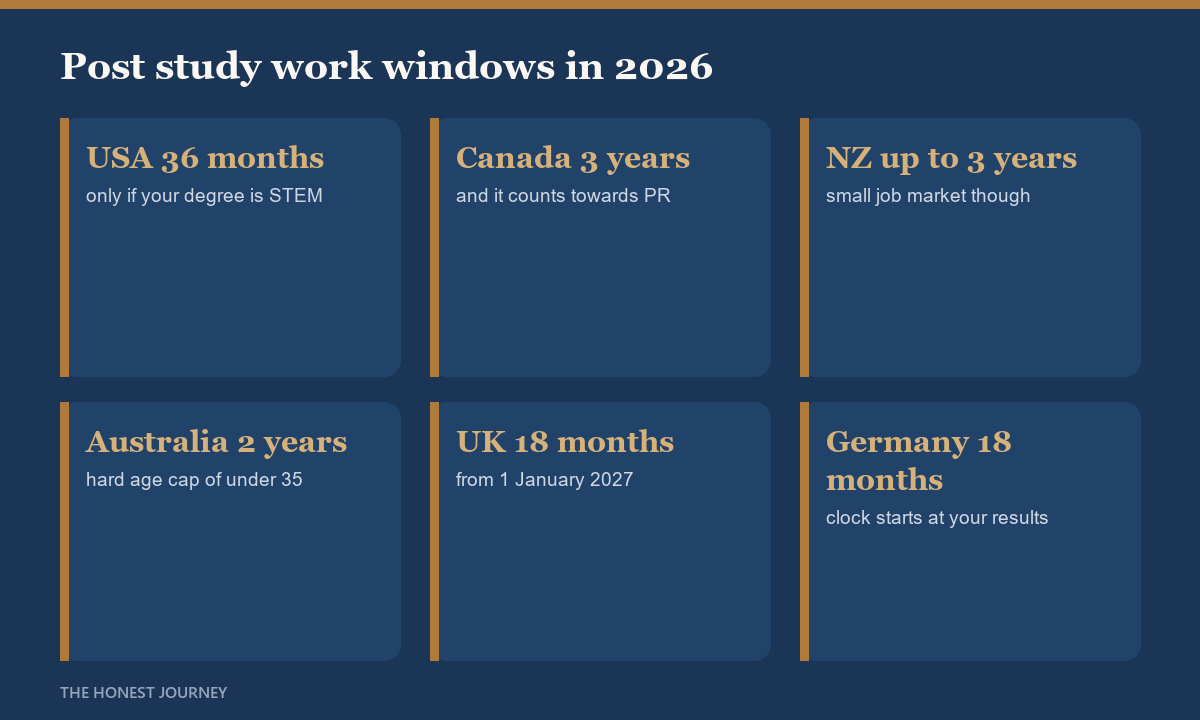
Short answer. Post study work rights in 2026 run from 12 months in France to three years in the USA with STEM OPT, Canada and New Zealand. Conversion matters more than length: Canada and Australia lead on permanent residence, the US rests on a wage weighted H-1B draw, and the UK drops to 18 months in 2027.
A post study work visa is the window a country gives you to stay and work after you graduate, without needing an employer to sponsor you first. In 2026 the honest ranking by length is New Zealand and the USA at up to three years, Canada at up to three years for degree graduates, Australia and Ireland at up to two, the UK at two falling to 18 months from 1 January 2027, and Germany, the Netherlands and France at 12 to 18 months. But length is the least important number. What actually decides your outcome is whether that window converts into something permanent, and on that measure Canada and Australia lead comfortably, the USA is a high stakes lottery, and the UK now offers a shorter window into a much harder conversion. Choose on the conversion, not the headline duration.
For Germany’s job search route without a German degree, see the Opportunity Card points calculator.
Almost every conversation about studying abroad ends up at the same question, usually asked too late: what happens when I finish. Families budget for tuition and living costs, agents talk about admissions, and the part that determines whether the whole investment pays back gets treated as a detail to sort out later. It is not a detail. For most Indian students taking a loan, the post study work window is the entire repayment plan.
So this guide does the thing the brochures do not. It lays out what every major destination actually offers in 2026, what each one costs, which ones lead to permanent residence and which are dead ends by design, and which rules changed recently in ways that break plans people made two years ago. Two of those changes are close enough to be urgent right now. If you are earlier in the process, this pairs with our best country to study abroad decision guide and the return to India or stay abroad financial comparison.
The comparison table
Rules verified September 2026. Durations are the standard case for a master’s graduate. Always confirm against the official source before acting.
| Country | Permit | Length (master’s) | Counts towards PR? | The catch |
|---|---|---|---|---|
| USA | OPT + STEM OPT | 12 months, or 36 if STEM | No direct path | H-1B cap now wage weighted, which disadvantages entry level offers |
| Canada | PGWP | 3 years | Yes, directly | Mandatory language test, hard 180 day deadline |
| New Zealand | Post Study Work Visa | Up to 3 years | Yes | Small job market; new 6 month short-term visa for Level 5 to 7 from 16 Nov 2026 |
| Australia | Subclass 485 | 2 years | Yes, via state and skills lists | Age cap under 35, IELTS 6.5, fee around AUD 5,750 |
| Ireland | Stamp 1G | 2 years (12 months after bachelor’s) | Yes, via employment permit | Small market, acute housing shortage |
| UK | Graduate Route | 2 years, 18 months from 1 Jan 2027 | No, does not count | Skilled Worker conversion now needs about £41,700 and RQF Level 6 |
| Germany | Job seeking residence permit | 18 months, non renewable | Yes, via EU Blue Card | Clock starts at exam results; German needed for most non technical roles |
| Netherlands | Orientation Year | 12 months | Yes, via highly skilled migrant | Short window, can be used within three years of graduating |
| France | APS, now RECE | 12 months, not renewable | Yes, via Talent Passport | French required for most roles outside a few sectors |
The three things that matter more than duration
Before going country by country, there are three structural truths that reframe the whole comparison, and missing them is how people pick badly.
1. An unsponsored window is not a job
Every permit in that table is unsponsored. That is exactly why they exist and why they are valuable: you can enter the country’s labour market without an employer having to commit to you first. But an unsponsored window only has value if it converts into a sponsored job before it expires, and the conversion requirements are set completely separately from the window.
This is the trap the UK now illustrates perfectly. The window shortened to 18 months while the conversion requirement rose to roughly £41,700 and graduate level roles only. Two independent policy levers moved in the same unhelpful direction, and the headlines only covered one of them. Always look up the conversion requirement, not just the window length.
2. Some windows count towards permanent residence and some are designed not to
This is the single biggest structural difference between destinations, and it is barely discussed.
Time on a Canadian PGWP counts towards permanent residence through Express Entry and the Canadian Experience Class. Time on the UK Graduate Route counts towards nothing. It does not lead to settlement, and the clock on settlement only starts once you switch to a qualifying route such as Skilled Worker. Two students, both working two years abroad, can end up in completely different positions depending only on which country they chose.
If your goal is to eventually settle, this factor should outrank salary, ranking and course content in your decision. If your goal is a few years of international experience and then a return to India, it barely matters and you should optimise for earnings instead. Either goal is legitimate. What is not legitimate is drifting into a country that structurally cannot deliver what you assumed it would.
3. The clock usually starts before you think
Almost every one of these permits keys off an administrative date that is earlier than graduation day, and students consistently get this wrong.
Germany’s 18 months starts when your final exam results are issued, not at the diploma ceremony. Canada gives you 180 days from your final marks, not from convocation. The UK’s two year versus 18 month split depends on your application date, which depends on when your university reports your completion. In the USA your status still continues automatically for now, but a blocked rule would replace it with a fixed admission date on your I-94, so keep an eye on it.
The practical instruction is the same everywhere: find out the exact administrative date that starts your clock, in writing from your university, in your final year. Not after results. A surprising number of lost work permits trace back to a student assuming they had until the ceremony.
USA: the longest runway and the highest variance
The US gives 12 months of OPT, extended by 24 months for STEM designated degrees, so up to three years. Both survived 2026 intact despite a lot of alarmed commentary suggesting otherwise.
One thing changed and one nearly did. DHS finalised a rule to replace duration of status with fixed admission periods capped at four years, with the grace period cut from 60 days to 30, due from 15 September 2026. On 14 September a federal court blocked it nationwide, so F-1 students stay in duration of status for now, and an appeal is expected. And the H-1B cap selection is no longer a random draw: it is weighted by the wage level of the offer, which structurally disadvantages the entry level salaries fresh graduates receive.
The US remains the highest ceiling option, with the best technical salaries anywhere and the longest post study window. It is also the most expensive and now the most administratively demanding. The single most important thing to verify before accepting an offer is whether your exact programme is STEM designated by CIP code, because that is the difference between one year and three, and therefore between one H-1B attempt and three. Full detail in our guide to OPT and the duration of status rule.
Canada: the clearest path to permanent residence
The PGWP gives up to three years of open work rights, and master’s and doctoral graduates now receive the full three years even from a programme as short as eight months. That ratio, one year of study to three years of open work, is the best on offer anywhere.
Canada’s decisive advantage is that PGWP time counts towards permanent residence. That is a published, arithmetic pathway rather than a hope, and it is why Canada still deserves serious consideration despite the reputational damage of the last two years.
The damage was real but concentrated. The rule changes hit the private college diploma route hardest: public private partnership programmes lost eligibility for anyone starting on or after 15 May 2024, and the field of study list constrains non-degree graduates. Degree graduates are exempt from that list altogether. The two things that most commonly sink applications are a language test that has expired, mandatory since November 2024 and needed in all four bands, and the strict 180 day deadline. Both are entirely avoidable with a calendar. Detail in our PGWP guide.
UK: shorter window, harder conversion
The Graduate Route currently gives two years, dropping to 18 months for applications submitted on or after 1 January 2027. PhD graduates keep three years. The trigger is your application date, not your course end date, so a student finishing in late 2026 who files in the new year loses six months for purely administrative reasons. It costs £937 plus roughly £1,035 per year of health surcharge.
The bigger issue is the conversion. Skilled Worker sponsorship now generally requires about £41,700, or the going rate for the occupation if higher, and the role must sit at RQF Level 6, up from Level 3. A great many roles that used to be sponsorable no longer are, and £41,700 is a genuine stretch for a fresh graduate outside technical fields. The new entrant rate softens it: switching from the Graduate visa, you can be sponsored at 70 percent of the going rate with a floor of £33,400, for up to four years in total. Add that Graduate Route time does not count towards settlement, and the UK proposition is materially weaker than it was in 2023.
It still works well for PhD graduates, for technical fields clearing the threshold, and for people with prior experience entering above graduate scale. It works poorly for general business master’s graduates expecting the market to sort it out. Our UK Graduate Route guide covers the deadline mechanic in full, and it is worth acting on this month if you finish in 2026.
Australia: good pathway, hard age gate
The subclass 485 Temporary Graduate visa gives around two years, and Australia’s skilled migration system offers a genuine route from there through state nomination and skills lists.
The problem is the age cap. Since 1 July 2024 the 485 is limited to applicants under 35 for most streams, down from under 50. Master’s by research and doctoral graduates can apply up to 49, as can Hong Kong and BNO passport holders. For a large group of Indian applicants, particularly those going abroad after some years of work experience, this single rule removes Australia from consideration entirely, and many do not discover it until late.
English requirements also rose to IELTS 6.5 with results valid for only one year, the application fee is around AUD 5,750, and the pandemic era two year extensions are fully gone by mid 2026. If you are under 35 and in a field on a shortage list, Australia is one of the strongest options available. If you are 36, it is closed, and you should know that before spending anything.
Germany: cheap to study, hard to convert without the language
Germany gives an 18 month residence permit to search for skilled work after graduating from a recognised German institution, with unrestricted work rights during it. It is non renewable, and the intention is that you convert to an EU Blue Card or a qualified professional work permit within the window. Those are solid, well established routes to permanent residence.
Three practical points decide whether it works. The 18 month clock starts at your final exam results, not at the ceremony, and applying late can get you refused. You need proof of roughly EUR 11,000 to 13,000 in living costs plus health insurance arranged before your student permit lapses. And appointment waits at the Ausländerbehörde can exceed eight weeks in cities like Berlin, so this is a booking you make months ahead.
The honest constraint is language. Germany is genuinely affordable, often with no tuition fees, which makes the total cost dramatically lower than the US or UK. But outside software engineering and some research roles, employment realistically requires German at a working level. Students who arrive intending to learn German and then do not are the ones who leave at month 18. If you are serious about Germany, start the language before you fly, not after.
The smaller destinations
Ireland gives Stamp 1G for two years after a master’s or 12 months after an honours bachelor’s, with a route onward through employment permits. It is English speaking, hosts substantial tech and pharma employers, and currently offers a longer window than the UK will from 2027, which makes the Ireland versus UK comparison genuinely worth running. The constraints are the size of the market and a severe housing shortage that is not improving.
New Zealand offers up to three years for degree level graduates and a real residence pathway, but a small economy limits opportunities in many fields. Note a change: from 16 November 2026 a new Short-Term Graduate Work Visa gives six months of open work rights to graduates of Level 5 to 7 qualifications studied for at least 24 weeks, which is a much shorter window aimed at a different group.
Netherlands gives a 12 month Orientation Year, usable within three years of graduating rather than immediately, which is unusually flexible. English taught programmes are plentiful and the highly skilled migrant route is well trodden.
France gives a 12 month permit, still widely called the APS but now issued as the RECE (recherche d’emploi ou création d’entreprise). It cannot be renewed, so plan around one year, with Talent Passport routes for higher earners. As with Germany, French is required for most roles outside a narrow set of sectors.
What changed, and when
If you are working from advice given to you in 2022 or 2023, here is what has moved underneath it. Every item below has taken effect or been confirmed, and several changed more than once.
- 1 July 2024, Australia: subclass 485 age cap cut from under 50 to under 35 for most streams. English raised to IELTS 6.5, test results valid one year.
- November 2024, Canada: language test made mandatory for all PGWP applications. Public private partnership college graduates lost eligibility entirely. Field of study restrictions introduced for non-degree graduates.
- May 2025, UK: immigration white paper signals the Graduate Route reduction.
- 22 July 2025, UK: Skilled Worker skill level raised from RQF Level 3 to Level 6, and the general salary threshold rises to £41,700, removing many previously sponsorable roles.
- 15 January 2026, Canada: IRCC confirms the PGWP field of study list is frozen for all of 2026, giving a full year of stability.
- Late February 2026, USA: H-1B cap selection moves from a random lottery to a wage weighted process.
- Mid 2026, Australia: the remaining pandemic era two year 485 extensions are fully removed.
- 17 July 2026, USA: DHS publishes a final rule to end duration of status for F-1 students from 15 September.
- 14 September 2026, USA: a federal court blocks the rule nationwide the day before it was due to start. Duration of status and the 60 day grace period continue while the case proceeds.
- 16 November 2026, New Zealand: new Short-Term Graduate Work Visa introduced, giving six months to Level 5 to 7 graduates.
- 1 January 2027, UK: Graduate Route falls from two years to 18 months for bachelor’s and master’s graduates. PhD stays at three years.
The pattern is unmistakable. Every significant change in the last two years has tightened rather than loosened, and the tightening has been concentrated on exactly the routes Indian students use most heavily. That does not mean the door is closing, but it does mean advice ages badly now, and anything more than a year old should be verified rather than trusted.
Germany and Australia in more detail
These two attract substantial Indian student interest and each has a decisive factor that determines whether they work for you at all.
Germany is the best value proposition in this entire comparison on paper. Public universities frequently charge no tuition fee, only a modest semester contribution, so the total cost of a master’s can land dramatically below the UK or US even after living expenses. The 18 month job seeking permit is unrestricted, and the conversion targets, the EU Blue Card and the qualified professional work permit, are established routes with a clear path to permanent residence. On cost adjusted return, Germany is arguably unbeatable.
The decisive factor is language. Outside software engineering, some research roles and a handful of international firms, working in Germany realistically requires German at a professional level, commonly B2 or above. English taught master’s programmes are plentiful, which creates a trap: students complete an English taught degree, spend the 18 months discovering that the job market wants German, and leave. The permit is generous, the barrier is linguistic, and the students who succeed are the ones who started learning before they flew rather than intending to pick it up. Administratively, remember that the 18 months runs from your final exam results, that you need roughly EUR 11,000 to 13,000 in evidenced funds plus health insurance before your student permit lapses, and that appointment waits at the foreigners’ office can exceed eight weeks in large cities. Book early. Our Germany ROI breakdown runs the full numbers.
Australia has one of the better structured skilled migration systems, with state nomination and occupation lists that create a visible route from the 485 through to permanent residence, and salaries and living standards that make the two year window genuinely productive. For those who qualify, it is a strong option.
The decisive factor is the age cap. The subclass 485 is limited to applicants under 35 for most streams, with master’s by research and doctoral graduates able to apply up to 49. For Indian applicants going abroad after several years of work, which is a large group, this closes Australia entirely, and it is frequently discovered late because agents do not lead with it. Check your age against the cap on the date you would apply, not the date you would start, and check it before you spend anything. Add IELTS 6.5, a fee around AUD 5,750, and the removal of pandemic era extensions, and the picture is clear: excellent if you are under 35 and in a listed occupation, closed if you are not. Our Australia ROI breakdown has the detail.
What these permits cost
Post study work visas are not free, and the bill arrives at the worst possible moment: after your loan disbursements have stopped and before your first salary. Students routinely fail to budget for this and end up borrowing at short notice on bad terms.
- UK: £937 application fee plus roughly £1,035 per year of immigration health surcharge, payable upfront. About £3,000 for the two year version, close to three lakh rupees in one payment.
- Australia: around AUD 5,750 for the subclass 485, one of the most expensive on this list, plus health insurance.
- Canada: comparatively modest permit fees, but budget for a fresh language test, which is a real cost and a real scheduling constraint.
- USA: OPT application fees are moderate, but the STEM extension and any status extension filings add up over three years.
- Germany: the permit itself is cheap, but you must evidence roughly EUR 11,000 to 13,000 in living costs plus health insurance, which is a blocked funds requirement rather than a fee.
Add this to your total cost of study from the beginning. If you are funding with an education loan, check explicitly whether the sanction covers post study visa costs, because many sanctions stop at tuition and living expenses and leave this gap unfunded. Our cost and funding guide covers how to size the total properly.
The five mistakes that cost people their window
Across every destination, the same avoidable errors recur. None of them are about being a weak candidate.
1. Assuming the clock starts at graduation. It usually starts at results. Germany’s 18 months, Canada’s 180 days and the UK’s application date all run off an administrative event that happens weeks before the ceremony. Find out your date in writing, in your final year.
2. Letting a language test expire. Canada requires a valid test under two years old at PGWP application, in all four bands. The test you sat for your study permit will often have lapsed by the time you graduate from a two year programme. Check the expiry date the day you start your final year.
3. Not verifying sponsorship before investing in an employer. In the UK and the US, an employer without a sponsor licence or a history of filing petitions cannot keep you, no matter how well the process goes. Both countries publish this information. Check it before the first interview, not after the offer.
4. Taking any job to pay rent, in a country where the job category matters. Canada only counts skilled work in TEER 0 to 3 towards the Canadian Experience Class. The US requires OPT employment to relate to your field of study. Months in an ineligible role feel like progress and are not.
5. Discovering an age or institution restriction late. Australia’s under 35 cap and Canada’s exclusion of public private partnership colleges both disqualify people absolutely, with no appeal. Both are checkable before you pay a deposit, and both are things agents have a financial incentive not to raise.
How to actually choose
Work backwards from what you want at the end, because the destinations diverge most sharply on that question and barely at all on the brochure.
If you want to settle permanently, Canada and Australia are the clearest arithmetic pathways, with New Zealand behind them. Canada if you are over 35 or want the longest open window; Australia if you are under 35 and in a listed occupation. The UK is now the weakest major option for this goal, because Graduate Route time does not count towards settlement at all.
If you want maximum earnings and can carry the risk, the USA is unmatched, provided your programme is STEM designated and your field commands a wage level that survives the weighted lottery. Size the loan against the scenario where H-1B does not land, because that scenario is common and is not a disaster unless the loan assumed otherwise.
If you want the lowest cost and are willing to learn a language, Germany is exceptional value with a real Blue Card pathway. If you want an English speaking European base, Ireland and the Netherlands are underrated.
And if your honest answer is that you intend to return to India after a few years, say so out loud early, because it changes the right choice substantially. You should then optimise for the cheapest good degree with a decent earning window, not for the country with the best PR pathway, and you can ignore half of this table. Our return to India comparison runs that maths over ten years.
The honest take
Post study work rules have tightened almost everywhere over the last two years, and the tightening has been uneven in ways that reward students who check and punish students who assume. The UK shortened its window and raised its conversion bar simultaneously. Australia cut its age limit by fifteen years. Canada dismantled the private college route while quietly improving the degree route. The US split permission to work from permission to remain and replaced a fair lottery with a weighted one.
None of that means do not go. It means the version of the plan that circulated in 2022 is unreliable now, and the specific country that suits you may not be the one that suited your senior. The good news is that every one of these rules is published and checkable. An afternoon spent verifying the window, the conversion requirement, the age limit and whether the time counts towards residence will tell you more than a month of talking to agents whose incentives point at a particular country.
Do that afternoon before you pay a deposit. It is the cheapest due diligence in this entire process and almost nobody does it.
Rules verified September 2026 against official government guidance for each country and current reporting. Immigration policy is moving quickly this year and several items here have changed more than once, so always confirm the current position on the relevant government website before you act.
Frequently asked questions
Which country gives the longest post study work visa?
The USA and New Zealand at up to three years, and Canada at three years for degree graduates. In the US the three years requires a STEM designated degree, otherwise it is 12 months.
Which post study work visa leads to permanent residence most reliably?
Canada, because PGWP time counts directly towards Express Entry and the Canadian Experience Class. Australia is strong for those under 35 in listed occupations. The UK Graduate Route does not count towards settlement at all.
Do I need a job offer to get a post study work visa?
No. Every permit covered here is unsponsored, which is the point of them. You still need a sponsored job to convert into a longer term visa before the window expires.
What is the biggest recent change I should know about?
Two. The UK Graduate Route drops from two years to 18 months for applications on or after 1 January 2027, and in the US a rule replacing duration of status with fixed admission periods was blocked by a court on 14 September 2026, so nothing has changed there yet.
Can I apply for a post study work visa after leaving the country?
Usually no. Most require you to be in the country when you apply, and several run tight deadlines from your results date. The Netherlands Orientation Year is a notable exception, usable within three years of graduating.
Does the age limit apply anywhere other than Australia?
Australia is the significant one, with a general cap of under 35 for the subclass 485. Most other major destinations do not impose an age limit on the post study work permit itself.
Can I bring my spouse during the post study work period?
It varies by country and several tightened dependant rules recently. See our guide to bringing your spouse or family on a student visa for the country by country position.
Where these figures come from
- gov.uk, Graduate visa: two years if you apply by 31 December 2026, 18 months after
- gov.uk, Skilled Worker new entrant rate
- DHS Study in the States, fixed admission period quick facts
- USCIS, H-1B registration process
- IRCC, PGWP eligibility
- Study Australia, Temporary Graduate visa (subclass 485)
- Immigration New Zealand, changes from 16 November 2026