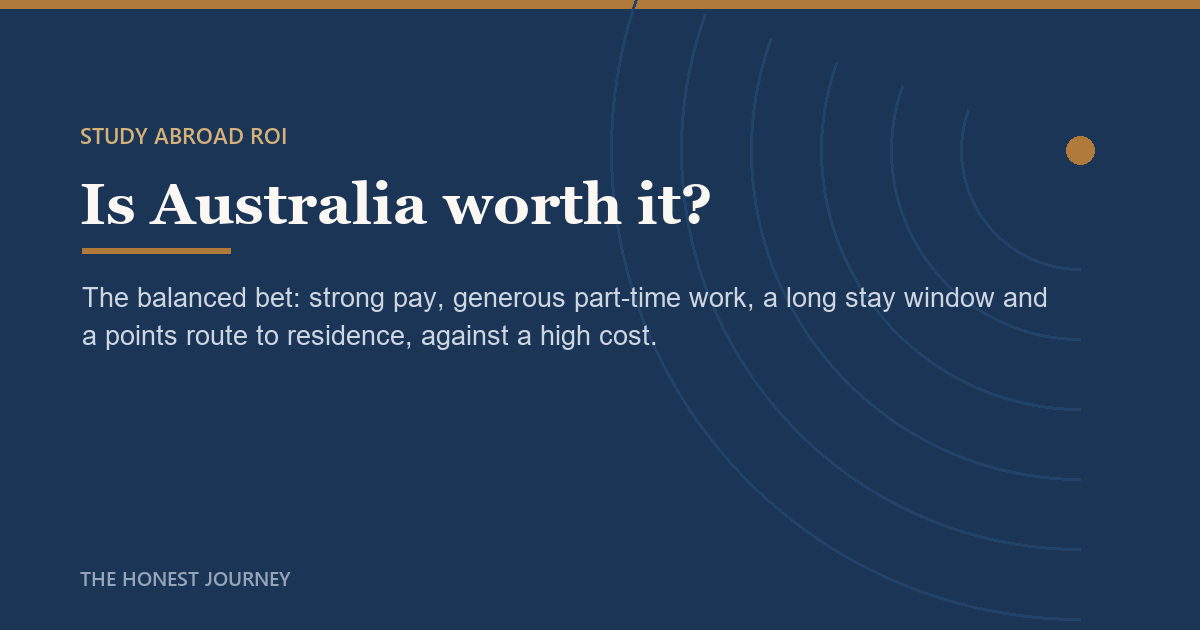
Short answer. The honest answer on whether studying in Australia is worth it for Indian students: Australia is the balanced bet, high wages, generous part-time work while you study, a long post-study stay of two to four years, and a points-based permanent-residence route you can realistically reach in three to four years.
A graduate earns ₹38 to 49 lakh, and a ₹45 lakh loan clears in five to seven years if you stay, which is a genuine possibility rather than a lottery. But it is also expensive, ₹45 to 60 lakh all-in, the cost of living in Sydney and Melbourne is brutal, and the salary does not reach US levels, so the loan is large against a moderate wage. Australia is worth it if you want a plannable path to staying with strong earnings and you can fund living through part-time work, and if you keep the loan sensible. It is weaker if you borrow heavily against the high cost without a clear intent to stay.
For how Australia’s graduate visa and its age limit compare, see post study work visas by country.
A student I know made Australia work through the part-time hours nobody talks about enough. Two-year Master’s in Melbourne, ₹52 lakh on paper, but she covered a real chunk of her living costs working the allowed hours through her degree, which quietly shrank the loan she actually needed. She then rode a two-year post-study visa into a job, added regional and skills points, and is now well down the permanent-residence track. Her salary is not American, but her stay was never a gamble, and the working hours turned a scary sticker price into a manageable one.
This post is the return question, not the cost question; the price detail lives on the cost of studying in Australia post. I will walk the all-in cost in rupees, what you actually earn, how the part-time work changes the maths, how fast the loan clears, and the specific risks that shape the Australian bet. For the math I use ₹55 per Australian dollar throughout; treat it as the planning frame.
If you are still choosing the country, the wider view is in is studying abroad worth it and the USA vs Australia comparison.
The ROI question in one paragraph
Australia is the balanced, mid-to-high-return option, and its distinctive feature is that the pieces fit together for someone who wants to stay. The wages are strong, second only to the USA in this set, the post-study work visa is a long two to four years, permanent residence runs on a points system you can plan toward, and generous part-time work rights during study let you offset living costs in a way no other destination here matches. The trade-off is cost: Australia is expensive, the big-city living costs are severe, and the salary, while strong, does not reach the US ceiling, so a large loan is doing real work against a moderate wage. Get the parts to line up, a sensible loan, part-time work to fund living, and a genuine intent to stay, and Australia delivers one of the better risk-adjusted returns here. Borrow heavily without the intent to stay, and the high cost bites.
Total all-in cost in INR
Australia is one of the more expensive destinations, close to the USA. A Master’s runs roughly AUD 30,000 to 45,000 per year in tuition, about ₹16.5 to 24.75 lakh a year, with living, especially in Sydney and Melbourne, around AUD 24,000 to 29,000 a year, or ₹13.2 to 15.95 lakh. All-in, a two-year Australian Master’s commonly lands between ₹45 and 60 lakh, and the student visa now requires proof of funds of around AUD 29,710 for living costs beyond tuition.
But Australia has a feature that changes the real number: generous part-time work rights. Students can work up to 48 hours per fortnight during term and unlimited hours in breaks, which for many students covers a meaningful share of living costs. That does not reduce tuition, but it can shrink the living portion of the loan noticeably, so the loan you actually carry is often smaller than the sticker all-in suggests. This is the single most underused lever in the Australian maths.
| Cost item | Two-year Australian Master’s |
|---|---|
| Tuition (full program) | ~₹33 to 50 lakh |
| Living (full program) | ~₹26 to 32 lakh |
| Rough all-in study cost | ~₹45 to 60 lakh |
| Typical loan shape | Large, but part-time work can shrink it |
| Proof of funds at visa | ~AUD 29,710 (~₹16.3L), plus tuition |
The breakdown and loan detail sit on the cost of studying in Australia post and the education loan for Australia post. The ROI point: the sticker is high, but Australia is the one destination where legitimate part-time work can materially cut the loan you actually need.
Faz's ruleAustralia is the only destination here where the hours you are allowed to work during study can meaningfully shrink the loan you carry. Treat part-time work as part of the funding plan, not pocket money, and the high sticker price comes down to earth.
Most students underuse Australia’s generous work rights. Up to 48 hours a fortnight in term and unlimited in breaks can cover a real share of living costs, which is the living half of your budget, so it directly reduces the loan you need rather than just funding weekend spending. Plan the work hours into the budget from the start and Australia’s scary sticker price becomes a much more manageable loan.
What you actually earn
Australian graduate pay is strong, the second-highest in this set behind the USA. A Master’s graduate commonly starts around AUD 70,000 to 90,000, roughly ₹38.5 to 49.5 lakh gross at ₹55, with the national graduate average sitting near the AUD 90,000 mark for many professional fields. That is well above UK, German and Canadian starting pay on gross, though still below US STEM levels.
Australian tax is moderate, so take-home on an AUD 80,000 salary is around AUD 62,000 to 64,000, about ₹34 to 35 lakh a year in hand, before rent. Sydney and Melbourne rents are among the highest in the world and take a heavy slice, which is why the maths improves markedly in Brisbane, Adelaide, Perth or a regional area, and regional study and work also add valuable permanent-residence points. For loan repayment, a disciplined graduate outside the priciest cities can direct ₹10 to 15 lakh a year at the balance.
The strength of the Australian salary is that it is both high and durable: high because the wages genuinely are strong, and durable because the two-to-four-year post-study visa and the points-PR route mean you can realistically keep earning it. That combination, strong pay you can plan on keeping, is what places Australia’s return near the top of this list for students who intend to stay.
The payback period, said plainly
Two scenarios frame the return, and Australia’s good column is genuinely reachable.
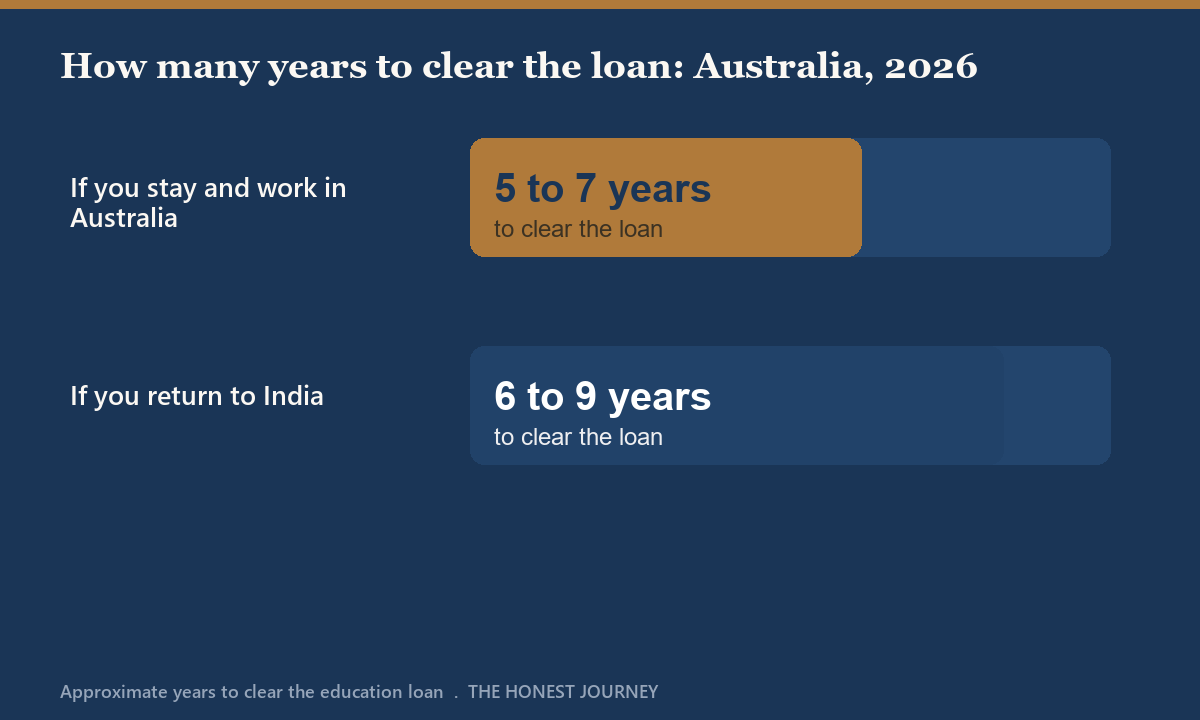
Scenario one, you stay and work in Australia. A graduate on AUD 80,000, directing ₹10 to 15 lakh a year at a balance near ₹50 lakh, clears the loan in roughly five to seven years, then continues on a strong salary toward permanent residence. Because the post-study visa is long and the PR route is points-based rather than a lottery, most graduates who plan for it can realistically reach this column, which is what makes the payback dependable despite the large loan.
Scenario two, you return to India. An Australian Master’s plus experience commands a decent Indian salary, often ₹14 to 25 lakh a year, and the same ₹50 lakh balance takes six to nine years to clear. This is the heavier column, because the loan is large against an Indian wage, so Australia’s return column is less forgiving than Germany’s or the UK’s. The high cost means you really want to be in the staying column, which is why intent to stay matters so much to the Australian bet.
| Payback factor | Stay in Australia | Return to India |
|---|---|---|
| Typical salary | AUD 70k to 90k (~₹38.5 to 49.5L) | ~₹14 to 25 lakh |
| Annual take-home in hand | ~₹32 to 36 lakh | ~₹11 to 19 lakh |
| Realistic yearly loan repayment | ~₹10 to 15 lakh | ~₹6 to 9 lakh |
| Years to clear ~₹50 lakh | ~5 to 7 years | ~6 to 9 years |
| What decides it | Using the 485 visa and points to stay | Large loan against an Indian salary |
Because the loan is large, the gap between Australia’s columns matters, but unlike the USA the good column is reached by planning, not luck, so a student who intends to stay can reasonably count on it.
Faz's ruleAustralia pays well and lets you plan the stay on points, but the loan is large, so the return column is heavy. This is a destination where you really want to intend to stay, and a strong reason to keep the loan sensible and use part-time work to fund living.
Australia’s staying column is strong and reachable through the long post-study visa and points PR, but its return-to-India column is heavier than Germany’s or the UK’s because the loan is big. The lesson is to keep the borrowing sensible, lean on part-time work for living costs, and be genuine about intending to stay. Do that and Australia’s balanced return is one of the best here.
The risks that shape the ROI
Three risks shape the Australian bet, and none is a lottery, which is part of its appeal.
The first is cost, especially living cost. Australia is expensive and Sydney and Melbourne rents are severe, so a student who studies in the priciest cities and borrows the full living cost carries a large loan against a moderate wage. The fix is within reach: use the part-time work rights, and consider Brisbane, Adelaide, Perth or a regional area, which cut living costs and add permanent-residence points at the same time.
The second is policy change on the post-study visa. Australia adjusts the length and rules of the Temporary Graduate visa periodically, including age and eligibility settings, so the exact window can shift between when you apply and when you graduate. It remains a long, usable stay of two to four years for most, but confirm the current settings for your qualification rather than relying on an older figure.
The third is intent-cost mismatch. Because the loan is large and the return-to-India column is heavy, Australia punishes a student who borrows heavily but does not really intend or manage to stay. The maths only sits comfortably when the strong salary is one you plan to keep earning. If you are genuinely unsure about staying, either keep the loan much smaller or look at a lower-cost destination, because Australia’s cost demands the staying column.
A worked payback example
Take one student, a two-year Australian Master’s graduate, ₹45 lakh loan at 10.5 percent after part-time work reduced the living borrowing.
| Step | Figure |
|---|---|
| Loan borrowed (after part-time offset) | ₹45 lakh at 10.5 percent |
| Balance after 2-year moratorium | ~₹52 to 54 lakh |
| Australian starting salary | AUD 80,000 = ~₹44 lakh gross |
| Take-home after Australian tax | ~AUD 63,000 = ~₹34.6 lakh |
| Yearly amount toward loan | ~₹13 lakh |
| Payback if staying (485 job) | ~5 to 6 years |
| Payback if returned to India | ~6 to 9 years |
The staying column is a strong, dependable return: a large loan cleared in about five to six years on a high, durable salary, with permanent residence building alongside on points you can plan. The returning column is the heavier one, a reminder that Australia’s high cost really wants the staying outcome. Same student, and the good column is reached by using the 485 visa and stacking points, both of which you control, helped enormously by having kept the loan sensible through part-time work.
When Australia is worth it, when it is not
It comes down to intent to stay and loan discipline.
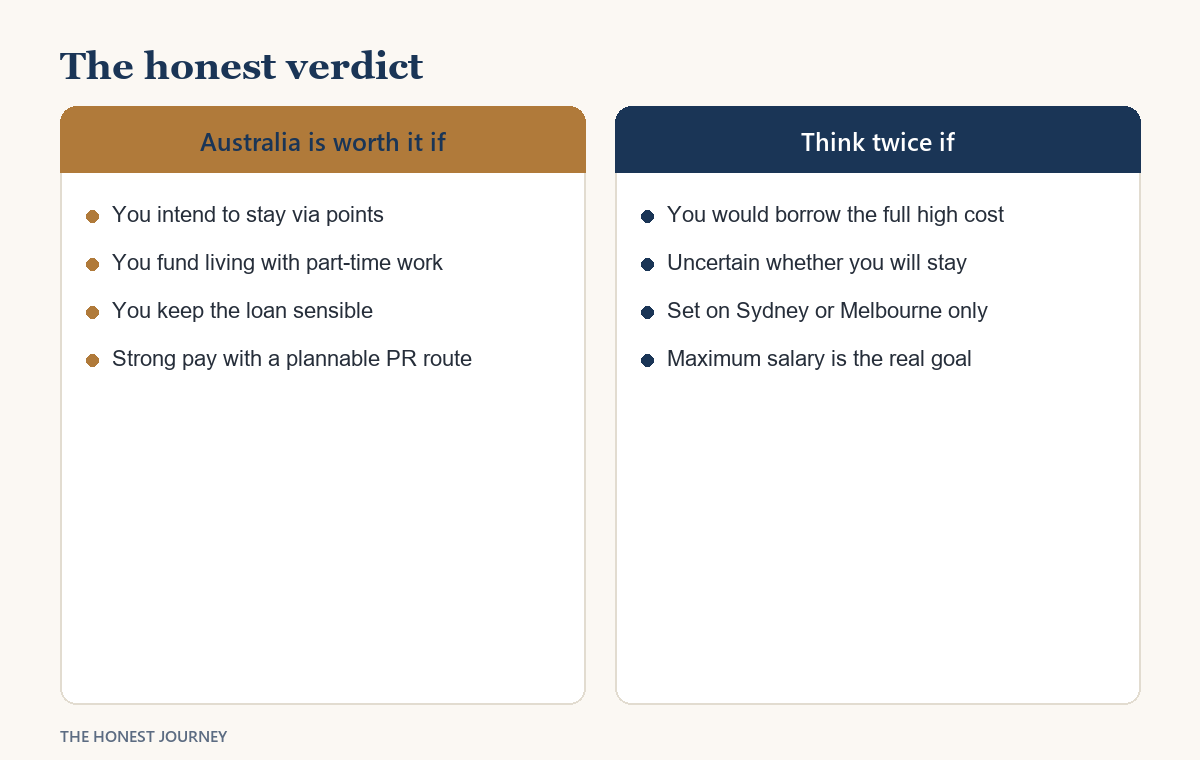
Australia is worth it if you want strong wages with a plannable, points-based route to staying, you will use the generous part-time work rights to fund living and keep the loan sensible, and you genuinely intend to stay long enough to ride the 485 visa into permanent residence. For that profile Australia offers one of the best balanced returns here: high pay, a long stay window, and a PR path you can engineer, without the US lottery.
Think twice if you would borrow the full high cost against an uncertain plan to stay, or you are set on the priciest cities without a cost strategy, because the large loan against a moderate wage makes the return-to-India column heavy. If maximum salary is the goal and you accept the visa lottery, the USA vs Australia comparison weighs that trade, and for a lower-cost points route the Canada vs Australia comparison is the one to read.
One note for everyone: an Australian Master’s plus experience is a solid asset in India too, but because the loan is large, a planned return is less financially comfortable than from cheaper destinations. Australia rewards the student who commits to staying and keeps the borrowing disciplined.
The honest take
The Melbourne graduate made Australia work not by earning American money but by fitting the pieces together: part-time work to shrink the loan, a sensible city choice, the long post-study visa, and points stacked deliberately toward permanent residence. She would tell you the sticker price frightened her family and the reality turned out manageable, precisely because she used every lever Australia offers instead of just borrowing the whole cost.
So reduce it to the honest test. Do you intend to stay and use the points route, will you fund living through part-time work and keep the loan sensible, and are you clear-eyed that the high cost makes the return-to-India column heavy? If yes, Australia is one of the best balanced returns in international education, strong pay and a plannable stay without a lottery. If you would borrow heavily against an uncertain stay, price that carefully and read the study in Australia page before you commit a rupee. Decide against the cost, and commit to the stay that justifies it.
Funding the move with a loan? Start with the complete education loan guide, then apply through the PM Vidyalakshmi portal, the government route most Indian students use.
Australia rewards points, and points move with age. See studying abroad in your 30s.
FAQ
Is an Australian Master’s degree worth it for Indian students in 2026?
For students who intend to stay and manage the loan sensibly, yes. Australia pays strong graduate salaries of ₹38 to 49 lakh, offers a long two-to-four-year post-study visa, and has a points-based permanent-residence route you can plan toward, so a ₹45 lakh loan clears in five to seven years if you stay. The catch is the high cost, ₹45 to 60 lakh all-in with severe big-city rents, which makes the return-to-India column heavy. Use part-time work to shrink the loan and it is one of the better balanced returns here.
How long does it take to repay an Australian education loan?
If you stay and work in Australia, roughly five to seven years on a strong graduate salary. If you return to India, the same loan takes about six to nine years, and because Australian loans are large, that return column is heavier than for cheaper destinations. The payback is reliable for those who stay, since the long post-study visa and points-PR route make the staying column genuinely reachable rather than a lottery, but the high cost means you really want to be in that staying column.
What salary can an Indian student expect after studying in Australia?
A Master’s graduate commonly starts around AUD 70,000 to 90,000, about ₹38.5 to 49.5 lakh gross at ₹55, with the graduate average near AUD 90,000 for many professional fields, the second-highest pay in this set behind the USA. Take-home after Australian tax is roughly ₹34 to 35 lakh on an AUD 80,000 salary, before rent. Sydney and Melbourne rents are very high, so working in Brisbane, Adelaide, Perth or a regional area improves the maths and adds PR points.
Can part-time work really reduce my Australian education loan?
Yes, more than in any other destination here. Students can work up to 48 hours per fortnight during term and unlimited hours in breaks, which can cover a meaningful share of living costs. Since living is roughly half the total budget, that work directly reduces the loan you need rather than just funding spending. Planning the allowed work hours into your budget from the start is the single most effective way to bring Australia’s high sticker price down to a manageable loan.
What is the biggest financial risk of studying in Australia?
Borrowing the full high cost against an uncertain plan to stay. Because the loan is large and the return-to-India column is heavy, Australia punishes a student who takes on maximum debt but does not manage to stay. The salary only comfortably services a big loan when you keep earning it in Australia. Keep the loan sensible, use part-time work for living, choose a cheaper city, and be genuine about intending to stay, and the risk becomes manageable.
Can Indian students settle permanently in Australia after studying?
Yes, through a points-based system you can plan toward, which is Australia’s core advantage. After graduating you can hold a Temporary Graduate visa for two to four years to gain experience, and permanent residence runs on a points test that rewards your qualification, work experience, English and factors like regional study. It is not a lottery, so most graduates who plan for it can realistically reach it, though you should confirm the current visa settings, which Australia adjusts periodically.
Should I take a large loan to study in Australia?
Keep it as sensible as possible, because the loan is large against a moderate, if strong, wage. Use the generous part-time work rights to fund living and reduce the living portion of the loan, choose a lower-cost city, and prefer secured options at a better rate where you can. A disciplined loan clears cleanly from an Australian salary if you stay, but a maximum loan against an uncertain stay is the setup that makes the return-to-India column painful. Borrow against a realistic plan to stay.
Is Australia or Canada a better return for Indian students?
They are close, both offering points-based routes to staying without a US-style lottery. Australia pays higher graduate salaries and has generous part-time work rights, but costs more and has severe big-city living expenses. Canada is somewhat cheaper with a strong Express Entry route, though it tightened significantly in 2024. For higher pay and part-time work leverage choose Australia; for a slightly lower cost and a well-established PR system choose Canada. The full split is in the Canada vs Australia comparison.
Faz · The Honest Journey · 2026