Short answer. For most Indian students the honest verdict is this: the UK is the cheaper, faster bet (a one-year Master’s runs roughly ₹30 to 45 lakh all in) while the USA is the higher-cost, higher-ceiling bet (a two-year Master’s runs roughly ₹70 lakh to over ₹1 crore).
The UK gives a guaranteed 2-year Graduate Route. The USA gives a 36-month STEM runway gated by the H-1B lottery. Pick on cash and risk tolerance, because PR is hard in both.
I get this question more than almost any other, and it is usually framed wrong. People ask which country is better, as if there is a universal answer. There is not. The USA and the UK are two completely different bets with different price tags, different time horizons and different ways of going wrong. The right call depends entirely on how much cash your family can put at risk and how much uncertainty you can stomach.
This post stays in the decision lane. I am not going to re-explain how to apply to either country, because the study in USA guide and the study in UK guide already do that. Here I want to put the two side by side on the five things that actually decide the outcome: total cost in INR, work runway, salaries, PR difficulty, and risk. I will use ₹84 per US dollar and ₹105 per British pound throughout, so the math is auditable.
The structural difference: two years versus one
The single fact that drives everything else is duration. A typical US Master’s is two academic years. A typical UK Master’s is twelve months, sometimes finished and graduated inside a single calendar year. That one difference cascades into cost, debt, opportunity cost and earning runway.
Two years in the US means two years of tuition, two years of living cost, and two years out of the Indian job market. One year in the UK means roughly half of each. The UK degree gets you back to earning faster, whether that earning happens in London or back home in Bengaluru. The US degree costs more and takes longer, and it has to earn that back through a longer or higher-paying work window. That is the whole trade in one sentence.
Neither is automatically better. A one-year degree that gets you a UK Graduate Route job paying GBP 35,000 is a fine outcome. A two-year STEM degree that lands a USD 110,000 tech role on OPT is a better one in raw rupees, if it lands. The word “if” is doing a lot of work, and we will get to it.
Total cost in INR, the honest comparison
Let me build both tickets from the ground up. These are mid-range, realistic numbers for a non-scholarship student, not the cheapest or the most expensive case. The detailed breakdowns live in the cost of studying in USA post and the cost of studying in UK post; here I am only comparing the totals.
| Line item | USA (2-year MS) | UK (1-year MSc) |
|---|---|---|
| Tuition (full program) | USD 50,000 to 70,000 | GBP 18,000 to 32,000 |
| Living cost (full program) | USD 28,000 to 36,000 | GBP 13,000 to 16,000 |
| Visa, health, insurance, flights | USD 4,000 to 6,000 | GBP 3,000 to 4,000 |
| Total (foreign currency) | USD 82,000 to 112,000 | GBP 34,000 to 52,000 |
| Total in INR | ₹69 lakh to 94 lakh | ₹36 lakh to 55 lakh |
So at the realistic middle, a US Master’s costs roughly ₹70 lakh to over ₹1 crore once you include the premium-program cases, and a UK Master’s costs roughly ₹36 to 55 lakh. The UK ticket is consistently around half the US ticket. That is not a small gap. On a loan, that difference compounds into years of repayment. For a family pledging collateral, it is the difference between mortgaging part of a house and mortgaging most of it. The education loan for USA post walks through why almost every US ticket lands in the secured-collateral tier, which the UK ticket often avoids.
Faz's ruleThe UK costs roughly half the USA for the degree itself, and you lose one fewer year of earning. If cost is your binding constraint, that math usually decides it before anything else does.
I have watched families stretch to fund a US two-year ticket on the assumption it will pay back, then spend three years anxious about the H-1B lottery. The UK removes a whole year of cost and opportunity cost. That is real money and real time, not a rounding error.
Work runway: a guaranteed two years versus a gated three
This is where the two countries diverge most sharply, and where people misunderstand the risk.
The UK gives every graduate the Graduate Route: two years of unrestricted work after you finish (three years for a PhD), no job offer required, no sponsorship needed, no lottery. You graduate, you switch to the Graduate Route, you have two years to find and hold a job. The official terms are on gov.uk. It is simple and it is guaranteed. The catch is that two years is not very long, and converting it into a longer Skilled Worker visa needs an employer willing to sponsor you at a qualifying salary, which is getting harder as thresholds rise.
The USA gives a STEM graduate up to 36 months of work authorisation: 12 months of Optional Practical Training plus a 24-month STEM extension. Three years is longer than the UK’s two. But there is a wall at the end of it, and the wall is the H-1B lottery. To stay and work beyond OPT, you need an H-1B visa, and the H-1B is allocated by random lottery, not merit. The official student-visa framing sits on travel.state.gov. Plenty of strong graduates do not get selected in three tries and have to leave. So the US gives you a longer runway but ends it with a coin toss. A non-STEM US degree is worse still: only 12 months of OPT, shorter than the UK’s guaranteed two years.
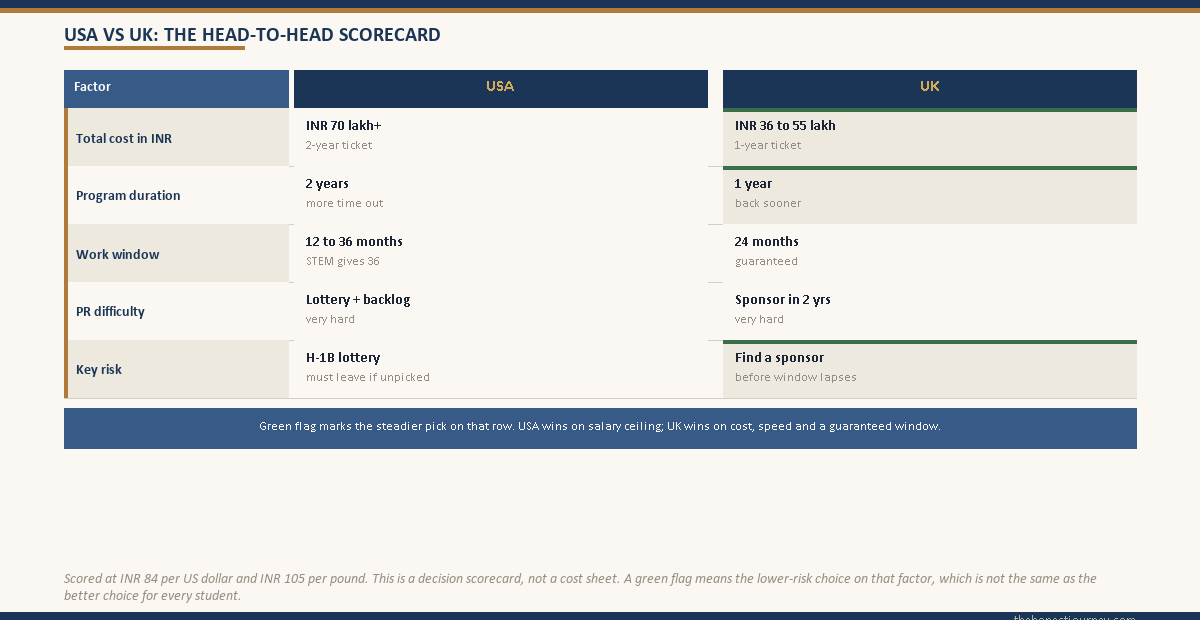
Read the runway honestly. The US runway is longer on paper but conditional. The UK runway is shorter but certain. If you are a STEM student confident in your skills and willing to gamble on the lottery, the US runway can be the better one. If you want a guaranteed window to recover your investment, the UK gives you that with no dice involved.
Salaries: the US ceiling is higher, the UK floor is steadier
US salaries, especially in tech, engineering and data, are the highest in the world. A new Master’s graduate in a US tech hub can earn USD 90,000 to 130,000, which is roughly ₹75 lakh to over ₹1 crore a year before tax. Nothing in the UK matches that ceiling. This is the real reason families stomach the US ticket: one or two years of that salary repays the loan and then some.
UK salaries are lower and flatter. A new graduate on the Graduate Route in a professional role typically earns GBP 28,000 to 40,000, roughly ₹29 to 42 lakh a year, with London paying more and the rest of the country less. That is a solid salary that comfortably services a UK-sized loan, but it does not throw off the surplus a US tech salary can. The UK number is steadier and more predictable; the US number is higher but only if you land the right role in the right city.
The honest way to read this: the US has the higher ceiling and the wider spread. A great US outcome dwarfs a great UK outcome. A poor US outcome, a mid-ranked non-STEM degree with no job at the end of 12 months OPT, is worse than almost any UK outcome, because the loan was twice as big. The UK compresses the range. You are less likely to hit it out of the park and far less likely to strike out badly.
PR difficulty: both are hard, and both are tightening
I want to be blunt here because too many people sell study abroad as a guaranteed immigration route. For the USA and the UK, permanent residency is genuinely hard, and it has gotten harder, not easier.
In the USA, the path runs OPT to H-1B to a green card. The H-1B is a lottery, so you may never get past step one. Even if you do, employment-based green cards for Indian nationals sit in a backlog measured in years, sometimes decades, because of per-country caps. Treating a US degree as a reliable PR route is a mistake. It is a route, but a slow and uncertain one.
In the UK, the path runs Graduate Route to Skilled Worker to indefinite leave to remain after five years of qualifying work. It is more linear than the US path, but the salary thresholds for the Skilled Worker visa have been rising, the post-study landscape is under political pressure, and getting an employer to sponsor you within your two-year Graduate Route window is the real bottleneck. It is doable, but it is not a given.
The honest summary: neither country should be chosen as a PR shortcut. If your single goal is permanent residency, Canada and Australia have clearer (though also tightening) points-based pathways, which I compare in the is studying abroad worth it post. Choose the US or UK for the education and the earning window, and treat PR as a possible bonus you work hard for, not a promise.
Faz's ruleDo not pick the USA or the UK as a guaranteed PR route. Both are hard and both are tightening. Pick them for the degree and the earning window, and treat staying long-term as something you earn, not something the visa hands you.
Every year I meet families who chose a destination purely because they heard it leads to a passport. The H-1B lottery and the rising UK salary thresholds make that thinking dangerous. Choose for the education and the realistic work runway, and you will not be crushed if the long game does not work out.
A worked INR comparison on the same student
Take one student admitted to both: a two-year STEM MS in the US and a one-year MSc in the UK, both at solid mid-ranked universities. Here is how the two bets look in rupees over the first few years, using ₹84 per dollar and ₹105 per pound.
| Factor | USA (2-year STEM MS) | UK (1-year MSc) |
|---|---|---|
| All-in study cost | ~₹80 lakh | ~₹45 lakh |
| Time out of earning | 2 years | 1 year |
| Guaranteed work window | 12 months OPT (36 if STEM) | 24 months Graduate Route |
| Typical starting salary | USD 90k to 130k (₹75 lakh+) | GBP 28k to 40k (₹29 to 42 lakh) |
| Big risk at the end | H-1B lottery, must leave if unpicked | Finding a sponsor before 2 years lapse |
| Loan tier likely | Secured collateral (above ₹7.5 lakh) | Often unsecured or smaller secured |
Read it as a wager. The US bet: put roughly ₹80 lakh and two years on the table, and if the STEM job and the lottery break your way, you repay it in two or three years and build serious savings. If they do not, you carry a large loan with a short earning runway. The UK bet: put roughly ₹45 lakh and one year on the table, take a steadier salary, and repay over a longer but lower-risk horizon. Same student, two very different risk profiles.
Choose USA if, choose UK if
Here is the decision boiled down. This is the block I would hand a cousin asking me which one.
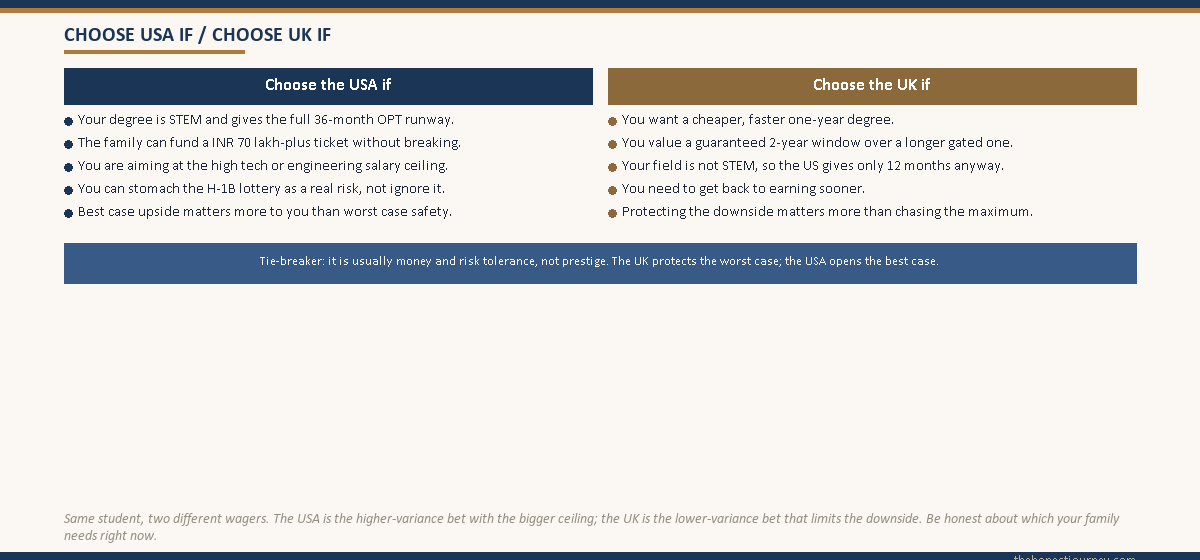
Choose the USA if your degree is STEM and gives you the 36-month runway, your family can fund a ₹70 lakh-plus ticket without it breaking them, you are aiming at the high salary ceiling in tech or engineering, and you can stomach the H-1B lottery as a genuine risk rather than ignoring it. The US rewards a strong STEM profile with the best earning runway anywhere, but only if you go in clear-eyed about the gamble at the end.
Choose the UK if you want a cheaper, faster degree, you value a guaranteed two-year work window over a longer gated one, your field is not STEM (so the US would give you only 12 months anyway), or you need to get back to earning sooner because the family cannot carry a ₹80 lakh loan for years. The UK is the lower-variance bet: less upside than a perfect US outcome, far less downside than a bad one.
If you genuinely cannot decide, the tie-breaker is usually money and risk tolerance, not prestige. The UK protects you from the worst case. The USA opens the best case. Be honest about which matters more to your family right now.
Weighing more than two countries? See also Ireland vs UK and Germany vs UK for Indian students.
FAQ
Is the USA or the UK cheaper for Indian students?
The UK is clearly cheaper. A one-year UK Master’s costs roughly ₹36 to 55 lakh all in, while a two-year US Master’s costs roughly ₹70 lakh to over ₹1 crore. The gap comes from both the higher US tuition and the extra year of tuition and living cost. The UK also gets you back to earning a year sooner, which reduces opportunity cost. At ₹84 per dollar and ₹105 per pound, the UK ticket is consistently around half the US ticket.
Which has a better post-study work visa, the USA or the UK?
It depends on your priorities. The UK Graduate Route gives a guaranteed two years of unrestricted work with no lottery and no job offer needed. The USA gives STEM graduates up to 36 months through OPT plus the STEM extension, which is longer, but staying beyond it needs an H-1B selected by random lottery. So the US runway is longer but conditional, while the UK runway is shorter but certain. A non-STEM US degree gives only 12 months, shorter than the UK.
Are US salaries really higher than UK salaries?
Yes, especially in tech, engineering and data. A new US Master’s graduate in a tech hub can earn USD 90,000 to 130,000, roughly ₹75 lakh to over ₹1 crore a year. A UK graduate on the Graduate Route typically earns GBP 28,000 to 40,000, roughly ₹29 to 42 lakh. The US ceiling is far higher, but the spread is wider too, so a poor US outcome can be worse than almost any UK outcome given the larger loan.
Is it easier to get PR in the USA or the UK?
Both are hard, and both are tightening. The US path runs OPT to H-1B to green card, but the H-1B is a lottery and employment-based green cards for Indians face a backlog of many years. The UK path runs Graduate Route to Skilled Worker to settlement after five years, which is more linear but depends on rising salary thresholds and finding a sponsor inside your two-year window. Neither should be chosen as a guaranteed PR route.
Should I pick the USA only if my degree is STEM?
Largely, yes. The US value case for an Indian student leans heavily on the 36-month STEM OPT runway, which gives time for the high tech salary to repay the large loan. A non-STEM US degree gives only 12 months of OPT, shorter than the UK’s guaranteed two years, while still carrying the higher cost. So a non-STEM student usually gets a better deal in the UK, with a lower ticket and a longer guaranteed work window.
How long does each degree take and why does it matter?
A US Master’s is typically two academic years; a UK Master’s is typically one year, often finished inside a calendar year. The extra US year means more tuition, more living cost, and an extra year out of the job market. The UK degree gets you back to earning faster, which lowers both the total cost and the opportunity cost. That duration difference is the single biggest driver of the cost gap between the two destinations.
Can I cover either with an Indian education loan?
Yes, but the US ticket almost always lands in the secured-collateral tier because a US Master’s runs well above the ₹7.5 lakh unsecured PSU ceiling. A smaller UK ticket can sometimes stay unsecured or need less collateral. The US loan is larger, so it needs a longer or higher earning runway to repay comfortably. Model your repayment against the realistic work window, not against a salary you assume will continue indefinitely.
What if I just want the safest financial bet?
Choose the UK. It is the lower-variance option: a cheaper one-year degree, a guaranteed two-year work window, and a steadier salary that comfortably services a UK-sized loan. You give up the chance at the very high US tech salary, but you also avoid the worst case of a large US loan with only 12 months of OPT and an unwon H-1B. If protecting your family from the downside matters more than chasing the maximum upside, the UK is the safer wager.
Faz · The Honest Journey · 2026