Short answer. CSIS pays your full interest during the moratorium if family income is under 4.5 lakh, on technical or professional courses, with no cap on beneficiaries. PM-Vidyalaxmi pays 3 percent if income is under 8 lakh, on any degree or diploma at a listed QHEI, capped at 1 lakh fresh students a year. You cannot hold both.
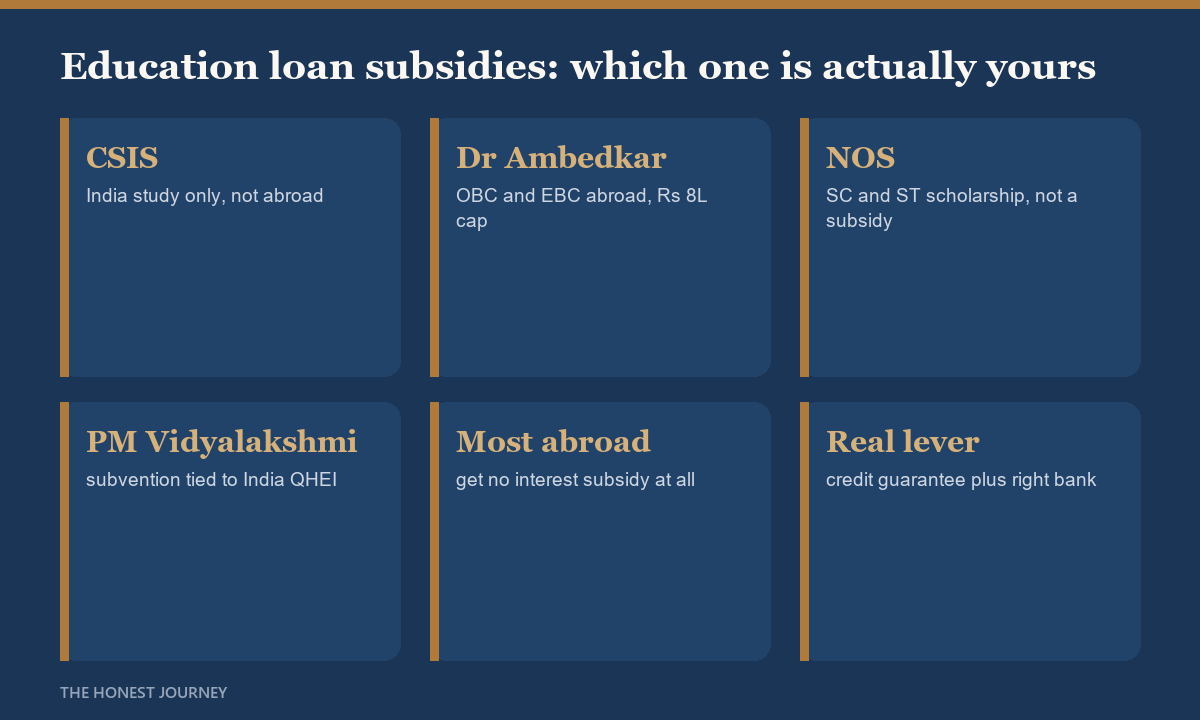
These are not schemes you choose between. Most students qualify for zero or exactly one, and your community and family income decide it before anything else. The honest picture for abroad study is narrow: the Central Sector Interest Subsidy is for study inside India only, the Dr Ambedkar scheme gives interest subsidy abroad but only to OBC and EBC students under an income ceiling, the National Overseas Scholarship funds SC and ST students but is a competitive scholarship not a loan subsidy, and the PM Vidyalakshmi interest benefit is tied to domestic Quality institutions. Many abroad students get no interest subsidy at all.
For the two central schemes, the interest subsidy calculator works out the rupee amount on your loan.
A reader assumed he would stack CSIS on his PM Vidyalakshmi loan and cut his abroad interest to nothing. Neither applied to him. His income was above the CSIS ceiling, CSIS does not cover study abroad anyway, and his university was not on the domestic Quality list the PM Vidyalakshmi subvention needs. He was general category, above the Dr Ambedkar ceiling, so that was out too. The useful answer was not a subsidy at all. It was the credit guarantee that made his loan collateral-free, plus choosing the right bank. Chasing subsidies he could never get had cost him two weeks. Knowing which one, if any, is actually yours saves that time.
This guide lines up the four schemes people confuse, shows who each actually fits, and answers the real question: which one, if any, applies to you. It funnels into the detailed pages for each, starting with the CSIS interest subsidy and the Dr Ambedkar scheme.
The four schemes people confuse
They share the education loan conversation, so they get treated as interchangeable. They are not. Each has a different purpose, a different eligible group, and a different answer to the one question that matters for this site’s readers: does it help an abroad loan.
- Central Sector Interest Subsidy (CSIS). Covers the interest during your moratorium period for economically weaker students, income under 4.5 lakh, but only for courses studied in India. It does not cover study abroad. Full detail on the CSIS page.
- Dr Ambedkar Central Sector Scheme. Interest subsidy during the moratorium for OBC and EBC students, under an income ceiling of around 8 lakh, and it does cover overseas study. For an abroad loan this is the main interest subsidy that exists, if you are in the eligible community and bracket.
- National Overseas Scholarship (NOS). Not a loan subsidy at all. It is a full scholarship for SC, ST and a few other communities to study abroad, covering tuition and living costs, but with lottery-thin odds. It replaces part of your funding, it does not reduce loan interest. See the NOS guide.
- PM Vidyalakshmi interest benefit. The interest subvention under the PM Vidyalakshmi scheme is tied to admission at a domestic Quality Higher Educational Institution, so it rarely reaches a foreign degree.
The one filter that decides most cases: where you study and who you are
Two facts settle eligibility before the fine print. First, are you studying in India or abroad. If abroad, CSIS and the PM Vidyalakshmi subvention are almost certainly out, because both are built around domestic study. Second, your community and income. Dr Ambedkar needs OBC or EBC status under its ceiling. NOS needs SC, ST or a listed community. If you are general category, above the income ceilings, and studying abroad, the honest answer is that no interest subsidy applies to you, and your effort belongs elsewhere.
Can you stack them
Rarely, and usually not in a way that helps. The schemes are built to avoid double-dipping on the same interest, so you do not layer CSIS and Dr Ambedkar on one loan. NOS is a scholarship, so if you won it you would be reducing how much loan you need rather than subsidising interest on it. The realistic combination is a scholarship reducing your borrowing plus, separately, the credit guarantee making the loan collateral-free. Interest subsidy on top of that, for an abroad loan, is the exception, not the plan.
If no subsidy applies to you, this is what actually helps
For the many abroad students who qualify for none of these, the leverage is not a subsidy. It is the credit guarantee that enables a collateral-free loan, choosing a bank that genuinely funds your country and course, and keeping your co-applicant profile clean so you are approved at a good rate in the first place. A loan approved quickly at a fair rate, with no collateral demanded, beats months spent chasing a subsidy you were never eligible for. Spend your energy where you can actually move the number.
The two schemes side by side, from the official comparison
| PM-USP CSIS | PM-Vidyalaxmi | |
|---|---|---|
| Institutions | NAAC or NBA accredited, INIs, and technical institutes approved by regulatory bodies | Top 100 NIRF private, top 200 NIRF state government, remaining central government. 1,425 institutions in total |
| Courses | Professional and technical courses | All degree and diploma courses |
| Family income ceiling | 4.5 lakh | 8 lakh |
| What you get | Full interest subvention during the moratorium | 3 percent interest subvention during the moratorium |
| Loan covered | Up to 10 lakh | Up to 10 lakh |
| Slots | No limit | 1 lakh fresh slots per year |
| Repayment | Up to 15 years after the moratorium, which is the course period plus one year | |
The four rules that decide your case
One. You cannot stack them. A student holding any other central or state government scholarship, any other interest subvention scheme, or a fee reimbursement is not eligible for CSIS or PM-Vidyalaxmi. Work out which single benefit is worth most and take that one.
Two. The 10 lakh line is on the subvention, not the loan. Borrow 28 lakh and the subvention is still calculated on the first 10 lakh of disbursed principal. The rest carries full interest.
Three. It is once per lifetime. Interest subvention and credit guarantee are available once, for an undergraduate, a postgraduate or an integrated course. Using it at bachelor’s level means it is gone for the master’s.
Four, and this is the one that matters on this site. Neither scheme funds a degree abroad. The official position is explicit: Indian campuses of foreign institutions, foreign campuses of Indian institutions and foreign institutions are all outside the scheme, and the loan is for programmes in India. The Vidya Lakshmi portal does list bank schemes that fund overseas study, which is where the confusion starts, but those are ordinary bank education loans without the 3 percent subvention or the credit guarantee attached.
If you are heading abroad, the honest planning assumption is that you are on a normal education loan, and you should be comparing bank rates, margin money and collateral terms rather than waiting on a subvention that will not arrive.
The honest closing take
The subsidy landscape looks generous from a distance and shrinks fast when you hold your own profile up to it. For abroad study the only interest subsidy most people can realistically claim is Dr Ambedkar, and only if they are OBC or EBC under the ceiling. SC and ST students have the NOS scholarship, competitive and separate from any loan. Everyone else, studying abroad, gets no interest subsidy, and the honest move is to stop looking for one and focus on a collateral-free, well-priced loan instead. Knowing which box you are in is worth more than any headline about free money.
FAQ
Which education loan subsidy can I get for studying abroad?
For abroad study the main interest subsidy is the Dr Ambedkar Central Sector Scheme, for OBC and EBC students under the income ceiling. CSIS and the PM Vidyalakshmi subvention are for domestic study. SC and ST students have the National Overseas Scholarship, which is a scholarship rather than a loan subsidy.
Does CSIS cover study abroad?
No. The Central Sector Interest Subsidy covers interest during the moratorium only for courses studied in India, for students under the 4.5 lakh income ceiling. It does not apply to foreign degrees.
Can I claim more than one subsidy on the same loan?
Generally no. The schemes are designed to prevent double subsidy on the same interest. The realistic combination is a scholarship that lowers how much you borrow plus a credit guarantee that makes the loan collateral-free, not two interest subsidies stacked together.
I am general category studying abroad. Do I qualify for any subsidy?
Usually not. The interest subsidy schemes are tied to specific communities and income ceilings or to domestic study. If none fits, focus on the credit guarantee for a collateral-free loan and on choosing the right bank, which is where you can actually reduce cost.
Is the PM Vidyalakshmi interest benefit available for foreign universities?
Rarely. The interest subvention under PM Vidyalakshmi is tied to admission at a domestic Quality Higher Educational Institution, so most foreign degrees do not qualify for it.