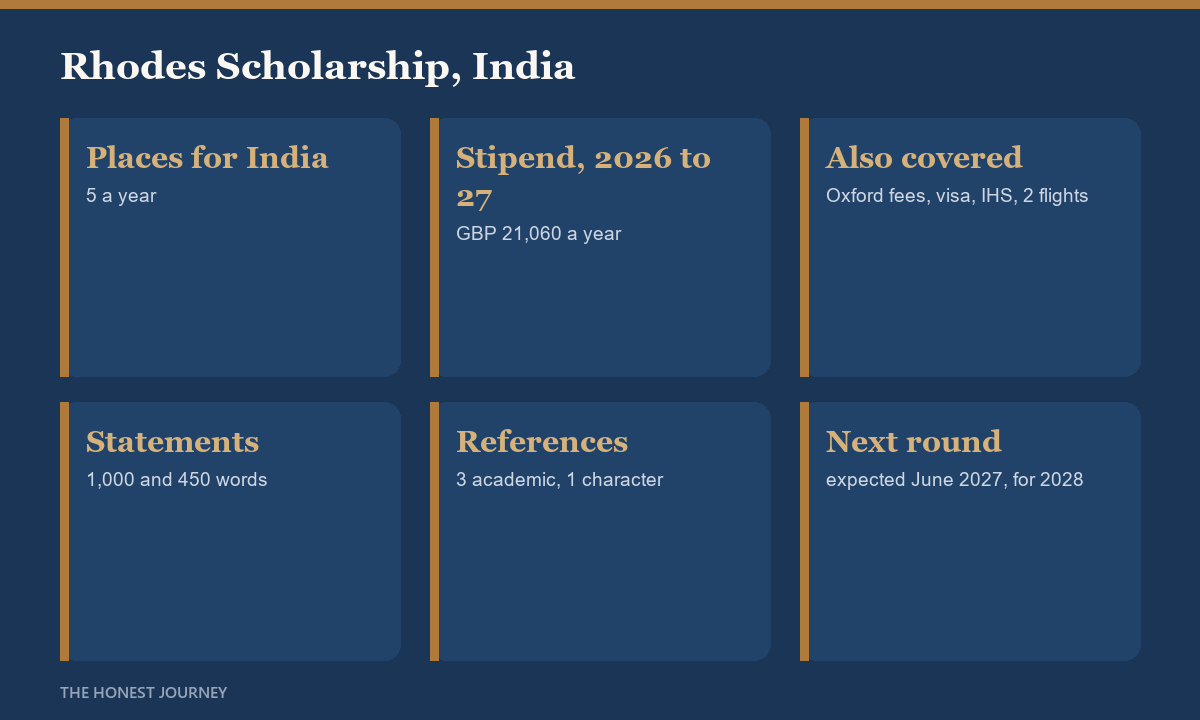
Short answer. India gets five Rhodes Scholarships a year for postgraduate study at Oxford. The award pays Oxford fees, visa costs, two flights and a stipend of GBP 21,060 for 2026 to 27. The round for 2027 entry closed on 23 July 2026, so the next realistic target is the round expected to open in June 2027, for October 2028.
The Rhodes Scholarship is the oldest international graduate scholarship in the world and among the hardest to win. For Indian students it is also one of the most misunderstood. It is not a reward for marks, it is not decided by your Oxford offer, and it is not something a consultant can write for you. Five people from India get it each year, and the selection is built to find out who you are, not how well you can present.
Everything below comes from the Rhodes Trust’s own India page, its scholarship FAQs and the 2026 to 27 Scholars Guide written by Indian Rhodes Scholars. For other funded options for a master’s in the UK, see our guides to Chevening and the Commonwealth Scholarship.
What the Rhodes Scholarship pays
| Item | What the Trust covers |
|---|---|
| Oxford course fees | In full |
| Living stipend | GBP 21,060 for 2026 to 27, paid as GBP 1,755 a month, about ₹2.2 lakh |
| Oxford application fee | Covered |
| UK student visa and Immigration Health Surcharge | Covered |
| Travel | Two economy flights to and from the UK |
| Arrival | A settling in allowance |
| Length | Usually two years; up to three years of fees and stipend for a direct entry DPhil |
The Trust is explicit that the stipend is not enough to support a partner or children, and you pay all your living costs, rent included, from it. One year courses such as the MBA, the MPP and the MSc in Financial Economics are funded for one year only, and the MBA needs at least two years of full time work experience. Part time courses, postgraduate certificates and diplomas, and graduate entry medicine are not covered at all, so check the Trust’s Conditions of Tenure before you pick a course.
The India round and its calendar
Rhodes Scholarships are allotted by constituency, and India is its own constituency with five places. Selection is run in India by the National Secretary for India and a panel that includes past Rhodes Scholars. The last round opened on 1 June 2026 and closed at 23:59 Indian Standard Time on 23 July 2026, for entry to Oxford in October 2027. The Trust’s main scholarship page now says applications are expected to reopen in 2027 for entry in 2028.
| Stage | Last cycle | What happens |
|---|---|---|
| Applications open | 1 June 2026 | Online form, no application fee |
| Applications close | 23 July 2026, 23:59 IST | Statements, CV, transcripts and four references |
| Shortlisting | After the deadline | Written applications are assessed |
| Finals | Later in the year | A social event and a final interview, both in person |
| Oxford application | After selection | You apply to your Oxford course separately |
What you submit
- A personal statement of up to 1,000 words, answering three prompts set in the India Information for Candidates. In the last round they asked which Rhodes quality you show most strongly, how you would contribute to communities at Oxford, and how you will use your talents on the world’s pressing problems.
- An academic statement of up to 450 words, explaining your choice of Oxford course and showing that you meet its admission requirements.
- Four references. Three must be academic, from people who taught you at university. The fourth is a character reference, from someone such as an internship supervisor or a coach. Family members cannot write them.
- A CV and your transcripts. Final year students can submit transcripts for the semesters completed so far.
You do not need GRE, IELTS or TOEFL scores to apply for the scholarship itself. Your Oxford course may ask for them later, when you apply for admission after selection. The online form will not accept text beyond the word limits, so a statement written long and trimmed in the form loses its ending. Our guides to the statement of purpose and recommendation letters cover the basics, but read the Rhodes rules below first, because they are stricter than any university’s.
Faz's ruleWrite the Rhodes statements yourself, and do not let anyone edit them. That rule is the Trust's, not ours.
The Scholars Guide written by Indian Rhodes Scholars says it plainly: you can take general guidance from professors and mentors, but your statements must be your own work and should not have been reviewed or edited by anyone else before you submit. The Trust’s own FAQs discourage using AI to write them, and AI is banned outright in interviews. Your statements become the basis of the interview, so anything that does not sound like you will be found out in the room. This is why paying someone to polish a Rhodes application is money spent against yourself.
What the selectors are looking for
Rhodes selection still runs on the criteria set in 1902: academic excellence, energy to use your talents to the full, truth, courage and devotion to duty, and moral force of character and instincts to lead. In practice that means a strong degree is the entry ticket, not the deciding factor. The Trust says a first class degree or a GPA of 3.7 out of 4.0 or above makes you more competitive, given how selective Oxford is. What separates finalists is evidence of service and leadership that has cost you something, explained with honesty about what you learned.
The final interview is wide ranging and can move from your subject to current affairs to your own choices. Indian Rhodes Scholars advise that there is no need to promise to return to India; what matters is a credible account of how you will use your work on problems that matter, wherever you do it. Selectors can also contact your referees during the process, so pick people who know you well rather than the most senior names you can reach.
Rules that catch Indian applicants
- Two attempts only. You can apply once a year and reapply once through the same constituency, a maximum of two applications. Several Indian scholars won on their second try.
- Age and residence rules are set per constituency. India’s limits are in its Information for Candidates and the Trust calls them immovable. Check them when the next round opens rather than relying on figures from earlier years.
- Selection is not admission. You still have to win a place on your Oxford course. Pick a course you are clearly qualified for.
- Other big awards do not stack. Substantive awards are not permitted alongside Rhodes, and any secondary award above GBP 6,950 a year must be declared.
- The MPhil to DPhil route is not funded because of the fee liability it creates, so plan a direct DPhil or a one year master’s.
The honest closing take
Five places for a country of India’s size makes Rhodes a long shot for anyone, and it should be one application among several, alongside Chevening, Commonwealth and university awards. But it is not a lottery and it is not reserved for students from a handful of colleges. It rewards people who have done real work for others and can talk about it truthfully.
If you are in your final year or just out of university, the useful thing to do now is not to draft statements. It is to line up the experience they will describe, ask three teachers and one supervisor whether they will write for you, and choose the Oxford course you would apply to anyway. When the round opens next June, you will have seven weeks to write about it.
FAQ
How many Rhodes Scholarships does India get?
Five a year. The first Indian Rhodes Scholars went to Oxford in 1947, and over 200 Indians have held the scholarship since.
Is the Rhodes Scholarship fully funded?
Yes, for the scholar. It pays Oxford fees, the Oxford application fee, the visa and health surcharge, two economy flights, a settling in allowance and a stipend of GBP 21,060 for 2026 to 27. It does not cover a partner or children.
When is the next Rhodes Scholarship deadline for India?
The 2027 entry round closed on 23 July 2026. The Trust expects applications to reopen in 2027 for entry in 2028; going by the last cycle, that means a window from about June to late July 2027. Confirm the dates on the Trust’s India page.
Do I need IELTS or GRE to apply for Rhodes?
Not for the scholarship application. Your Oxford course may require an English test or other scores when you apply for admission after you are selected.
Can I apply for Rhodes in my final year of college?
Yes. Many candidates do. You submit transcripts for the semesters completed so far, and you may be asked for updated results during selection.
Does Rhodes cover an MBA at Oxford?
Yes, for one year only, and you need at least two years of full time work experience. The tenure cannot be extended.
Where these figures come from
- Rhodes Trust, the Rhodes Scholarships for India
- Rhodes Trust, scholarship FAQs
- Scholars Guide 2026 to 27, written by Indian Rhodes Scholars
- European Central Bank, euro reference exchange rates
Checked against the sources above in October 2026. The India Information for Candidates sets the age and residence rules for each round; read the current version before you apply.