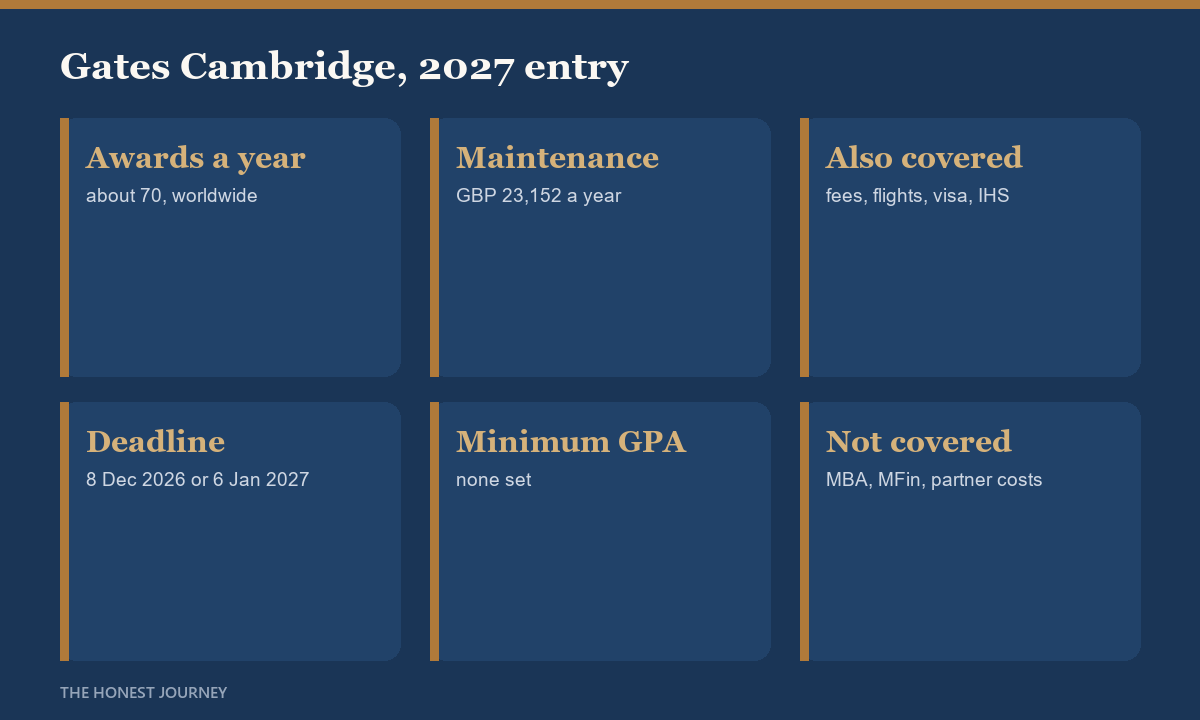
Short answer. Gates Cambridge funds about 70 postgraduate students a year from outside the UK, Indians included, at the University of Cambridge. It pays full fees, GBP 23,152 a year to live on, flights, visa and health surcharge. Indians apply in the international round, closing 8 December 2026 or 6 January 2027 depending on the course.
The Gates Cambridge Scholarship was set up in 2000 with a gift of US$210 million from the Gates Foundation to the University of Cambridge. It is one of the few full cost awards for postgraduate study in the UK that Indian students can apply for, and unlike Rhodes, it is not divided into country places: apart from a separate round for US residents, everyone competes in one international round.
Its timing makes it urgent. Applications for entry in 2027 are open now, and the international round closes in December or January depending on your course. Everything below is from the Gates Cambridge Trust’s own pages, checked in October 2026. For the Oxford equivalent, see our guide to the Rhodes Scholarship for Indian students.
What Gates Cambridge pays
| Component | Amount for 2026 to 27 |
|---|---|
| University Composition Fee | Paid in full at the rate that applies to you |
| Maintenance allowance | GBP 23,152 for 12 months, about ₹29 lakh; pro rata for shorter courses |
| Travel | One economy airfare at the start and one at the end of the course |
| Visa and health | Inbound visa costs and the Immigration Health Surcharge |
| Children | Up to GBP 12,793 a year for one child, GBP 18,244 for two or more, on application |
| Academic development | GBP 750 to GBP 4,000 for conferences and courses, depending on course length, on application |
| PhD length | Up to 4 years |
Two gaps are worth knowing. There is no funding for a partner, only for children. And the Trust does not cover the Cambridge application fee, which you pay yourself unless you qualify for the university’s own fee waiver. If you hold another substantial scholarship or a salary, the Trust can reduce or withhold the maintenance allowance, and it shares costs rather than paying twice.
Dates for 2027 entry
| Stage | International round, which includes India |
|---|---|
| Applications open | 11 September 2026 |
| Application deadline | Tuesday 8 December 2026 or Wednesday 6 January 2027, set by your course’s funding deadline, 11:59 pm UK time |
| Departmental ranking | December to February |
| Outcome emails | By Monday 8 March 2027 |
| Interview panels | 22 and 23 March 2027 |
| Offers | By early April 2027, to be accepted within 72 hours |
Which of the two deadlines applies depends on your course, and the University’s Course Directory lists it as the course funding deadline. Check it today. If your course closes on 8 December, you have weeks, not months, to line up references and a research proposal.
Who can apply, and for which courses
Any citizen of a country outside the United Kingdom can apply, including dual UK citizens. The scholarship covers a PhD, full time or part time, an MLitt, and full time one year master’s courses such as the MPhil, MRes and LLM. About two thirds of awards go to PhD students. It does not cover undergraduate degrees, the MBA, Executive MBA, Master of Finance, PGCE, MASt, postgraduate certificates and diplomas, or the medical degrees.
There is no minimum GPA. Academic excellence is judged from your whole application and references, which is worth remembering if you are worrying about how your CGPA looks to a UK panel. There is no English test requirement from the Trust either, though the University sets its own.
How you apply
There is no separate Gates Cambridge form. You apply for your course and a College place through the University’s Graduate Application Portal, and complete the Gates Cambridge part of the funding section. That section asks four questions, one for each selection criterion:
| Question | Length |
|---|---|
| How your education and experience show academic excellence | About 200 words, up to 1,400 characters |
| Why this specific course at Cambridge, and how it serves your plans | About 200 words, up to 1,400 characters |
| How you have shown a commitment to improving the lives of others | About 300 words, up to 2,100 characters |
| How you have shown a capacity for leadership | About 300 words, up to 2,100 characters |
You also need a Gates Cambridge reference, separate from your academic references, focused on the scholarship criteria. The same person can write both, but they should be two distinct letters. PhD and most research MPhil applicants must contact a potential supervisor and submit a research proposal. Our guide to recommendation letters covers how to brief referees.
Faz's ruleWin your department first. Gates Cambridge only sees the applicants Cambridge departments put forward.
Selection runs in two stages. Academic departments nominate a small number of applicants who meet all four criteria at a very high level, and only those nominees are interviewed. So the strength of your course application, your fit with the department and, for research degrees, a supervisor who wants you, decide whether Gates Cambridge ever reads your answers. Spend your first week on the course and the supervisor, not on the scholarship essays.
The interview
Nominated candidates are invited to a 25 to 30 minute interview, in person or online, before one of four subject panels: arts, biological sciences, physical sciences and social sciences. Panels ask about your understanding of Gates Cambridge and your motivation, your academic work and your choice of course, and your career plans, and may add intellectual or ethical questions with no right answer. The Trust does not give feedback to unsuccessful applicants.
The honest closing take
About 70 awards a year, open to the whole world outside the UK, makes Gates Cambridge one of the most competitive scholarships there is. But it is a fair one for Indian applicants: one international round, no minimum GPA, needs blind selection, and a full cost award if you win. If you are applying to Cambridge anyway, ticking the Gates Cambridge box costs you four short answers and one extra reference.
The work that matters is the course application. Pick a course you can justify precisely, secure a supervisor’s interest for a PhD, and give your referees time. Apply alongside Chevening and the Commonwealth Scholarship, and keep a funding backstop, because even excellent candidates are mostly turned down.
FAQ
Can Indian students apply for Gates Cambridge?
Yes. Citizens of any country outside the United Kingdom can apply, and Indian applicants apply in the international round, which closes on 8 December 2026 or 6 January 2027 depending on the course.
How much is the Gates Cambridge stipend?
GBP 23,152 for 12 months at the 2026 to 27 rate, about ₹29 lakh, plus full fees, flights, visa costs and the Immigration Health Surcharge. Shorter courses get a pro rata amount.
Is there a minimum CGPA for Gates Cambridge?
No. The Trust sets no minimum GPA, though academic excellence is one of its four criteria and is judged from your whole application.
Does Gates Cambridge fund an MBA?
No. The MBA, Executive MBA and Master of Finance are excluded, along with undergraduate degrees, the PGCE and part time master’s courses.
How many Gates Cambridge Scholarships are awarded each year?
Around 70, about a third in the US round and the rest in the international round. About two thirds go to PhD students.
Where these figures come from
- Gates Cambridge Trust, the scholarship
- Gates Cambridge Trust, eligibility and FAQs
- Gates Cambridge Trust, timeline
- Gates Cambridge Trust, how to apply and how we select
- European Central Bank, euro reference exchange rates
Checked against the sources above in October 2026. The Trust updates its rates and dates every year.