Short answer. Study in New Zealand for Indian students in 2026 means a two-year Master’s that runs roughly ₹45 lakh to ₹75 lakh all-in, with tuition between NZD 22,000 and NZD 45,000 per year (₹11 lakh to ₹22.5 lakh).
Living costs sit at NZD 20,000 to 25,000 a year (₹10 lakh to ₹12.5 lakh), the student visa fee is NZD 330, and IELTS 6.5 overall is the typical English benchmark. Post-study work rights run 3 years for a Master’s or Bachelor’s, and 1 year for a Level 7 PG diploma under the post-2024 rule changes.
Every counselling call I take from a parent in Hyderabad or Pune now seems to end with the same sentence. “Australia is getting hard, what about New Zealand?” The honest answer is that NZ is a real option, the rules are calmer, and the country has eight proper universities, not eighty. It is also a smaller job market than Australia, which is the part the brochures skip.
This post walks through what a New Zealand Master’s actually costs, which universities matter for Indian students, what the post-study work visa now allows after the 2024 changes, the PR pathway via Skilled Migrant Category, and where the honest weak spots are.
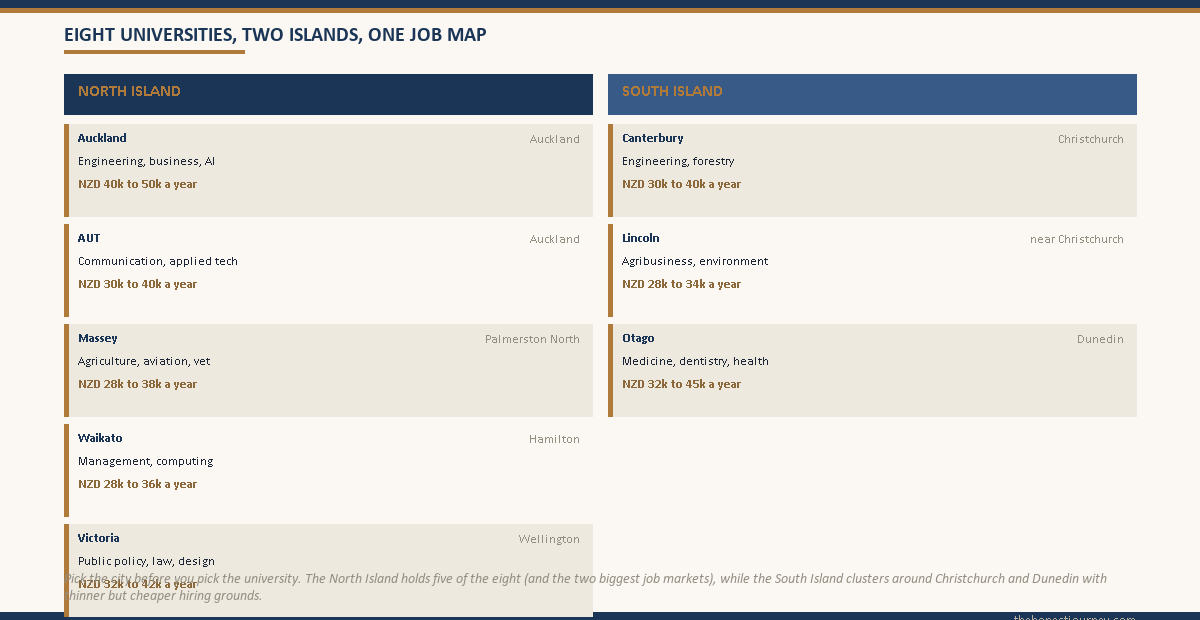
The eight universities and what they are actually known for
New Zealand has only eight universities, all of them public, all of them on the QS top 500. That is the entire higher-education map at the university level (there are also Te Pukenga polytechnics for Level 7 diplomas, which I cover later). The full directory sits with Universities New Zealand, the official body that represents all eight.
Knowing what each is strong in matters because the job market is regional. The university you pick often decides which city you end up working in after graduation.
| University | City | Known for | 2026 PG tuition band (NZD/yr) |
|---|---|---|---|
| University of Auckland | Auckland | Engineering, business, biomed, AI | 40,000 to 50,000 |
| University of Otago | Dunedin | Medicine, dentistry, health sciences | 32,000 to 45,000 |
| Victoria University of Wellington | Wellington | Public policy, law, design, CS | 32,000 to 42,000 |
| University of Canterbury | Christchurch | Engineering, earthquake and forestry | 30,000 to 40,000 |
| Massey University | Palmerston North, Auckland, Wellington | Agriculture, aviation, veterinary | 28,000 to 38,000 |
| University of Waikato | Hamilton | Management, computing, Maori studies | 28,000 to 36,000 |
| Lincoln University | Lincoln (near Christchurch) | Agribusiness, land and environment | 28,000 to 34,000 |
| Auckland University of Technology (AUT) | Auckland | Communication, hospitality, applied tech | 30,000 to 40,000 |
Auckland is the biggest, the highest ranked globally, and also the most expensive city to live in. Otago has the strongest medical school and the lowest cost of living among the main university cities. Wellington is the capital and the best city for public-sector careers. Canterbury and Lincoln cluster around Christchurch and feed engineering and agritech roles in the South Island. The full programme list per university lives on Study with New Zealand, the government’s official student portal.
What a two-year Master’s actually costs in 2026
Tuition is the easy line item because every university publishes a fee schedule. Living is the one most Indian students underestimate, especially in Auckland.
For a one-year taught Master’s at Otago, Waikato or Massey in a non-lab subject, tuition lands around NZD 28,000 to NZD 32,000. For a two-year research Master’s or a STEM Master’s at Auckland, you are looking at NZD 40,000 to NZD 45,000 a year. Living in Auckland or Wellington runs NZD 22,000 to NZD 25,000 a year for shared accommodation, groceries, transport and a phone plan. Dunedin and Palmerston North run closer to NZD 18,000 to NZD 20,000.
Below is a worked rupee total for a typical two-year Master of Science at a mid-tier university like Waikato or Canterbury, where most Indian students actually end up.
| Line item | NZD | Rs (at ₹50/NZD) |
|---|---|---|
| Year 1 tuition | NZD 34,000 | ₹17.0 lakh |
| Year 2 tuition | NZD 34,000 | ₹17.0 lakh |
| Year 1 living (rent, food, transport) | NZD 22,000 | ₹11.0 lakh |
| Year 2 living | NZD 22,000 | ₹11.0 lakh |
| Student visa fee + IVL | NZD 330 + NZD 100 | ₹21,500 |
| Health insurance (mandatory, 2 years) | NZD 1,400 | ₹70,000 |
| IELTS + application fees | NZD 800 | ₹40,000 |
| Return flights (2 trips home) | NZD 3,200 | ₹1.6 lakh |
| Initial settlement (bond, furniture, sim) | NZD 2,500 | ₹1.25 lakh |
| Forex spread and wire charges | NZD 1,500 | ₹75,000 |
| Two-year all-in total | NZD 121,830 | ₹60.9 lakh |
An Auckland Master’s with full living costs pushes this to ₹70 lakh to ₹75 lakh. A Lincoln or Waikato Master’s at a Master’s-by-coursework level in a non-STEM subject can drop to ₹45 lakh to ₹50 lakh if part-time work is consistent. For the worked-out figures behind these ranges, read the full cost of studying in New Zealand for Indian students.
Faz's rulePick the city before you pick the university. A ₹12 lakh difference between Auckland and Dunedin over two years is real money, and the degree from either is recognised the same way at PR stage.
Auckland is the obvious choice for an Indian student because the family already knows someone there, the diaspora is large, and the airport is busy. It is also where rent eats your loan. If your subject is offered at Otago, Canterbury or Waikato at the same level, run the numbers honestly before defaulting to Auckland.
Student visa, proof of funds and IELTS
The student visa is called the Fee Paying Student Visa, processed by Immigration New Zealand. The fee is NZD 330 for an online application from India, and you pay an additional NZD 100 International Visitor Conservation and Tourism Levy at the same time.
Proof of funds is NZD 20,000 for one year of living costs, on top of paid tuition or a sanction letter that covers tuition. INZ accepts a few forms of evidence: a paid tuition receipt from the university, a sanctioned education loan from a scheduled Indian bank, a sponsor’s bank statements for the last 6 months with a sponsorship affidavit, or a combination. A pure education loan sanction is the cleanest documentation because it covers tuition and living in one letter.
English is IELTS 6.5 overall with no band below 6.0 for most Master’s programmes. Some Master’s of Public Health, Education and Law ask for 7.0. PTE Academic and TOEFL iBT are accepted at equivalent scores. The university decides the academic IELTS band; INZ does not set its own English benchmark for university-level study.
The visa file also expects a Statement of Purpose, academic transcripts, a tuberculosis chest X-ray for a course longer than 6 months, and a police clearance certificate from India if you are over 17. The chest X-ray must be done at an INZ-approved panel physician in India, not any random hospital. The current panel list sits on the INZ website.
The post-2024 post-study work visa rules
This is where New Zealand stayed steady while Australia and Canada tightened. The Post-Study Work Visa rules were revised in 2023 to 2024, and the structure that applies in 2026 is the following.
For a Master’s degree (Level 9) of one year or more, completed in New Zealand, the Post-Study Work Visa is 3 years. For a Bachelor’s degree of three years (Level 7), it is also 3 years. For a Postgraduate Diploma at Level 7 or Level 8 (the one-year qualification that sits below a Master’s), the work visa is 1 year, not 3. This was the major change post-2024: the Level 7 PG diploma route, which used to give 2 or 3 years, was cut to 1 year to push students toward Bachelor’s or Master’s level.
| Qualification | Level | Min duration | Post-study work visa |
|---|---|---|---|
| Master’s degree | Level 9 | 1 academic year | 3 years open work |
| Bachelor’s degree | Level 7 | 3 years | 3 years open work |
| Postgraduate Diploma | Level 7 or 8 | 1 year | 1 year open work |
| Bachelor’s Honours | Level 8 | 4 years | 3 years open work |
| PhD | Level 10 | varies | 3 years open work + partner work rights |
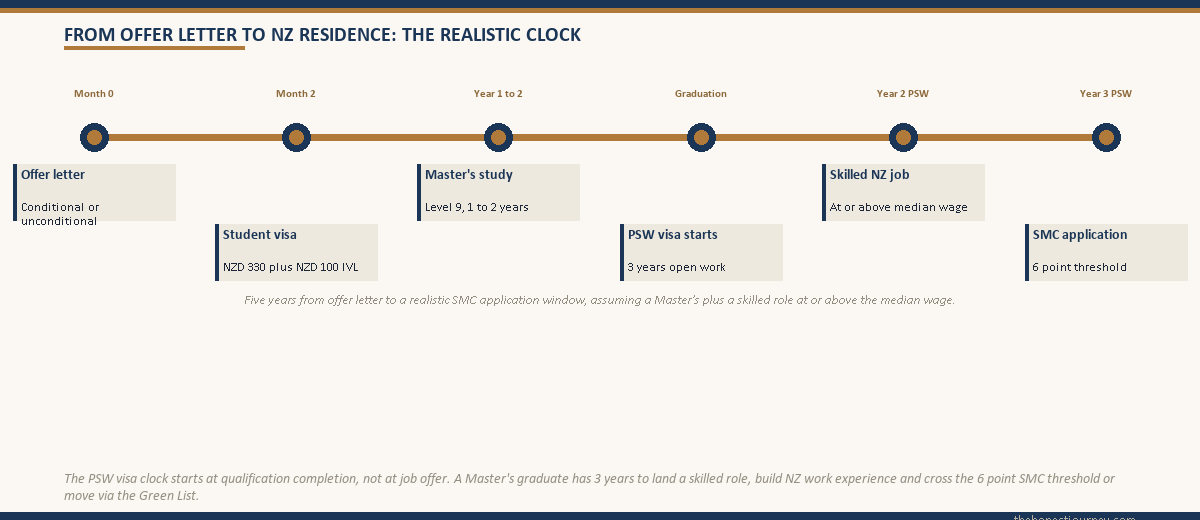
The post-study work visa is open. You can work for any employer, in any role, including roles unrelated to your degree. The clock starts when you complete the qualification, not when you find a job. A Master’s graduate has three years to land a skilled role, build NZ work experience, and move to a residence pathway. This is the part that matters for the PR maths.
Faz's ruleIf you are considering a one-year Level 7 PG diploma to save money, run the maths on the 1-year work visa cliff before you accept. Two years to recover from a cheaper qualification often costs more than a Master's that gives three.
The PG diploma used to be a smart-money play when it came with a 2 or 3 year work visa. After the post-2024 changes, it comes with one. Twelve months is not enough runway in a small job market to find a skilled role, build experience, and apply for residence. The Master’s (Level 9) is the route that actually keeps the PR option open.
Skilled Migrant Category and the Green List
New Zealand’s main PR route for international graduates is the Skilled Migrant Category (SMC), revamped in 2023 to a 6-point system. You need 6 points to be eligible to apply, and points come from qualifications, occupational registration or NZ income above the median wage threshold.
Under the current system, a Master’s degree gives 4 points, a Bachelor’s gives 3, and a PhD gives 6. You add points from skilled NZ work experience or by holding occupational registration in a regulated profession (nursing, engineering, teaching, medicine). A Master’s graduate (4 points) plus 2 years of skilled NZ work at or above the median wage (2 points) crosses the 6-point threshold.
The Green List is the faster lane. It is a published list of occupations New Zealand actively wants, and it has two tiers: Tier 1 (Straight to Residence) and Tier 2 (Work to Residence after 2 years). Tier 1 includes most senior doctors, engineering roles, ICT roles like senior software engineer and DevOps engineer, and senior secondary teachers in shortage subjects. Tier 2 includes registered nurses, midwives, primary teachers and a wider band of engineering and trades roles. The current Green List is on Immigration New Zealand, and it changes every 6 to 12 months.
The honest read for Indian Master’s graduates is this: if you graduate into a Green List occupation and find a job that pays at or above the median wage (NZD 33.56/hr in 2026, roughly NZD 70,000 a year), residence is realistic within 2 to 3 years. If you graduate into a non-list role, you can still apply via SMC, but you will need work experience to accumulate the points, and the timeline stretches to 4 to 5 years.
Funding the NZ Master’s from India
Taking out an education loan for New Zealand follows the same PSU bank framework as other Tier-1 destinations. SBI Global Ed-Vantage, Bank of Baroda Vidya and Canara Bank’s overseas product all treat NZ universities as approved destinations. SBI’s education loan product page lists the eligibility, collateral norms and sanction caps.
For a ₹60 lakh requirement, the standard structure is a secured loan against residential property at 9.5 to 10.5 percent from a PSU bank, with moratorium covering the two-year course plus six months. Unsecured options through NBFCs (Avanse, Auxilo, HDFC Credila) go up to ₹50 lakh for select NZ universities at 11.5 to 13.5 percent, usually only for Master’s at the eight Universities NZ institutions.
The sanction letter doubles as proof of funds for the INZ visa file. The loan amount in the sanction must cover at least one year of tuition plus the NZD 20,000 living cost benchmark. If the loan covers only tuition, you need additional family savings documented for the living component. For the broader breakdown of how proof of funds works across countries, see the proof of funds for student visa guide. The mandatory health insurance piece is in the health insurance for study abroad post.
The honest weak spots: smaller job market and seasonal hiring
This is where most NZ posts go quiet. The country has a population of 5.2 million. The graduate job market is smaller than a single Indian metro. Compared to Australia, where Sydney and Melbourne each have a tech and finance job market of their own, New Zealand has one and a half job markets: Auckland for tech, business and consulting, Wellington for public sector and policy, and a thin scatter of roles in Christchurch and Hamilton.
Hiring is also seasonal. The NZ financial year ends 31 March, and most graduate hiring programmes run February to April, with a second wave September to November. If you graduate in November and start applying in December, the market is on summer break until late January. This single rhythm catches a lot of international graduates by surprise. The students who do well plan applications six months before graduation, not after.
The other honest point is salary. Median graduate salaries in NZ run NZD 55,000 to NZD 75,000 (₹27.5 lakh to ₹37.5 lakh), and senior software engineers cap out around NZD 130,000 to NZD 160,000 (₹65 lakh to ₹80 lakh) for most companies outside the big tech offices. These numbers are lower than Australia and meaningfully lower than the US. The cost of living, particularly in Auckland, eats more of the salary than the headline rate suggests.
Faz's ruleThe decision between New Zealand and Australia is not about which country is better. It is about how much margin of error you want on a smaller job market with calmer rules versus a bigger market with more rule changes.
New Zealand’s PSW visa is steady. Australia’s post-study work rights have moved three times in two years. New Zealand’s job market is small but the rules are predictable. Australia’s job market is larger but the goalposts keep shifting. The right answer depends on your tolerance for change and your network in either country.
What part-time work during study actually pays
Student visa holders can work up to 20 hours a week during semesters and full time during scheduled holidays. The 2026 minimum wage is NZD 23.50 an hour, and typical student roles (retail, hospitality, library, on-campus tutoring) pay NZD 23.50 to NZD 28 an hour. A consistent 20-hour week generates around NZD 1,800 to NZD 2,200 a month after tax, which covers groceries, transport and phone, with some left for incidentals.
Part-time work does not meaningfully offset tuition. It does offset the living cost line in the budget table, which is why Auckland and Wellington students with steady jobs often land at the lower end of the cost range. Master’s-level students, especially in research programmes, sometimes pick up tutoring or research assistant roles at NZD 32 to NZD 45 an hour, which moves the needle more.
The 20-hour limit is enforced. Working over the cap is a visa breach and can affect the post-study work visa application. The current rules and approved working hours are listed on Education New Zealand and the INZ student visa page.
The honest closing take
New Zealand is a smaller, calmer option in a region where the bigger options keep changing the rules. The cost band of ₹45 lakh to ₹75 lakh for a two-year Master’s is real, the 3-year post-study work visa for Master’s graduates is real, and the PR pathway through SMC and the Green List exists in a form that has been stable for the past 18 months.
The trade-off is the job market. A small country with a regional economy and a single hiring rhythm is a different financial product from a large country with parallel job markets. For a Green List occupation graduate with a job lined up, the maths works cleanly. For a non-list field, the runway is real but tighter, and the network you build during the study years matters more than it would in Sydney or Toronto.
For Indian students who want the ANZ post-study work option without the recent Australian rule churn, who can land in a Green List or median-wage role, and who are honest about Auckland costs versus a smaller-city alternative, New Zealand holds up as a sensible choice. For students who need the largest possible job market and the highest-paying entry roles, Australia, Canada or the US still answer better. For the side-by-side cost comparison with the other destinations, see the cost of studying in Canada for Indian students post and the cost of studying in the UK for Indian students post.
Sorting the visa is the step most people underestimate. The full process, fees and funds proof for New Zealand sit in the New Zealand student visa guide.
FAQ
Is New Zealand cheap for Indian students?
Cheaper than the US and the UK, broadly comparable to Australia, more expensive than most parts of Europe. A two-year Master’s at a mid-tier NZ university lands at ₹45 lakh to ₹65 lakh all-in, while an Auckland Master’s at a top programme pushes to ₹70 lakh to ₹75 lakh. Tuition is NZD 22,000 to NZD 45,000 a year and living is NZD 20,000 to NZD 25,000 a year. The country is not “cheap” by Indian salary standards, but it is one of the more honest cost destinations in the developed-country shortlist.
What is the NZ post-study work visa in 2026?
The Post-Study Work Visa is 3 years for a Master’s (Level 9), 3 years for a Bachelor’s (Level 7), and 1 year for a Postgraduate Diploma (Level 7 or 8). The visa is open, meaning you can work for any employer in any role, including roles unrelated to your degree. The clock starts on qualification completion, not on job offer. The Level 7 PG diploma route was cut from 2 to 3 years down to 1 year in the post-2024 rule changes, which is the single biggest shift to plan around.
How much is the NZ student visa cost?
The Fee Paying Student Visa, applied online from India, costs NZD 330 in 2026. There is an additional NZD 100 International Visitor Conservation and Tourism Levy paid at the same time, so the total visa-stage outflow to Immigration New Zealand is NZD 430. Beyond this you pay separately for the tuberculosis chest X-ray at an INZ-approved panel physician (around ₹4,000 to ₹5,000) and a police clearance certificate from India. IELTS, application fees and translation costs are separate from the visa fee.
Is IELTS mandatory for New Zealand?
For most Master’s programmes the academic IELTS benchmark is 6.5 overall with no band below 6.0. Some programmes in Public Health, Law and Education ask for 7.0 overall. PTE Academic and TOEFL iBT are accepted at equivalent scores. The English requirement is set by the university, not by Immigration New Zealand. If you have studied in an English-medium institution in India for the previous three years, some universities accept a medium-of-instruction letter in place of IELTS, but most still ask for a standardised test.
What is the NZ PR pathway for international students?
The main route is the Skilled Migrant Category, a 6-point system where a Master’s gives 4 points, a Bachelor’s 3, a PhD 6, and additional points come from skilled NZ work experience or median-wage NZ income. A Master’s graduate plus 2 years of skilled work above the NZD 33.56/hr median wage crosses the 6-point threshold. The faster lane is the Green List, a published list of occupations with Tier 1 (straight to residence) and Tier 2 (work to residence after 2 years) categories covering engineering, ICT, nursing, teaching and medicine.
How many universities are in New Zealand?
Eight, all public, all on the QS top 500. They are the University of Auckland, University of Otago, Victoria University of Wellington, University of Canterbury, Massey University, University of Waikato, Lincoln University and Auckland University of Technology. The full directory and programme list is maintained by Universities New Zealand, the official representative body for all eight. Below the university level there are Te Pukenga polytechnics that issue Level 7 diplomas, but these are separate institutions with their own admissions and post-study work rules.
Can I work part time as a student in New Zealand?
Yes, up to 20 hours a week during academic semesters and full time during scheduled holidays. The 2026 minimum wage is NZD 23.50 an hour, and typical student roles in retail, hospitality, library and on-campus tutoring pay NZD 23.50 to NZD 28 an hour. A consistent 20-hour week earns around NZD 1,800 to NZD 2,200 a month after tax, which covers groceries, transport and phone bills but does not offset tuition meaningfully. The 20-hour limit is enforced and exceeding it can affect your post-study work visa application.
Is the NZ job market smaller than Australia?
Yes, materially. New Zealand’s population is 5.2 million, smaller than a single major Indian city. The graduate job market is concentrated in Auckland (tech, business, consulting) and Wellington (public sector, policy), with thinner activity in Christchurch and Hamilton. Hiring is also seasonal, with graduate programmes running February to April and a second wave September to November, and a quiet stretch through summer. Salaries are lower than Australia: median graduate salaries are NZD 55,000 to NZD 75,000, and senior engineers cap around NZD 130,000 to NZD 160,000 outside big tech.
Faz · The Honest Journey · 2026