Short answer. Since 1 April 2026, money sent abroad for education out of an education loan from a bank or notified lender attracts no TCS at all. Self-funded education remittances pay 2 percent on the amount above ₹10 lakh a year. Any TCS collected shows up in Form 26AS, and you claim it back in that person’s ITR.
If TCS was collected on a remittance that came out of your education loan, the bank applied it wrongly, and you can ask for it to be reversed or claim it back. If the money was your family’s own, the TCS is real but refundable. Either way it lands in Form 26AS under the PAN of whoever paid, and comes back through that person’s ITR. Most students get the full amount back.
I keep seeing the same panic message in family WhatsApp groups every June. A parent forwards a screenshot from a banking app showing TCS deducted on a tuition wire, and someone in the chain says “the 20 percent rule has kicked in.” It almost never has. On a ₹15 lakh self-funded tuition wire today, TCS is 2 percent of the ₹5 lakh above the threshold, which is ₹10,000. On the same wire paid out of a bank education loan, it is zero.
The rules are simple once you separate them from the 20 percent rate on non-education remittances, and once you know that most of what you read online describes rules that no longer apply. This post covers the current rates, where TCS shows up in your tax records, and how to claim it back in the right person’s ITR.
What TCS on an education remittance actually is
Tax Collected at Source (TCS) is collected by an authorised dealer, your bank, when you remit money abroad under the Liberalised Remittance Scheme. Since 1 April 2026 it is governed by section 394 of the Income-tax Act 2025; under the old Act it was section 206C(1G). It is not a separate tax. It is a prepayment that gets adjusted against your final income tax liability for the year, and if you owe nothing, it is refunded in full.
For education remittances paid out of an education loan from a financial institution, which section 394 defines by reference to section 129(3)(b) as a bank or a lender the central government has notified, no TCS is collected at all. For education remittances paid from any other source, such as savings, an FD or a gift, the rate is 2 percent on the amount above ₹10 lakh in a tax year. Until 31 March 2026 that rate was 5 percent. Both sit far below the 20 percent that applies to most other LRS spending above ₹10 lakh.
The ₹10 lakh threshold is per remitter, per PAN, per tax year. Two parents wiring separately each have their own. Once you cross it, TCS applies only on the excess, not on the full amount.
Faz's ruleThe 20 percent TCS panic does not apply to education remittances. It applies to foreign investments, gifts and most other non-education LRS outflows above ₹10 lakh.
I have watched families abandon perfectly good remittance plans because someone in the chain mixed up the education rate with the 20 percent rate. ₹25 lakh of self-funded tuition in a year costs 2 percent of the ₹15 lakh above the threshold, which is ₹30,000, all of it refundable. Paid out of a bank education loan, it costs nothing. The same ₹25 lakh sent abroad for a non-education purpose would mean ₹3 lakh collected at 20 percent. The rate you face depends entirely on what the remittance is classified as.
The rate structure from 1 April 2026
Budget 2026 cut the rate on education and medical remittances from 5 percent to 2 percent from 1 April 2026, in the same year the TCS rules moved into section 394 of the new Income-tax Act. Here is what applies for tax year 2026 to 2027.
| Purpose of LRS remittance | Up to ₹10 lakh a year | Above ₹10 lakh a year |
|---|---|---|
| Education, paid out of a loan from a bank or notified lender | Nil | Nil |
| Education, paid from own funds (savings, FD, gift) | Nil | 2% |
| Medical treatment abroad | Nil | 2% |
| Overseas tour package | 2% | 2% |
| Any other LRS purpose (investments, gifts, property) | Nil | 20% |
For an education loan disbursement going directly to a foreign university, where the bank pays the university out of the loan account, no TCS should be collected at all. If the loan is first paid into the student’s savings account and the student then wires it, the exemption can still apply, but only if the bank accepts that the remittance is the loan money. Banks are stricter about that route, so pay straight from the loan where you can.
For tuition you pay from your own bank account, with no education loan involved, the 2 percent rate applies above ₹10 lakh in the tax year. Here the TCS goes against the PAN of the remitter, which is usually the parent or whoever owns the funding bank account.
The loan versus own funds distinction is why the funding source paperwork matters at the remittance stage. The bank classifies the transaction based on what you declare in the LRS Form A2 and the supporting documents. An education loan sanction letter and disbursement reference let the bank apply the exemption. Without those, it defaults to the self-funded rate. More on the sanction letter side in my TCS on education loan India post.
Where the TCS shows up: Form 26AS and AIS
Every TCS deduction by the bank gets reported to the Income Tax Department under the PAN of the person whose account funded the remittance. It appears in two places when you log into the e-filing portal.
Form 26AS (Part II for TCS). This is the consolidated tax statement under your PAN. The TCS entry shows the deductor (bank name and TAN), the date, the amount remitted, and the tax collected. It usually reflects within 2 to 4 weeks of the remittance, after the bank files its quarterly TCS return.
Annual Information Statement (AIS). The AIS is the broader information statement and shows the same TCS entry, plus the underlying foreign remittance. If the bank’s report and your records do not match, you flag a feedback through AIS itself.
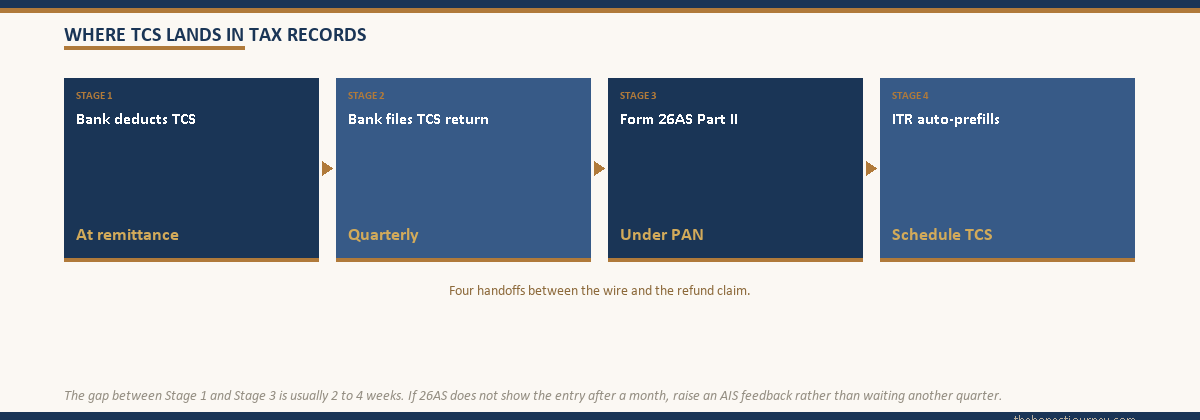
The critical thing: TCS lands under the PAN of whoever’s bank account funded the remittance, not always the student. If the parent’s savings account paid the wire and the student is the beneficial owner of the education, the TCS is in the parent’s 26AS, and the parent claims it in their ITR. If the student’s loan account funded the wire directly, the TCS is in the student’s 26AS. Track this at the remittance stage so you know whose ITR carries the credit.
How to claim TCS refund in the ITR
Claiming the TCS as a credit or refund is a routine line item in the ITR, not a separate refund application. The mechanics:
Step 1. Log into the e-filing portal using the PAN under which the TCS was deducted. Confirm the TCS entry in Form 26AS Part II for the relevant assessment year.
Step 2. Start the relevant ITR (typically ITR-1 for salaried, ITR-2 if there is capital gains or foreign assets, ITR-3 if there is business income). The portal auto-prefills the TCS amount from 26AS into Schedule TCS of the return.
Step 3. Cross-check the prefilled TCS amount against your bank remittance receipts and Form 26AS. If anything is missing, edit Schedule TCS manually with the deductor’s TAN, the amount of TCS, and the financial year.
Step 4. Compute total tax liability for the year. The TCS amount is treated like a prepaid tax (similar to TDS and advance tax) and reduces the final liability. If TCS plus TDS plus advance tax exceeds total tax owed, the excess becomes a refund.
Step 5. Pre-validate the bank account where you want the refund credited. The refund processes after the Centralised Processing Centre (CPC) verifies the return, usually 20 to 90 days from e-verification.
Faz's ruleA student with no other income gets the full TCS amount back as a refund, because their total tax liability is zero.
This is the case I see most often now: the bank wrongly collects TCS on a tuition wire that came straight out of the student’s education loan, and reports it under the student’s PAN. The student has no salary, no other income, no tax liability. First ask the bank to reverse it, since that remittance was exempt. If it will not, the student files a NIL return claiming the TCS, and the full amount lands in their bank account a couple of months later.
Student ITR vs co-applicant ITR: who claims the refund
This is where most families get stuck. The TCS credit belongs to whoever’s PAN it sits under in Form 26AS, which is whoever’s bank account funded the remittance. Pick the wrong person to claim it, and the refund stalls.
Three common scenarios:
Scenario A: Loan disbursed directly to university by the bank. The loan account is usually in the student’s name, with the parent as co-applicant. This remittance is exempt, so there should be no TCS. If the bank collected some anyway, it is reported under the student’s PAN: ask the bank to reverse it, and if it will not, the student claims it in their own ITR. With no other income, the full amount comes back.
Scenario B: Loan disbursed to the student’s savings account, student wires the money. Whether the exemption applies depends on the bank accepting that the wire is the loan money. If TCS is collected, it lands under the student’s PAN and the student claims it in their own ITR.
Scenario C: Co-applicant (parent) pays tuition from their own account, separate from the loan. Even if there is an education loan in the background, if the actual remittance was funded by the parent’s savings account, the TCS is in the parent’s 26AS. Parent claims it in their ITR against their salary tax liability. The rate here is 2 percent above ₹10 lakh, because the bank classifies it as self-funded education, not loan-funded.
| Who funded the wire | TCS | Under whose PAN | Claimed in |
|---|---|---|---|
| Bank pays the university straight from the loan | None, exempt | Student’s, only if wrongly collected | Ask the bank to reverse it, or the student’s ITR |
| Loan paid into the student’s account, student wires it | None if the bank accepts it is loan money, otherwise 2% above ₹10 lakh | Student’s | Student’s ITR |
| Parent pays from own savings | 2% above ₹10 lakh | Parent’s | Parent’s ITR |
Worth flagging: if the student is going abroad mid-year and will become a non-resident for tax purposes, the TCS still gets claimed in whatever ITR is filed for the relevant financial year. Residency status affects which income is taxable, not whether TCS credit can be claimed. The student files an Indian ITR for the year and reclaims TCS even if they have no Indian income, since TCS is a prepaid tax against zero liability and becomes a refund.
Why the figures you read online are wrong
The reason families are still confused is that the rules have changed repeatedly. The original section 206C(1G) introduced TCS on education remittances in October 2020 with a ₹7 lakh threshold, at 0.5 percent if the remittance was funded by an education loan and 5 percent otherwise.
The Finance Act 2023 kept those concessional rates for education and medical remittances while moving most other LRS spending to 20 percent. Since then the threshold has gone up to ₹10 lakh, remittances paid out of an education loan from a bank or notified lender have stopped attracting TCS altogether, and from 1 April 2026 the self-funded rate fell to 2 percent, with the whole provision moving into section 394 of the Income-tax Act 2025. Much of what still ranks online, including the 0.5 percent figure, describes rules that no longer apply.
So the current state, for tax year 2026 to 2027:
- Education paid out of a loan from a bank or notified lender: no TCS
- Education paid from own funds: 2 percent above ₹10 lakh
- Medical treatment abroad: 2 percent above ₹10 lakh
- Everything else under LRS: 20 percent above ₹10 lakh
The practical effect is that a formal education loan now removes TCS from the remittance entirely, rather than just reducing it. That stacks with the deduction for interest on the same loan, which was section 80E and is now section 129, if you file under the old tax regime.
Direct tuition payment by bank vs forex by family
One common question: does TCS apply if the bank pays the university directly from the loan account, with no money passing through anyone’s savings account?
It is still an LRS remittance. The trigger is the outflow from India, regardless of which Indian account it leaves from. But a bank wiring tuition straight from the education loan account is exactly the case section 394 exempts, so no TCS should be collected. If you see TCS on that wire, the bank has applied the self-funded rule by mistake.
If a family wires tuition from a parent’s NRE account (the parent is an NRI), the LRS rules do not apply (LRS is a resident-only scheme), so no TCS is collected. NRI parents paying for resident students should keep this in mind. For more on resident-status and forex movement, see my how much money to carry abroad as a student post.
The RBI’s LRS framework, governed under the Foreign Exchange Management Act, sits separately from the TCS provisions but the bank applies both at the same remittance point, which is also where you sign the A2 form under the LRS to send money abroad as a student. Reference on rbi.org.in for the LRS master direction, and the IBA circulars for the bank-side implementation.
Timing and refund speed
Practical timing notes that matter when you are planning:
TCS deducted at remittance. On a self-funded wire the bank collects the TCS when the money goes out. If you send ₹20 lakh of your own money for tuition in a year with no earlier remittances, the bank collects 2 percent of the ₹10 lakh above the threshold, which is ₹20,000. Build this into your cash plan so the university still receives the exact amount it needs.
Form 26AS reflects in 2 to 4 weeks. The bank files its TCS return quarterly, so the entry usually shows up after the quarter ends.
ITR can be filed once the tax year ends. TCS collected in tax year 2026 to 2027, April to March, is claimed in the return filed after 31 March 2027. File early to start the refund clock.
Refund processing. The CPC at Bengaluru typically processes refunds within 30 to 90 days of e-verification of the return. Refunds under ₹1 lakh process faster than larger ones. Bank account pre-validation must be complete or the refund stalls.
The honest verdict
If your remittance comes out of an education loan from a bank or notified lender, there should be no TCS at all, and the main job is making sure the bank knows that. If you are paying from your own money, the TCS is 2 percent of the excess above ₹10 lakh a year. It sits as a credit against the remitter’s PAN and comes back through the normal ITR process.
The two things to get right are: track whose PAN the TCS lands under (it is whoever’s account funded the wire), and file that person’s ITR with the TCS credit claimed. A student with no other income typically gets the full amount back. A salaried parent who paid from their account adjusts it against their salary tax liability. Neither is complicated.
What gets people in trouble is mixing this up with the 20 percent rate on non-education LRS, relying on the old 0.5 or 5 percent figures, or treating TCS as a lost cost instead of a refundable credit. It is not lost. It is money parked with the government for a year, returned through the ITR. See the broader education loan India complete guide for how this fits into the overall borrowing picture.
FAQ
What is the TCS rate on education loan remittances in 2026?
From 1 April 2026, nil if the remittance is paid out of an education loan from a bank or a lender the central government has notified, under section 394 of the Income-tax Act 2025. If the remittance is from your own funds, 2 percent on the amount above ₹10 lakh in the tax year, down from 5 percent before April 2026. Below ₹10 lakh a year, no TCS applies either way. Most other LRS remittances pay 20 percent above ₹10 lakh.
Can I get a refund of TCS deducted on my education loan?
Yes. TCS is not a tax. It is a prepayment of income tax that gets credited against the final tax liability of whoever’s PAN the TCS was deducted under. When you file the ITR for that PAN, the TCS amount is offset against any tax owed, and any excess is refunded to your pre-validated bank account. A student with no other income usually gets the full TCS amount back, since their total tax liability is zero. The refund typically processes within 30 to 90 days of e-verifying the return.
How do I claim TCS refund in my ITR?
Log into the e-filing portal at incometax.gov.in using the PAN under which the TCS was deducted, start the relevant ITR (ITR-1, ITR-2, or ITR-3 depending on income type), and confirm the TCS entry in Schedule TCS, which is auto-prefilled from Form 26AS. Cross-check the amount against your bank remittance receipts. The TCS is treated as a prepaid tax and reduces final liability. If TCS exceeds total tax owed, the balance is refunded to your bank account after CPC processes the return.
Does TCS apply if the bank pays tuition directly to the foreign university?
It is still an LRS remittance, but if the money comes straight out of an education loan from a bank or notified lender, section 394 exempts it, so no TCS should be collected. If you pay the university from your own funds instead, 2 percent applies on the amount above ₹10 lakh in the tax year, credited to the remitter’s PAN.
What is Form 26AS and how does it show TCS?
Form 26AS is the consolidated tax statement available on the e-filing portal under your PAN. It shows all TDS deducted by employers and others, all TCS collected by banks on your remittances, advance tax paid, and refunds received. TCS appears in Part II of Form 26AS, listing the deductor’s name and TAN, date of collection, amount remitted, and tax collected. The entry reflects 2 to 4 weeks after the remittance, once the bank files its quarterly TCS return.
Who can claim TCS refund: student or parent?
Whoever’s PAN the TCS is reported under in Form 26AS, which is whoever’s bank account funded the remittance. If the loan account or student’s savings account paid the wire, TCS lands under the student’s PAN and the student claims it. If a parent paid tuition from their own savings account separately from any loan, the TCS lands under the parent’s PAN and the parent claims it. Track the funding source at the remittance stage so the correct person files the claim in their ITR.
Is the 20 percent TCS rate applicable to education remittances?
No. The 20 percent rate applies to non-education, non-medical LRS remittances above ₹10 lakh in a tax year, such as foreign investments, gifts and property. For education, it is nil if paid out of an education loan from a bank or notified lender, and 2 percent above ₹10 lakh if paid from your own funds.
Does TCS rate change if the student becomes a non-resident during the year?
No. TCS at the remittance stage depends on how the remittance is classified, not on the student’s eventual residency. The student can still file an Indian ITR for the relevant year and reclaim any TCS collected under their PAN, because it is a prepaid tax, and a non-resident with no Indian income simply gets it all back.
Faz · The Honest Journey · 2026