Short answer. Most portal rejections are not credit decisions. They are data mismatches: a course name that does not match the allotment letter, a management or NRI quota admission that was never eligible, or an institute outside the 1,425 QHEI list. Fix the data and resubmit, switch banks, or go direct to a branch.
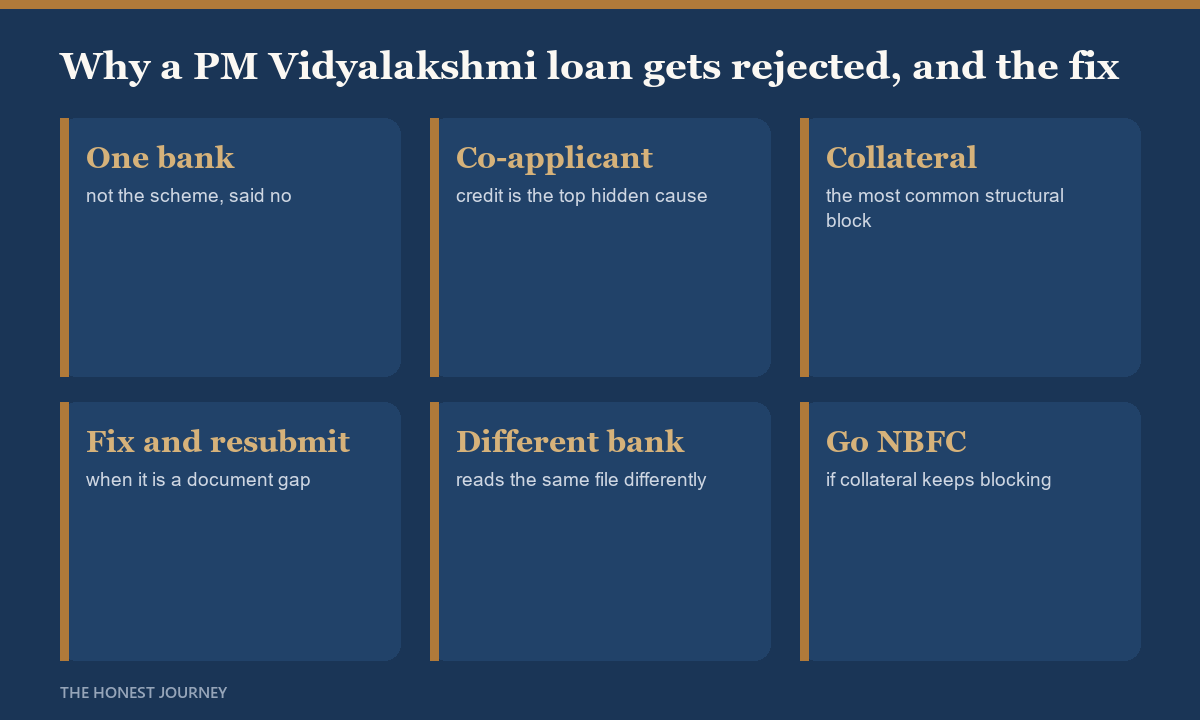
A PM Vidyalakshmi rejection is almost always one bank declining your application, not the scheme rejecting you. The portal routes your form to banks, and a bank can say no for reasons that have nothing to do with the government scheme: a co-applicant with a weak credit history, collateral it will not accept, a course or university it does not fund, or simply missing documents. The fix is rarely to give up. It is to find out which of those caused it, correct what you can, and re-route to a bank that fits.
For a plan that breaks after sanction rather than before it, see what happens if you drop out, defer or cancel.
A reader treated his rejection as a verdict. One public sector bank had declined, the portal showed “rejected”, and he assumed he was not eligible for an education loan at all and began looking at selling family gold. The actual reason, once he asked the branch, was that his co-applicant’s existing loan obligations left too little room on paper. A different bank with a different view of the same file sanctioned him three weeks later. Nothing about his eligibility had changed. Only the lender had. That gap between “I was rejected” and “one bank said no” is where most people lose an intake they did not need to lose.
This guide covers why portal applications actually get rejected, how to find the real reason, and the three routes forward: fix and resubmit, apply to a different listed bank, or go outside the portal. If collateral is the sticking point, read education loans without collateral, and if you have not yet chosen where to apply, the bank list guide shows which lenders fund abroad study.
Why portal applications actually get rejected
Banks decline for a small set of recurring reasons, and knowing them tells you which fix applies:
- Co-applicant profile. The co-applicant’s credit history and existing obligations weigh heavily. A low credit score, missed payments, or too many current loans can sink an application even when the student is strong. This is the most common hidden cause.
- Collateral the bank will not accept. For loans above roughly 7.5 lakh, most public sector banks want collateral, and they are particular about what qualifies. Agricultural land, disputed titles or property in another family member’s name are often refused.
- Course or university not funded. Some banks hesitate on newer destinations, certain diploma or short courses, or universities outside their approved lists. A strong student applying to a course the bank will not fund still gets a no.
- Loan amount versus repayment capacity. If the requested amount looks large against the family’s declared income and the expected post-study earnings, the bank may decline or offer far less.
- Incomplete or mismatched documents. Gaps, or figures that do not match across your admission letter, cost estimate and income proofs, are an easy rejection. These are the most fixable.
How to find the real reason
The portal status will say “rejected” and rarely explains why in useful detail. The real reason lives at the branch. Call or visit the branch the application was routed to, give your application number, and ask directly what caused the decline and whether it is fixable. Officers will usually tell you, and the answer decides your next move. Do not resubmit blindly before you know the cause, because the same gap will produce the same result.
Route one: fix and resubmit
If the reason is a document gap, a mismatch in figures, or something the branch says can be corrected, fix it precisely and resubmit to the same bank. Make sure your admission letter, cost of study and income proofs all tell the same story, and that the loan amount is justified by the itemised costs. A clean, consistent file removes the easiest reasons for a no. The documents and eligibility checklist covers exactly what a complete file looks like.
Route two: apply to a different listed bank
If the reason is structural to that bank, its view of your co-applicant, its collateral rules, its stance on your university, then the answer is a different bank, not a different you. Banks assess the same file differently. Use the portal to send your application to another lender from the abroad shortlist, or use the direct branch route if one bank has started to engage. A decline from one public sector bank says very little about how the next will read your case.
Route three: go outside the portal
If two or three listed banks decline for the same structural reason, especially collateral, the honest next step is to look beyond the portal. The non-banking lenders that are not on Vidya Lakshmi, such as the specialist abroad-education financiers, assess risk differently and often fund profiles that public sector banks refuse, particularly no-collateral cases for strong universities. They cost more, but a costlier loan you can actually get beats a cheaper one you cannot. The no-collateral guide covers that path.
Check these four things before you assume it was your profile
| Check | Why it rejects |
|---|---|
| Course name against the allotment letter | The manual states incorrect details may cause the bank to reject, and may affect PM-Vidyalaxmi and CSIS eligibility |
| Admission quota | Management quota and NRI quota admissions are excluded from the scheme benefit entirely |
| Institute on the QHEI list | 1,425 institutions are covered. Outside that list the collateral-free benefit does not apply |
| Loan above 7.5 lakh without security | Outside the QHEI list, or on management or NRI quota, security is required above that amount |
Use the grievance route, it is not decorative
The portal has a formal grievance channel and most students never open it. Register New Complaint, select the application ID, the grievance type and subtype and the bank, describe it and attach a PDF. You get a grievance ID, updates by SMS, email and WhatsApp, and the right to re-raise it if the bank’s reply resolves nothing. That paper trail is worth more than a phone call to a branch.
If the status has already moved past Submitted you cannot withdraw the application yourself. That branch has to close it. Do that before you reapply anywhere, because a stale open application is a live enquiry sitting against your file.
The honest closing take
The word “rejected” on the portal does more damage than the decision behind it, because it reads like a final judgment when it is usually one lender’s opinion of one file on one day. Find the actual reason at the branch, fix what is fixable, and re-route what is not. Most students who are declined by their first bank are funded by a later one, often within weeks, with nothing changed but the lender. Treat a rejection as routing information, not a verdict, and keep a loan moving in parallel so a single no never costs you an intake.
FAQ
Why was my PM Vidyalakshmi loan rejected?
Usually because one bank declined for a specific reason: a weak co-applicant credit profile, collateral it would not accept, a course or university it does not fund, an amount too large for the declared income, or missing documents. The portal rarely explains it, so ask the branch directly.
Does a portal rejection mean I am not eligible for the scheme?
No. A rejection is one bank saying no, not the scheme rejecting you. Other listed banks may assess the same file differently, and many students declined by their first bank are sanctioned by a later one.
Can I reapply after a rejection?
Yes. You can fix the cause and resubmit to the same bank, or apply to a different listed bank through the portal. Find the real reason first, since resubmitting without fixing it produces the same result.
What if several banks reject me for collateral?
If public sector banks keep declining over collateral, look outside the portal at non-banking lenders that fund no-collateral cases for strong universities. They cost more but often approve profiles banks refuse. The no-collateral guide covers this.
How do I stop a rejection from delaying my intake?
Keep a second application moving in parallel and act on any document request the same day. If one bank declines, you still have another in progress, so a single no never stalls your whole plan.