Short answer. One application form goes to a maximum of three banks. The portal shows which loan scheme and which interest subvention scheme you qualify for based on what you entered, plus a View Loan Schemes link per bank. Loans run through scheduled banks, regional rural banks and cooperative banks participating in the scheme.
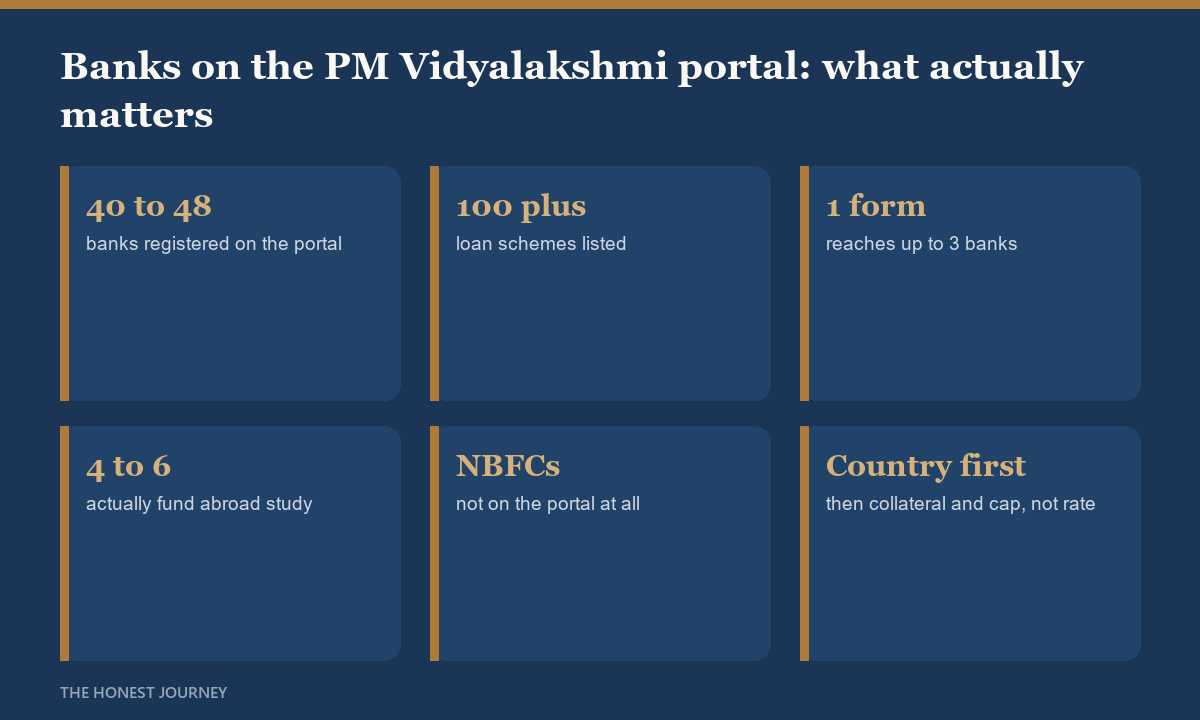
The Vidya Lakshmi portal lists roughly 40 to 48 banks and well over 100 loan schemes, but almost all of them are public sector and cooperative banks. The big private NBFCs that most abroad students actually use, Credila, Avanse, InCred, MPOWER and Prodigy, are not on the portal at all. So the real question is not how many banks are listed, it is which of the listed banks fund your country and course, and that shortlist is short. One application form on the portal reaches up to three banks at once, which is the feature worth using well.
A reader last year sent me a screenshot of the portal bank list, forty-odd names long, and asked which one had the lowest interest rate so he could pick it. That is the wrong first question, and picking that way is how people burn three weeks and a rejection. The bank that quotes the lowest headline rate may not fund your country, may want collateral you cannot give, or may cap the loan below your first-year fees. A bank list is not a menu of interchangeable options. It is a set of very different lenders, and only a handful will seriously fund an abroad degree.
This guide walks through who is actually on the portal, the difference between the older forty-bank list and the newer collateral-free layer, which banks fund abroad study at scale, and how to use the one-form-to-three-banks feature without wasting an application. If you are still deciding whether to use the portal at all, start with the honest read on the PM Vidyalakshmi portal, and if collateral is your worry, read education loans for abroad studies without collateral alongside this.
How many banks are on the Vidya Lakshmi portal
As of the last portal update the count sits at around 40 to 48 registered banks offering somewhere north of 100 education loan schemes between them. The number moves, so treat any fixed figure, including this one, as a rough guide and check the live list when you log in. What matters more than the exact count is the composition, and the composition barely changes: the list is almost entirely public sector banks, a few private banks, some regional rural and cooperative banks, and nothing else.
That last part is the piece most guides skip. The non-banking financial companies that dominate abroad study lending, HDFC Credila, Avanse, InCred, and the international lenders MPOWER Financing and Prodigy Finance, are not on the Vidya Lakshmi portal. They are not banks in the regulatory sense the portal uses, so they never appear. If your profile fits an NBFC better, and many abroad profiles do, the portal will never surface that path. You apply to those lenders directly, outside the portal, and you should know that before the list makes you think it is the whole market.
The two layers: the classic portal list and the collateral-free PM Vidyalakshmi layer
People confuse two things that share a website, and the confusion changes which banks you see. The older Vidya Lakshmi portal has existed for years as a single-window application system across those 40-plus banks. The newer PM Vidyalakshmi scheme, launched in November 2024, sits on top of it and adds a collateral-free, credit-guaranteed loan of up to 7.5 lakh for students admitted to a Quality Higher Educational Institution on the approved list, plus interest subvention for eligible income brackets.
The practical effect: the full bank list is the classic layer, open to most courses including many abroad ones. The collateral-free PM Vidyalakshmi benefit runs through a smaller integrated set of banks and is tied to the QHEI institution list, which is heavily domestic. For a foreign degree you will usually be applying through the classic portal to a public sector bank under its own abroad scheme, not claiming the 7.5 lakh collateral-free guarantee, because most foreign universities are not on the QHEI list. Knowing which layer you are in tells you which banks and which limits actually apply to you.
Which banks on the portal actually fund abroad study
For an abroad degree the serious lenders on the portal are a short public sector shortlist, each with a named abroad scheme:
- State Bank of India, through Global Ed-Vantage, is the largest abroad-study lender on the list and funds high-ticket loans with property or fixed-deposit collateral. It is the default first application for most abroad students.
- Bank of Baroda, through Baroda Scholar, competes closely with SBI on abroad loans and often moves faster for premier-institution admits.
- Canara Bank and Union Bank of India both fund abroad study and are worth a parallel application when SBI or Baroda drag.
- Punjab National Bank and Bank of India round out the realistic set, stronger for some regions and course types than others.
Everything else on the list, the smaller private banks and the regional and cooperative banks, rarely funds a foreign degree at the size you need. They exist on the portal mainly for domestic loans. So of forty-plus names, your genuine shortlist for abroad is usually four to six, and often just the top two.
One form, up to three banks: use it deliberately
The portal’s real advantage is the Common Educational Loan Application Form. You fill it once and send it to up to three banks at the same time, rather than repeating the same paperwork at three branches. Used well, this is how you keep options moving in parallel instead of losing weeks waiting on a single bank.
The mistake is spending those three slots badly. Do not fill all three with whichever banks sit at the top of the list. Pick your three from the abroad shortlist above, usually SBI plus Baroda plus one of Canara or Union, so that all three can actually fund your degree. Sending the form to a cooperative bank that will never sanction an overseas loan wastes a slot you cannot easily reuse. Three good applications beat three that look like effort.
How to read a bank’s scheme before you pick it
Before you commit a slot, check four things on each candidate bank’s abroad scheme, none of which is the headline interest rate:
- Does it fund your country and university. Some banks lend freely for the US and UK but hesitate on newer destinations. A lower rate is meaningless if the bank will not fund your admit.
- Collateral requirement at your loan size. Most abroad loans above about 7.5 lakh need collateral at public sector banks. If you cannot give it, that bank is not your path regardless of its rate, and you should read the no-collateral route instead.
- Loan cap and what it covers. Confirm the maximum and whether it includes living costs, travel and insurance, not just tuition.
- What the sanction letter will say. The sanction letter is what your visa and university need, so it has to match your real costs. The sanction letter and proof of funds guide covers what to check there.
How to use the three bank limit deliberately
Three is a hard cap, so treat it as a portfolio rather than three shots at the same target. The portal surfaces the eligible loan scheme and the eligible subvention scheme for each bank once your inputs are in, and a View Loan Schemes link against each one. Read those before selecting, because two banks on the same list can be running very different schemes.
The rate is capped for you. Under the scheme the interest rate cannot exceed the individual bank’s Externally Benchmarked Lending Rate plus 0.5 percent, and it must be lower than that bank’s rate on education loans outside the scheme. Banks may also give up to 1 percent extra concession if you service the interest during the study and moratorium period, and that concession is where the banks genuinely differ.
The cost of the three bank cap is on the exit. You can withdraw an application yourself only while it reads Submitted. Once a bank updates the status, closing it means contacting that branch. Pick three you would actually accept.
The honest closing take
The bank list looks like the portal’s main feature, and it is the part that misleads people most. Forty-plus names suggest a wide-open market and invite you to shop by interest rate. The reality is narrower and simpler: a handful of public sector banks do the real abroad-study lending, the private NBFCs that might suit you better are not on the portal at all, and the one-form-to-three-banks feature is the thing genuinely worth using. Pick your three from the short abroad shortlist, check each scheme for country, collateral and cap before the rate, and keep a direct NBFC option in mind if none of the listed banks fit. That is how the list works for you instead of against you.
FAQ
How many banks are registered on the Vidya Lakshmi portal?
Around 40 to 48 banks, offering well over 100 loan schemes between them. The exact number changes, so check the live list after you log in. They are almost all public sector, private, regional and cooperative banks.
Are NBFCs like Credila, Avanse or MPOWER on the portal?
No. HDFC Credila, Avanse, InCred, MPOWER Financing and Prodigy Finance are not on the Vidya Lakshmi portal, because it lists banks rather than non-banking lenders. If an NBFC suits your profile better, you apply to it directly, outside the portal.
Which bank is best for an abroad education loan on the portal?
For most abroad students the realistic shortlist is State Bank of India (Global Ed-Vantage) and Bank of Baroda (Baroda Scholar), with Canara Bank, Union Bank, PNB and Bank of India as parallel options. The right one depends on your country, collateral and loan size, not the headline rate.
How many banks can I apply to with one portal form?
The Common Educational Loan Application Form lets you apply to up to three banks at once with a single application. Use all three on banks that genuinely fund abroad study rather than the first names on the list.
Is the collateral-free PM Vidyalakshmi loan available for abroad study?
Usually not. The collateral-free, credit-guaranteed benefit of up to 7.5 lakh is tied to institutions on the Quality Higher Educational Institution list, which is mostly domestic. For a foreign degree you generally apply through the classic portal to a public sector bank under its own abroad scheme.