Short answer. Eligibility is merit admission to one of the 1,425 listed QHEIs. Management quota and NRI quota admissions are excluded outright. Uploads must be PDF, PNG or JPEG and each file must stay under 200 KB. The course you pick has to match your allotment letter exactly, because a mismatch is a documented rejection reason.
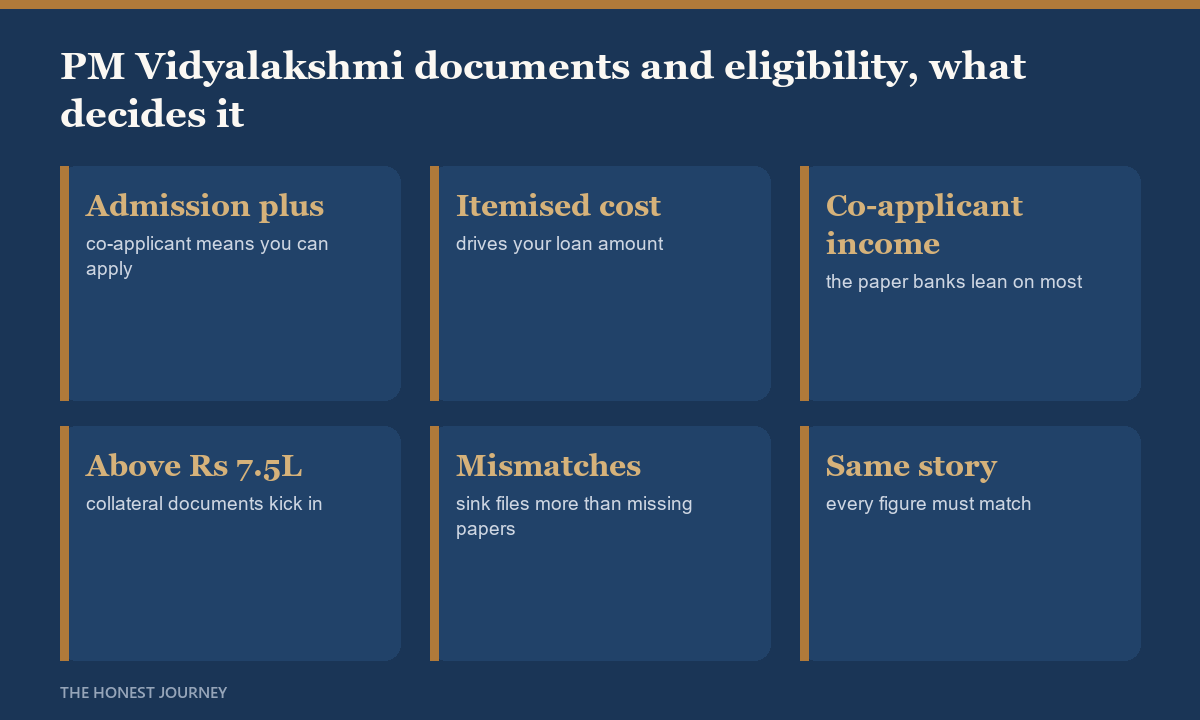
The portal will accept your application with gaps. The bank will reject it on them. That is the whole story of documents and eligibility on PM Vidyalakshmi. Eligibility is broad: an Indian student with a confirmed admission and a co-applicant can apply. The documents are where applications actually live or die, because the bank checks that your admission letter, your cost of study, your academic record and your co-applicant’s income all tell the same consistent story. A clean, matching file gets sanctioned. A file with a mismatch or a missing paper gets a no, no matter how strong the student.
A reader was certain he was ineligible after a rejection, when the real problem was that his cost-of-study figure on the form did not match the university’s own estimate, and his co-applicant’s income proof was a year out of date. Neither was an eligibility failure. Both were document failures, and both were fixable in a day. He had read a paperwork gap as a verdict on whether he deserved a loan. The bank was not judging him. It was checking whether the numbers added up, and they did not. Once they did, he was sanctioned. Documents are not bureaucracy for its own sake. They are the thing the decision is actually made on.
This guide covers who is eligible, the exact document set the portal and bank expect, the difference between the collateral and non-collateral document lists, and the mismatches that quietly cause rejections. If you have already been declined, pair this with the loan rejected guide, and for what the final approval paper must contain, see the sanction letter and proof of funds guide.
Who is eligible
Eligibility for a PM Vidyalakshmi loan is not the hard part. In broad terms you qualify if you are an Indian national, have secured admission to a recognised course and institution, and can provide a co-applicant, usually a parent or guardian. There is no community or income bar to applying for the loan itself, unlike the subsidy schemes, which have their own separate ceilings. Age and course-recognition conditions apply and vary by bank, but the core requirement is simple: a real admission and a co-applicant. If you have those, you can apply. Whether you are sanctioned comes down to the documents and the co-applicant’s financial profile.
The core document set
Every application needs the same foundation, regardless of bank:
- KYC and identity. Aadhaar, PAN and photographs for both the student and the co-applicant.
- Admission proof. The confirmed admission or offer letter from the university.
- Cost of study. An itemised statement of tuition, living costs, travel and insurance, matching what the university publishes. This figure drives your loan amount, so it has to be defensible.
- Academic records. Mark sheets and certificates from Class 10 onward, plus test scores where relevant.
- Co-applicant income proof. Recent salary slips, income tax returns or business income proof, and bank statements. This is what the bank leans on most, so it must be current and complete. The co-applicant guide covers what makes a strong one.
Collateral versus non-collateral document lists
The document set forks based on loan size. Below roughly 7.5 lakh, most loans are non-collateral, and the core set above is usually enough. Above that, public sector banks typically require collateral, which adds a second document layer: property title deeds, a valuation report, an encumbrance certificate proving the property is free of dispute, and often approval of the property by the bank’s panel. This is where many applications stall, because the property is in another relative’s name, the title is unclear, or the paperwork is incomplete. If collateral is your obstacle, the no-collateral route is worth reading before you fight it.
The mismatches that quietly cause rejections
Most document rejections are not missing papers, they are inconsistent ones. The bank cross-checks figures, and a discrepancy reads as a red flag:
- A cost-of-study figure on the form that does not match the university’s own estimate.
- A loan amount that is larger than the itemised costs justify.
- Co-applicant income proof that is out of date or does not match the tax returns.
- Names or dates that differ across documents, often from a spelling variation in one place.
Before you submit, lay the documents side by side and confirm every number and name matches across all of them. This one check removes the most common reason a strong application is declined.
The upload rules that waste people an evening
These are in the official student manual and nowhere on most guides. They are worth knowing before you start scanning anything.
| Rule | Detail |
|---|---|
| Accepted formats | PDF, PNG or JPEG only |
| Size limit | 200 KB per file, no exceptions |
| Mandatory files | Anything marked with an asterisk on the upload screen |
| Course selection | Must match the allotment letter issued by the college |
| Income certificate | Issued by a public authority, or Annexure-6 from the institute |
| Repayment entry | Instalments capped at 180, which is the 15 year ceiling |
A 200 KB ceiling on a scanned degree certificate is tight. Scan in greyscale at 150 dpi rather than colour at 300, and the same document lands around 120 KB without becoming unreadable.
When you still have to provide security
The collateral-free promise is real but conditional. Per the official manual, you are asked for security or guarantor details when your institute is not on the QHEI list, or your admission is under management or NRI quota, and the loan exceeds 7.5 lakh rupees. Below that line the government credit guarantee covers 75 percent of the bank’s exposure, which is why banks stop asking.
One more ceiling people trip over: a vocational course caps out at 7.5 lakh rupees regardless of anything else.
The mismatch that quietly causes rejections is the course name. Students pick the closest sounding option from the dropdown instead of the exact one on the allotment letter. The manual states plainly that incorrect details may cause the bank to reject the application and may affect eligibility for both PM-Vidyalaxmi and CSIS. Check your institute on the official QHEI directory first.
The honest closing take
Eligibility gets the attention and the documents do the deciding. Almost any Indian student with a real admission and a co-applicant is eligible to apply, so eligibility is rarely why people are turned down. They are turned down because a figure did not match, a paper was out of date, or the collateral was not clean. The portal’s willingness to accept an incomplete form hides this until the bank finds the gap. Build a file where every number tells the same story, keep the co-applicant’s proofs current, and know before you apply whether your loan size will trigger the collateral layer. A consistent file is worth more than a strong profile with a careless application.
FAQ
Who is eligible for a PM Vidyalakshmi education loan?
Broadly, any Indian national with a confirmed admission to a recognised course and institution, plus a co-applicant such as a parent or guardian. There is no community or income bar to applying for the loan itself. Sanction then depends on the documents and the co-applicant’s financial profile.
What documents do I need for the portal application?
KYC and identity for student and co-applicant, the admission letter, an itemised cost of study, academic records from Class 10 onward, and the co-applicant’s income proof and bank statements. Loans above about 7.5 lakh usually add collateral documents.
When do I need collateral documents?
Typically for loans above roughly 7.5 lakh at public sector banks. Those add property title deeds, a valuation report and an encumbrance certificate. If the property is disputed or in another relative’s name, this is where applications stall, so consider the no-collateral route.
Why do complete applications still get rejected?
Usually because the documents are inconsistent rather than missing: a cost figure that does not match the university, a loan amount larger than the costs justify, or out-of-date income proof. Lay everything side by side and confirm all figures and names match before submitting.
Does the portal check my documents before the bank?
No. The portal accepts your form even with gaps. The real check happens at the bank, which is why a file that looks submitted can still be rejected. Make it consistent before it reaches the bank.