Short answer. The portal is the only route to the 3 percent interest subvention and the 75 percent credit guarantee, so if you are at a listed QHEI it is not really optional. Going direct is faster and leaves you free to walk away. The portal caps you at three banks and makes exits harder once a bank has touched the file.
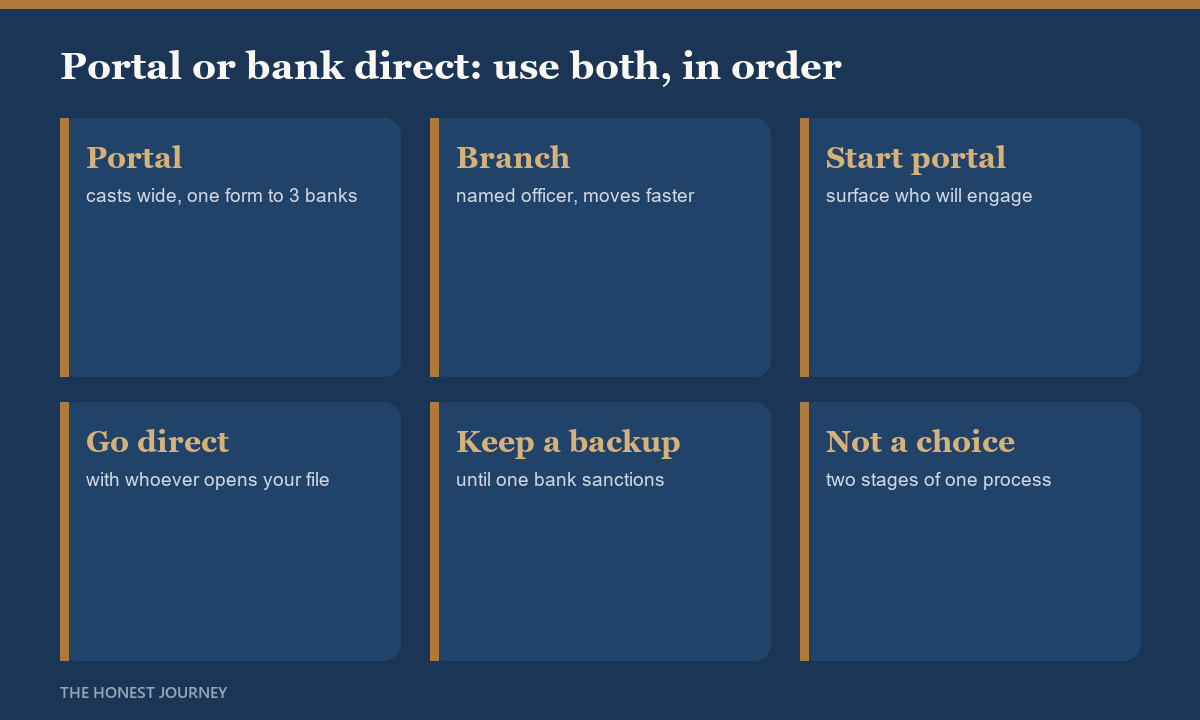
You do not have to choose. The Vidya Lakshmi portal is best for casting wide early, one form reaching up to three banks, so you find out quickly which lenders will engage. Applying directly at a branch is best once a bank is serious, because a named officer and a real relationship move faster than a portal queue. The honest approach is to use both in order: start on the portal to surface your options, then go direct with whichever bank actually opens your file. Using only one is how people either lose time or lose leverage.
A reader asked me which was better as if it were a fork in the road. It is not a fork. He had spent three weeks refreshing a portal status while the branch two kilometres away had never been visited. The portal had done its job, routing his application to a bank, but the bank needed a person in front of an officer to move, and no one had gone. The moment he walked in with his application number, the file progressed. The portal and the branch are two stages of the same process, not two competing choices, and the students who finish fastest use each for what it is good at.
This guide compares what the portal does well, what the direct branch route does well, and the sequence that uses both. If you have not yet chosen which banks to target, read the portal bank list guide, and for the full honest picture of the scheme, start with the PM Vidyalakshmi portal overview.
What the portal does well
The portal’s strength is reach with low effort. You fill the Common Educational Loan Application Form once and send it to up to three banks at the same time, instead of repeating identical paperwork at three branches. That is genuinely useful early, when you do not yet know which bank will fund your country, course and collateral profile. It surfaces interest quickly and lets you compare which lenders respond. As a discovery tool at the start of the process, nothing beats it.
Its weakness is that it is a submission system, not a relationship. It routes your file and then shows you a vague status. It cannot advocate for your case, cannot answer a nuanced question about your collateral, and cannot push an officer to open your file. Those things need a person.
What applying directly does well
A direct branch application gives you what the portal cannot: a named officer, a face-to-face conversation, and the ability to explain a case that does not fit a form neatly. If your profile has something to discuss, an unusual co-applicant situation, collateral that needs explaining, a university the bank is unsure about, a real person assessing it beats a queue. Direct applications also tend to move faster once a bank is genuinely interested, because you can follow up in person and remove obstacles as they appear.
Its weakness is effort and reach. Applying directly to several banks means repeating the whole file at each, which is slow, so people usually only do it at one or two. That is fine once you know which banks matter, and wasteful as a way to discover them.
The sequence that uses both
The two are stages, so use them in order:
- Start on the portal. Send the CELAF to three banks from the abroad shortlist. Let it surface which lenders engage. This is your wide, low-effort opening.
- Go direct with whoever engages. The moment a bank shows real interest or your status sits at “under process”, visit that branch with your application number. Put a person on your case. This is where the loan actually moves.
- Keep a second option alive. Do not drop the other portal applications until one bank sanctions. Parallel options are your protection against a single slow or declining bank.
Used this way, the portal gives you breadth and the branch gives you speed, and you never have to bet everything on one channel.
When to skip the portal and go straight to a branch
There is one case for going direct from the start. If you already have a strong existing relationship with a bank, a salary account, a home loan, a long history, that branch may move faster and offer better terms than a cold portal application, because they know your family’s finances. In that situation, start where the relationship already is. For everyone else without that head start, the portal’s wide opening is worth using first.
What each route actually costs you
| Through the portal | Direct to a branch | |
|---|---|---|
| 3 percent interest subvention | Available if family income is under 8 lakh | Not available, the claim runs through the portal |
| 75 percent credit guarantee | Applies on loans up to 7.5 lakh | Not applied |
| Rate ceiling | Capped at the bank EBLR plus 0.5 percent | The bank ordinary rate |
| Banks you can approach | 3 per application | As many as you like |
| Walking away | Self-withdrawal only while status reads Submitted | You simply stop |
The honest read: if your institute is on the QHEI list and your family income is under 8 lakh rupees, the subvention and the guarantee are worth more than the flexibility you give up, and the portal is the route. If your institute is not on the list, the portal is just a slower application form with a three bank cap, and going direct is the better use of your time.
There is one route people miss. Nothing stops you doing both, as long as you keep track. Submit through the portal, then walk into a branch that is not among your three and ask what they would offer outside the scheme. Just close whatever you do not take.
The honest closing take
Framing this as portal versus bank is the mistake. They are not rivals, they are the beginning and middle of the same journey. The portal is the best tool ever built for casting a wide net cheaply, and it is useless at closing. The branch is where loans actually get sanctioned, and it is slow to use for discovery. Open wide on the portal, then walk into the branch of whichever bank bites, and keep a backup alive until you have a sanction in hand. That sequence, not a choice between the two, is how you get funded without wasting weeks.
FAQ
Is it better to apply through PM Vidyalakshmi or directly to the bank?
Neither alone. The portal is best for applying wide early with one form to up to three banks, and the direct branch route is best for moving fast once a bank is serious. Use the portal to surface options, then go direct with whichever bank engages.
Does applying through the portal get me a worse deal than going direct?
No. The portal routes your application to the bank’s own scheme, so the terms are the bank’s terms either way. What direct application adds is a named officer and speed once the bank is interested, not different pricing.
Can I apply on the portal and at the branch at the same time?
Yes, and it is the recommended approach. Start on the portal, then follow up in person at the branch your application was routed to. They are two stages of one process, not conflicting applications.
When should I skip the portal entirely?
Only if you already have a strong relationship with a bank, such as a long-held account or an existing loan. That branch may move faster and offer better terms because they know your finances. Otherwise, the portal’s wide opening is worth using first.
How many banks should I apply to at once?
Use all three portal slots on banks that genuinely fund abroad study, then concentrate your in-person effort on whichever one engages first while keeping the others alive until you have a sanction.