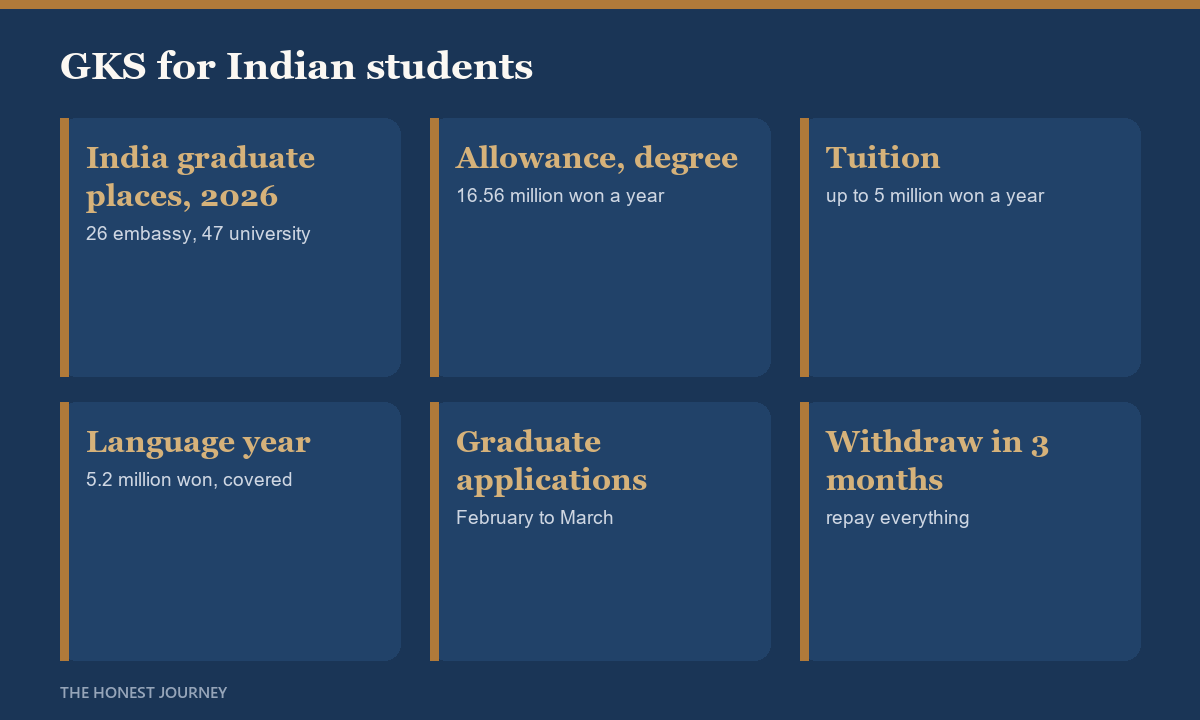
Short answer. The Global Korea Scholarship covers airfare, tuition up to 5 million won a year, a year of Korean language training and a monthly allowance worth 16.56 million won a year on a degree. India had 26 embassy track graduate places in 2026, plus 47 more through universities. Graduate applications open around February; the undergraduate university track runs to November.
The Global Korea Scholarship, GKS, is the Korean government’s flagship award for international students, run by the National Institute for International Education, NIIED. For Indian students it is one of the more reachable fully funded scholarships, because India gets a sizeable country quota rather than competing in a single global pool. It also comes with a condition most guides mention only in passing: unless you already speak Korean well, your first year is spent learning the language before your degree starts.
The figures below come from NIIED’s 2026 application guidelines for graduate degrees and from Study in Korea, the official portal. For other options, see our list of scholarships for Indian students to study abroad.
What GKS pays
| Benefit | Amount, 2026 graduate guidelines |
|---|---|
| Airfare | Economy class ticket, actual cost |
| Tuition | Up to 5 million won a year; the university covers the admission fee |
| Korean language training | 5.2 million won, paid over four quarters |
| Monthly allowance, language programme | 14.4 million won a year |
| Monthly allowance, degree programme | 16.56 million won a year |
| Monthly allowance, research programme | 20.88 million won a year |
The degree allowance works out to 1.38 million won a month. Scholars who arrive with TOPIK level 5 or 6 can skip the language year and receive a Korean proficiency grant instead, with some exceptions set out in the guidelines.
How many places India gets
GKS splits places by country and by route. In the 2026 graduate round, India was allotted 26 places through the embassy track. Through the university track, India had 5 general places and 42 more under R-GKS, a stream for applicants from developing countries that includes India. That is about 73 graduate places in all, one of the larger country quotas in the programme, which is out of roughly 2,000 graduate places worldwide.
| Route | How you apply | India’s 2026 graduate quota |
|---|---|---|
| Embassy track | Through the Korean embassy in India; it recommends candidates to NIIED | 26 |
| University track, general | Directly to a GKS university | 5 |
| University track, R-GKS | Directly to a GKS university, for developing country applicants | 42 |
Who can apply
- Nationality: you and both your parents must hold non-Korean citizenship.
- Age: under 40 for master’s and doctoral degrees; under 25 for undergraduate degrees.
- Marks: for graduate study, your previous degree must show 80 percent or above, or a place in the top 20 percent of your class, or a CGPA of at least 2.64 out of 4.0, 2.80 out of 4.3, 2.91 out of 4.5 or 3.23 out of 5.0. Undergraduate applicants face a similar test: 80 percent, the top 20 percent, or the required CGPA.
- Degree: a completed bachelor’s or master’s degree for graduate study.
Indian transcripts on a 10 point scale do not map neatly onto these. If you are near the line, a class rank certificate from your university can carry you where the percentage cannot, and the guidelines accept a transcript converted to one of the listed GPA scales as supporting evidence. To see your percentage under your own university’s rule, use the CGPA to percentage calculator.
Faz's ruleDo not apply unless you are sure you will go. Withdraw within your first three months and GKS asks for everything back.
The guidelines are blunt about this. A scholar who withdraws within the first three months after enrolling must return the full amount received since selection, which includes the airfare, the settlement allowance, the monthly allowance and tuition. Even after three months, a change in status can mean repaying part of it. If you are holding a GKS offer alongside others, decide before you fly, not after.
The calendar
| Stage | Graduate degrees | Undergraduate degrees |
|---|---|---|
| Announcement | February | September |
| Applications | February to March | Embassy track in September; university track September to November |
| Screening | April to June | October to December |
| Final results | June | December |
The embassy track window is short. For 2026 entry it ran online from 12 to 25 February, two weeks in total. If you are reading this in October or November, the undergraduate university track may still be open at some universities. If you want a master’s, the next round is announced around February, so the months before that are for choosing universities, preparing your study plan and collecting recommendation letters. Our guide to recommendation letters covers what referees should actually write.
Embassy track or university track?
On the embassy track you apply once, through the Korean embassy, and can list up to three universities for undergraduate study, including at least one from the Type B list of universities outside the most competitive group. On the university track you apply straight to one GKS university, which screens you before NIIED does. The university track has the larger Indian quota at graduate level, mostly through R-GKS. The tracks also interact: under the 2026 rules, applicants who do not pass the first round of the embassy track may then apply through a university, as long as they can still meet that university’s deadline, but candidates selected or held in reserve on the embassy track cannot.
The honest closing take
GKS is one of the more realistic fully funded awards for Indian students, because India has a real quota and two routes in. The parts that trip people up are not the competition. They are the short embassy window, the language year that adds twelve months to your plans, and the repayment rule if you change your mind early.
If you can commit to Korea, a year of language included, it is worth a serious application. Shortlist universities from the official list well before February, check your marks against all three academic tests rather than only the 80 percent figure, and decide in advance whether you will use the embassy track, the university track or both in sequence.
FAQ
Is GKS fully funded?
Close to it. It pays airfare, tuition up to 5 million won a year, language training and a monthly allowance. If your programme’s tuition is above the cap, the difference is not covered, so check the fee before you apply.
Do I need IELTS or TOPIK for GKS?
Neither is a blanket requirement, but scores earn points in the evaluation, for example TOEFL iBT 95 or IELTS 7.0 and above score higher than lower bands, and some universities set their own minimums. TOPIK level 5 or 6 lets you skip the language year. For English test choices, see our IELTS, TOEFL, PTE and Duolingo comparison.
How many Indian students get GKS?
For graduate degrees in 2026, India’s quota was 26 on the embassy track and 47 on the university track, so about 73 places. Undergraduate quotas are smaller and set separately.
What is the age limit for GKS?
Under 40 for master’s and doctoral programmes, born after 1 September 1986 for the 2026 round, and under 25 for undergraduate programmes. Current academic professors from eligible countries can apply for graduate study up to 45.
Can I apply through both the embassy and a university?
Not at the same time in practice. Under the 2026 rules, applicants who do not pass the first round of the embassy track may apply through a university afterwards, if that university’s deadline allows. Candidates selected or held in reserve on the embassy track cannot.
Where these figures come from
- Study in Korea, Global Korea Scholarship programmes
- NIIED, 2026 Global Korea Scholarship application guidelines for graduate degrees
Checked against the sources above in October 2026. GKS revises its quotas and allowances every year, so confirm in the current notice.