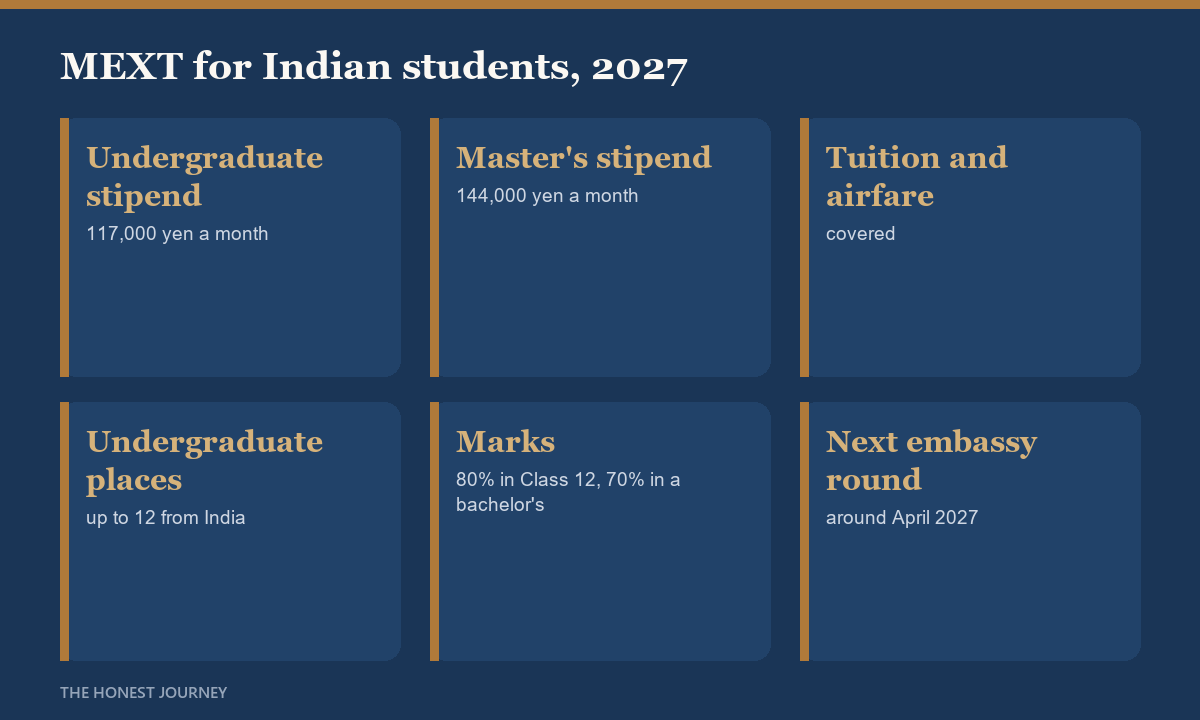
Short answer. The MEXT scholarship pays tuition, return airfare and a monthly stipend of 117,000 yen for undergraduates and 144,000 yen for master’s students. Indian applicants apply through the Embassy of Japan, which takes applications once a year in April and May. The 2027 round has closed, so the next window is around April 2027.
The Japanese Government scholarship, known everywhere by the name of the ministry that funds it, MEXT, is one of the few fully funded awards an Indian student can get for a bachelor’s degree, not only a master’s. It covers tuition, flights and a monthly stipend, and there is no application fee. The catch is the calendar. The embassy route opens once a year, for a few weeks, roughly a year and a half before you would arrive in Japan, and most students hear about it after it has closed.
This guide uses the Embassy of Japan in India’s own 2027 pages, so the figures are the ones Indian applicants actually face. If you are comparing awards, start with our list of scholarships for Indian students to study abroad and the fully funded scholarships that genuinely cover everything.
What MEXT pays
| Category | Monthly stipend | Tuition | Travel |
|---|---|---|---|
| Undergraduate students | 117,000 yen (about ₹68,800) | Exempted | Return airfare |
| Research students, preparatory stage | 143,000 yen (about ₹83,100) | Exempted | Return airfare |
| Research students, enrolled in a master’s | 144,000 yen (about ₹84,700) | Exempted | Return airfare |
| Research students, enrolled in a doctorate | 145,000 yen (about ₹85,300) | Exempted | Return airfare |
Because tuition is waived and the stipend is paid every month, MEXT is one of the rare awards where you may not need an education loan at all. You still need money before you leave, for the visa, the first weeks of rent and anything the stipend does not cover in its first month.
The two ways in: embassy or university
There are two routes to the same scholarship. Under embassy recommendation, you apply to the Embassy of Japan or a Japanese consulate in India, sit a written test and an interview, and if you are recommended, MEXT places you at a university. Under university recommendation, a Japanese university that has already accepted you, usually through a professor willing to supervise you, nominates you to MEXT directly. The embassy says plainly that all MEXT applications go through embassies, consulates or Japanese universities, and nowhere else.
For most Indian applicants the embassy route is the realistic one, because it does not depend on already having a Japanese professor on your side. The university route suits research applicants who have been in touch with a lab for months.
Undergraduate: who qualifies
- Age: born on or after 2 April 2002, for the 2027 round.
- Marks: at least 80 percent in Class 12 if you have already finished it. If you are still in Class 12, 80 percent in Class 10 plus a school certificate saying you are expected to score above 80 percent.
- Fields: social sciences and humanities, or natural sciences, including engineering, agriculture and pharmacy. Medicine and dentistry are not offered to applicants from India, and art and music are excluded.
- Places: up to 12 applicants from India go forward to the final MEXT selection.
- Language: preference goes to candidates with some Japanese. Most undergraduates spend a first year in preparatory education, Japanese language included, so the scholarship runs five years.
If your school reports grades rather than marks, convert them using your board’s own formula; CBSE, for example, multiplies CGPA by 9.5. The CGPA to percentage calculator has the rules for CBSE and the major universities.
Research students: the master’s and PhD route
- Age: under 35, which in principle means born on or after 2 April 1992 for the 2027 round.
- Marks: a bachelor’s in a relevant field with at least 70 percent, or 65 percent in humanities and social sciences. For the second phase of a doctorate, a master’s with 70 percent plus research, teaching or work experience.
- Fields: twenty listed areas, from humanities and economics to computer science, robotics, aerospace and civil engineering.
- Start: April, September or October 2027, often first as a non-regular research student before entering a degree programme.
Faz's ruleRead the preliminary form rules twice. The embassy rejects the file automatically if it is anything but a Word document under 1 MB.
For 2027, the research student round started with a one page preliminary application, emailed to the embassy as a Microsoft Word file no larger than 1 MB. PDFs, scans, Google Docs links and PowerPoint files were rejected without being read, and so was anything that arrived after 11.59 pm on 15 May. Strong candidates lose their year to a file format. It costs nothing to get this right.
The calendar, and why it catches people out
| Stage | Research students, 2027 round | Undergraduates, 2027 round (New Delhi) |
|---|---|---|
| Applications | 20 April to 15 May 2026 | 23 April to 25 May 2026 |
| Written examination | 5 July 2026 | 20 June 2026 |
| Interview | 16 to 19 July 2026, online | 22 June 2026, online |
| Arrival in Japan | April, September or October 2027 | April 2027 |
You apply about a year before you would start, and the window is a few weeks long. The 2027 round has closed for both categories. If the pattern holds, the round for 2028 entry opens in late April 2027; the embassy posts the new guidelines on its scholarship page shortly before. Use the months in between to prepare: the embassy publishes past written examination questions, and the subjects tested depend on your field.
Undergraduate applications go to whichever office covers your state: the consulates in Kolkata, Chennai, Mumbai or Bengaluru, or the embassy in New Delhi for the rest of India. They are sent by post, courier or by hand. Email applications are not accepted for undergraduates.
If MEXT does not come through
Twelve undergraduate places for a country of India’s size means most strong applicants will not get one. Plan the alternative at the same time. Japanese universities offer their own fee waivers, and other governments run similar programmes: Korea’s Global Korea Scholarship gives India dozens of places a year, and Europe has Erasmus Mundus and DAAD. If you end up self funding part of the cost, an interest free loan scholarship from an Indian trust is usually cheaper than a bank loan; our comparison of JN Tata, KC Mahindra and Narotam Sekhsaria explains how they work.
The honest closing take
MEXT is generous and genuinely open to Indian students, and it is free to apply. What it is not is forgiving of timing. The embassy round opens once a year for a few weeks, about eighteen months before you would land in Japan, and it asks for a file in a precise format. Most people who miss it do not lose on merit. They lose on the calendar.
So treat it as a project with a fixed start date. If you want to begin a degree in Japan in 2028, the work starts now: marks checked against the cutoff, a research plan drafted, past written papers practised, and an alert set for the embassy’s scholarship page from March 2027.
FAQ
Is there an application fee for MEXT?
No. The embassy states that no application fee is charged, and that any organisation or person asking for a fee or a deposit has no connection with the Japanese Government.
Do I need to know Japanese for MEXT?
Not to apply, but it helps. Undergraduate candidates with Japanese are given preference, and most undergraduates spend a preparatory year learning the language before university. Research students can work in English if their supervisor and programme allow it.
How many Indian students get MEXT?
For undergraduate study, up to 12 applicants from India pass the first screening and go forward to the final MEXT selection. The number of research student places is announced each year by the embassy.
When is the last date for MEXT 2027?
It has passed. Embassy applications for 2027 entry closed on 15 May 2026 for research students and 25 May 2026 for undergraduates in New Delhi. The next embassy round, for 2028 entry, is expected around April and May 2027.
Can I apply for MEXT after graduation?
Yes, as a research student, if you meet the age limit and the marks requirement: a bachelor’s with at least 70 percent, or 65 percent in humanities and social sciences, and you must be under 35. Final year students can apply if they will have their degree before the stated date, 30 September 2027 for the October 2027 batch.
Does MEXT cover medicine for Indian students?
No. Medicine and dentistry are not offered to undergraduate applicants from India under the embassy route for 2027.
Where these figures come from
- Embassy of Japan in India, Japanese Government (MEXT) scholarships
- Embassy of Japan in India, research students for 2027
- Embassy of Japan in India, undergraduate students for 2027
- Study in Japan, past MEXT examination questions
Checked against the sources above in October 2026.