Short answer. For an Indian student, Singapore’s Student’s Pass is the visa you study on, and it starts with your institution registering you in ICA’s SOLAR+ system after you accept admission. You then file the e-Form 16, do a medical, and show proof of funds.
Fees run about SGD 30 to apply, SGD 60 to issue, and SGD 30 for a multiple-journey visa if needed. At ₹62 per SGD, that is roughly ₹7,400.
A cousin of a friend got into a Singapore university for a Master’s and spent two weeks panicking about the visa, refreshing the embassy website, asking around for an agent. Then his admissions office emailed him a SOLAR+ reference number and told him to log in and fill the form. That was it. The thing he had been dreading was already half done, because in Singapore the institution drives the registration, not you running around an embassy. His real lesson came later: ICA is fast, but it does not forgive a missing document or a late upload.
This post stays strictly in the visa lane. It is the Student’s Pass, the SOLAR+ route, the e-Form 16, the IPA letter, the fees, the funds proof, the medical, and the work rules. If you want admissions, course choice and the wider Singapore picture, including the MOE Tuition Grant and its service bond, that lives in the study in Singapore for Indian students guide. Here we only talk about the pass.
What the Student’s Pass actually is
Singapore does not issue a separate “student visa” the way the UK or the US does. The document you study on is the Student’s Pass, an immigration pass administered by the Immigration and Checkpoints Authority, ICA. It is the legal permission that lets you reside in Singapore for the duration of your course at an approved institution. Every full-time international student at a registered school, polytechnic or university holds one.
The most important thing to understand, and the thing that confuses Indian applicants used to the embassy model, is that you do not start this process. Your institution does. Once you accept your admission offer, the school registers your application in ICA’s electronic system called SOLAR+, the Student’s Pass Online Application and Registration system. Only after that are you invited to log in and complete your part. So the timeline is admission first, institution registration second, your submission third. You cannot jump the queue or apply cold to ICA on your own.
As of the 2026 intake the fees, the forms and the steps are as I lay them out below, but ICA updates these between intakes, so treat every figure here as a planning number and confirm the current figure on ica.gov.sg before you pay anything.
The fees, in INR
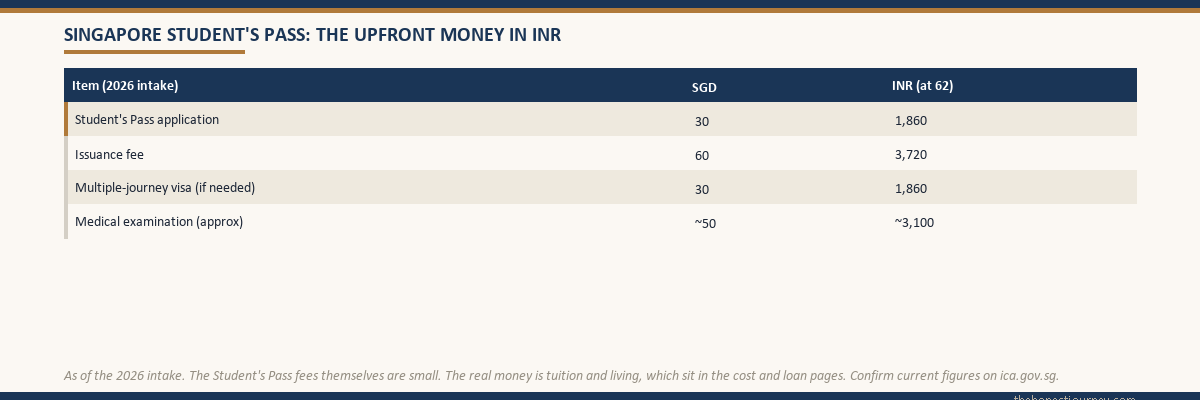
Let me put the money on the table first, because the rest is process. The planning rate through this article is ₹62 per SGD. It moves, so re-check it the week you pay. These are the core Student’s Pass charges, not your tuition or living costs, which belong to the cost and study-in pages.
| Fee (per applicant) | SGD | INR (at 62) |
|---|---|---|
| Application / processing fee | 30 | ~1,860 |
| Issuance fee (when pass is granted) | 60 | ~3,720 |
| Multiple-journey visa (if required) | 30 | ~1,860 |
| Medical examination (varies by clinic) | ~50 to 120 | ~3,100 to 7,440 |
| Core pass fees (excl. medical) | ~120 | ~7,440 |
So the Student’s Pass itself is genuinely cheap by international-student standards. The SGD 30 application fee plus the SGD 60 issuance fee are the two charges everyone pays. The SGD 30 multiple-journey visa is only relevant if your nationality requires an entry visa to re-enter Singapore after travelling, which many Indian students will want so they can fly home and return without re-applying. The medical exam is a separate, variable cost. Compared with a UK Student visa where the health surcharge alone runs into lakhs, Singapore’s pass cost is a rounding error against your tuition.
Faz's ruleThe pass is cheap, but the documentation is not forgiving. Singapore charges you almost nothing for the Student's Pass and makes up for it by being merciless about deadlines and document accuracy.
People hear “SGD 30 to apply” and relax. The cost is trivial. The risk is the upload window. ICA expects clean, complete, correctly named documents inside the timeline your institution sets, and a single missing page can stall the whole pass. Treat the paperwork with the seriousness the fee does not demand of your wallet.
The SOLAR+ route, step by step
Here is the actual sequence, the one your admissions office will walk you through, written out so you know what is coming before the emails arrive.
Step one, your institution registers you in SOLAR+. After you firmly accept your offer, the school enters your details into ICA’s SOLAR+ system. This generates a registration acknowledgement with a reference number and a link for you to log in. You cannot do this part. You wait for it. The lag between accepting your offer and receiving this is the first place timelines slip, so chase your admissions office if it is quiet.
Step two, you submit the e-Form 16 and supporting documents. Logging in with the SOLAR+ reference, you complete the Student’s Pass application form, historically known as the e-Form 16, online. You attach a recent passport-style photo, your passport bio page, the school’s acceptance details, and the financial and personal documents requested. Accuracy here is everything. The name on every document must match your passport exactly.
Step three, you receive the In-Principle Approval letter. Once ICA assesses your application, it issues an In-Principle Approval, the IPA letter. This is the document that matters most before you travel. The IPA acts as a single-entry visa that lets you enter Singapore. You carry it, print it, and show it at the checkpoint on arrival. Without the IPA you do not board and you do not enter.
Step four, you complete formalities and collect the card. After arriving in Singapore you complete the remaining steps: the medical examination if not already done, and an appointment at ICA to have the physical Student’s Pass card issued, where your photo and thumbprint are taken. This is when the SGD 60 issuance fee applies and the actual pass card is produced.
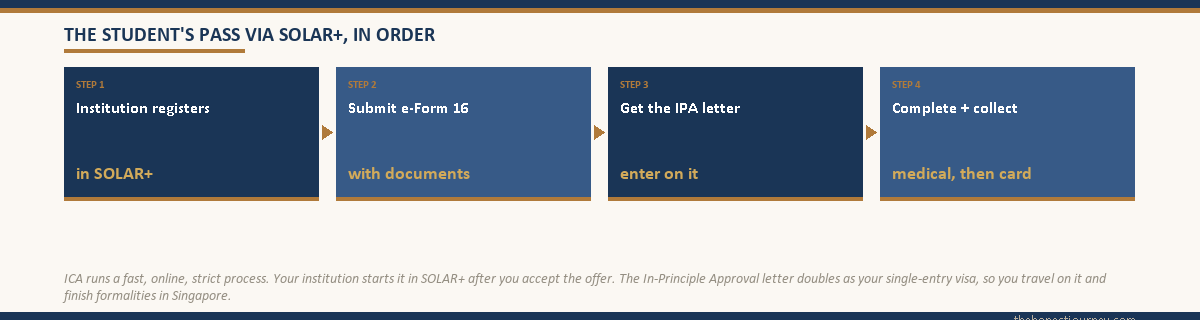
That four-step shape is the whole process. Notice how front-loaded it is on the institution and how clean the rest is once you are in the system. The official, current version of every step is published by ICA on ica.gov.sg, the only source you should trust over an agent.
Proof of funds: what you actually show
Singapore does not publish a single fixed bank-balance figure the way Germany’s blocked account or the UK’s maintenance rule does. What ICA and your institution want is credible evidence that you can support your studies and living costs in Singapore. In practice that means documentation showing your tuition is funded and that you have access to living expenses for your time there.
The documents that establish this are typically bank statements, a financial undertaking from a parent or sponsor, proof of any scholarship or loan sanction, and the receipts or sanction letters that show your tuition is arranged. Because the exact figure is not a public flat number, the honest planning move is to be able to show comfortably more than a year of tuition plus living costs in accessible funds. The funds-proof breakdown below shows the categories assessors look at, not a fixed amount, because the amount tracks your specific course and institution.
| Funds-proof element | What it demonstrates |
|---|---|
| Bank statements (applicant or sponsor) | Liquid funds available for fees and living |
| Sponsor’s financial undertaking | A named person commits to supporting you |
| Tuition payment or loan sanction | The fee side is arranged, not hoped for |
| Scholarship award letter (if any) | Reduces the funds you must self-evidence |
If you are assembling this with a loan, the sanction letter is part of your funds story, and how a Singapore education loan is structured for Indian families sits in the education loan for Singapore post. If a scholarship is in play, the routes are covered in the scholarships for Indian students guide. The broader question of how families build the whole funding pot, savings plus loan plus scholarship, is in the studying abroad cost and funding guide. The mechanics of presenting funds cleanly to any immigration authority are in the proof of funds for a student visa post.
Faz's ruleSingapore reads your funds for credibility, not a magic number. There is no single balance to hit, so the goal is a clean, consistent, well-sourced financial story rather than a last-minute lump sum.
Because ICA does not publish one flat figure, people either over-stress about a number that does not exist or under-prepare because there is no obvious bar. Neither is right. Show funded tuition, accessible living money, and a named sponsor whose statements look settled, not freshly stuffed. Consistency reads as genuine. A sudden deposit reads as borrowed for show.
The medical examination
A medical examination is part of the Student’s Pass process. The exact requirements depend on your course and length of stay, but a standard medical, typically including a chest X-ray and an HIV test, is the common shape for a full-time student staying beyond a short period. Some institutions accept a medical done in India on a prescribed form before you travel, while others require it to be completed in Singapore at an approved clinic after arrival, as part of the final formalities before the pass card is issued.
The practical advice is simple. Ask your institution which route applies before you book anything, because doing the medical on the wrong form or at the wrong time is a classic cause of delay. The cost varies by clinic, which is why the fees table gives a range. Confirm the current requirement for your category on ica.gov.sg.
Processing time and the honest reality
Singapore’s process is, by global student-visa standards, fast and clean. Once your institution has registered you in SOLAR+ and you have submitted a complete e-Form 16 with correct documents, the In-Principle Approval often comes through in a matter of weeks, not months. There is no consular interview to clear, no make-or-break appointment of the kind the US F-1 demands. The system is online, structured, and predictable.
That said, smooth is not the same as lenient. The whole reputation of being fast rests on you doing your part exactly right. ICA is strict on documentation and on timelines. The common failure modes are not dramatic refusals on intent, the way Canada or the US refuse people. They are mundane: a document that does not match your passport name, a blurry upload, a missed window your institution set, a medical done on the wrong form. Fix those and Singapore is one of the least stressful student-visa processes an Indian student can go through. Ignore them and the speed works against you, because there is no slow, forgiving back-and-forth to save a sloppy file.
Plan to have every document ready before your SOLAR+ login arrives, so that when it does, you submit a clean file the same week. The applicants who struggle are almost always the ones who start gathering documents after the registration lands, not before.
Working on the Student’s Pass
Work rights on the Student’s Pass are real but limited, and they vary by the type of institution. Students enrolled full-time at approved institutions, which includes the autonomous universities and certain other approved schools, may work up to 16 hours per week during term time, and may work full-time during scheduled vacation periods. The 16-hour cap is the figure to hold in your head for term-time work.
The honest framing is the same as everywhere else I write about. Sixteen hours of part-time work is a living-cost supplement, not a tuition fund. Singapore is an expensive city, and term-time earnings will help with day-to-day expenses, not close a funding gap. Never present part-time work to a bank, to ICA, or to yourself as the thing that pays for your degree. Plan your tuition and core living as funded before you arrive, and treat work as breathing room. Confirm whether your specific institution qualifies for these work rights, because not every school’s students are eligible, and the rules are published by ICA.
The MOE Tuition Grant: mention, not deep-dive
One thing many Indian students considering Singapore run into is the MOE Tuition Grant, a subsidy from Singapore’s Ministry of Education that lowers tuition substantially. It is genuinely attractive on cost, but it is not free. Accepting the Tuition Grant carries a service bond, an obligation to work for a Singapore-registered company for three years after you graduate. That is a real commitment, not a footnote, and it changes the whole calculus of studying in Singapore.
The Tuition Grant and its bond belong to the cost-and-decision conversation, not the visa lane, so I am only flagging it here. The full picture of how the grant works, what the bond means for your career plans, and whether it is worth it, sits in the study in Singapore guide. The official terms are published by the Ministry of Education on moe.gov.sg. For the purpose of your Student’s Pass, just know the grant exists, the bond is three years, and you should decide on it with eyes open before you sign.
The honest take on the Singapore Student’s Pass
Of all the student-visa routes I write about, Singapore’s is among the most painless to actually navigate. There is no embassy queue, no nerve-wracking interview, no enormous health surcharge, and the institution does the heavy lifting of registration. The fees are small, the process is online, and approvals are fast. For an Indian student used to horror stories about visa stress, the Student’s Pass is a relief.
The catch is precision. Singapore trades speed for strictness. The system rewards a clean, complete, on-time file and quietly punishes a sloppy one, because there is no drawn-out human process to rescue mistakes. So prepare everything before your SOLAR+ login arrives, match every document to your passport, hit every deadline your institution sets, and decide the Tuition Grant bond question separately and deliberately. Do that, and Singapore is one of the smoothest doors into a world-class degree an Indian student can walk through.
FAQ
What is the Student’s Pass for Singapore?
The Student’s Pass is the immigration pass issued by Singapore’s Immigration and Checkpoints Authority, ICA, that lets an international student reside in Singapore for the duration of a full-time course at an approved institution. It is not called a “student visa” in Singapore, but it serves the same purpose. Every full-time international student at a registered school, polytechnic or university holds one, and your institution registers your application in ICA’s SOLAR+ system after you accept admission.
How does the SOLAR+ application process work?
After you accept your offer, your institution registers you in ICA’s SOLAR+ system, which generates a reference number and login link. You then log in and submit the e-Form 16 with your passport, photo and supporting documents. ICA assesses it and issues an In-Principle Approval letter that acts as a single-entry visa to enter Singapore. After arrival you complete the medical and an ICA appointment to collect the physical pass card. Confirm the current steps on ica.gov.sg.
How much does the Singapore Student’s Pass cost?
As of the 2026 intake the core charges are about SGD 30 for the application, SGD 60 for issuance when the pass is granted, and SGD 30 for a multiple-journey visa if your travel needs it. At ₹62 per SGD that is roughly ₹7,400 for the core pass fees, plus a variable medical examination cost. Compared with most destinations this is very cheap, but confirm the current figures on ica.gov.sg before you pay.
How much money do I need to show for a Singapore Student’s Pass?
Singapore does not publish a single fixed balance figure. Instead ICA and your institution want credible evidence that your tuition is funded and that you can cover living costs for your stay. That typically means bank statements, a sponsor’s financial undertaking, and proof of any loan or scholarship. The honest planning move is to show comfortably more than a year of tuition plus living costs in accessible, settled funds, so your financial story reads as genuine rather than freshly arranged.
Is a medical examination required for the Student’s Pass?
Yes, a medical examination is part of the Student’s Pass process, typically including a chest X-ray and an HIV test for a full-time student. Some institutions accept a medical done in India on a prescribed form before you travel, while others require it in Singapore at an approved clinic after arrival. Ask your institution which route applies before booking, because doing it on the wrong form or at the wrong time is a common cause of delay. Confirm requirements on ica.gov.sg.
How long does the Singapore Student’s Pass take to process?
Singapore’s process is fast by global standards. Once your institution has registered you in SOLAR+ and you submit a complete e-Form 16 with correct documents, the In-Principle Approval often comes through in weeks, not months. There is no consular interview to clear. The speed depends entirely on a clean file, though, because ICA is strict on documentation and timelines, and there is no slow back-and-forth to rescue a sloppy or incomplete application.
Can I work part-time on a Singapore Student’s Pass?
Students enrolled full-time at approved institutions, including the autonomous universities and certain other approved schools, may work up to 16 hours per week during term time and full-time during scheduled vacations. The 16-hour cap is the term-time figure to remember. Treat this as a living-cost supplement, not a tuition fund, because Singapore is expensive and part-time earnings will not close a funding gap. Confirm whether your specific institution qualifies, since not every school’s students are eligible.
What is the MOE Tuition Grant service bond?
The MOE Tuition Grant is a subsidy from Singapore’s Ministry of Education that lowers tuition substantially, but accepting it carries a service bond requiring you to work for a Singapore-registered company for three years after graduation. It is a real commitment that changes the calculus of studying in Singapore. The grant and bond belong to the cost-and-decision side, so review the full picture in the study in Singapore guide and the official terms on moe.gov.sg before signing.
Faz · The Honest Journey · 2026