Short answer. Studying in Singapore as an Indian student means a top-ranked degree from NUS, NTU or SMU, a Student Pass from the ICA, and an all-in cost of roughly ₹38 to 42 lakh for a one-year non-subsidised Master’s at a planning rate of ₹62 per Singapore dollar.
The MOE Tuition Grant can cut that tuition sharply, but it comes with a three-year service bond to work in Singapore after you graduate.
A friend’s younger sister finished a one-year Master’s at NTU last year. She loved the city, walked into a good analytics role inside two months, and pays nothing in rupee terms on the tuition that scared her family at the start, because she took the MOE Tuition Grant. What nobody explained to her clearly upfront was the catch attached to that grant: a three-year bond to work for a Singapore-registered employer. She is happy to stay, so it worked out. For a student who wanted to come home to India straight after, it would have been a problem.
This is the honest, end-to-end picture of studying in Singapore from India. The universities, the Student Pass, the real cost in rupees, the grant and its bond, work rules, the job market, and the plain question of whether it is worth it. The funding-product side, which banks lend and how much, sits in a separate companion piece on the education loan for Singapore.
The universities: NUS, NTU and SMU
Singapore is a small country with a short, deep list of universities that matter for an international student. Three carry the weight for most Indian applicants.
- National University of Singapore (NUS). The flagship, consistently top of Asian rankings, strong across engineering, computing, business and the sciences. Admissions are competitive and lean heavily on academics. The official programme list and entry requirements sit on nus.edu.sg.
- Nanyang Technological University (NTU). The other research heavyweight, especially strong in engineering, computing and materials. Comparable selectivity to NUS.
- Singapore Management University (SMU). Smaller, city-centre, focused on business, economics, law and information systems, with a seminar-style teaching model that suits some students far better than a large lecture hall.
Admissions are driven by your academic record, your GRE or GMAT where the programme asks for it, your statement and references, and for some programmes relevant work experience. There is no single national application portal: you apply to each university directly through its graduate admissions system. Deadlines for the August intake usually fall between November and February, so the timeline is earlier than many Indian students expect.
One honest point. Singapore’s universities are genuinely selective and the cohort is strong, with students from across Asia and beyond. A degree from NUS or NTU carries real weight with employers in Singapore and the wider region. It is not a soft option you fall into; it is a place you earn.
The Student Pass from the ICA
Every international student studying full-time in Singapore needs a Student Pass, issued by the Immigration and Checkpoints Authority. The university sponsors your application through the ICA’s Student’s Pass Online Application and Registration system once you accept your offer. The official process is on ica.gov.sg.
The sequence is straightforward. You accept the offer, the university registers you in the ICA system, you submit your forms and documents, you receive an in-principle approval letter, you travel, and you complete the formalities and collect the pass after you arrive. Among the documents the process expects is evidence that you can fund your studies and living, so the proof-of-funds question matters here just as it does for other destinations. The general approach to that is in the post on proof of funds for a student visa.
The Student Pass is tied to your enrolment. It is not a general work or residence permit. It allows the limited part-time work described below during term and full-time work in the official vacation periods, and it lapses when your course ends, at which point you move to a different pass if you stay on to work.
The real cost in INR
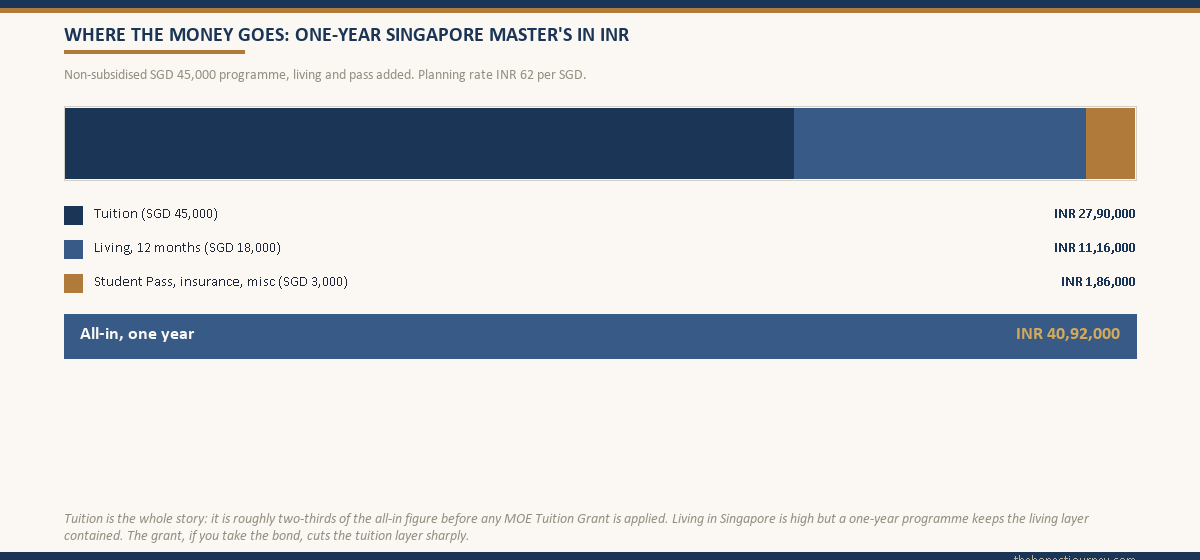
Here is the honest money picture, before any grant. Tuition for a non-subsidised Master’s at NUS, NTU or SMU typically runs SGD 30,000 to SGD 50,000 for the programme, depending on the field. Take a mid case of SGD 45,000 and a planning rate of ₹62 per Singapore dollar, and that tuition alone is about ₹27.9 lakh.
Living in Singapore is expensive by Asian standards. A realistic budget for accommodation, food, transport and personal costs sits around SGD 1,400 to SGD 1,800 a month, so call it SGD 18,000 for a one-year programme, roughly ₹11.16 lakh. Add the Student Pass fees, mandatory health insurance and the usual miscellaneous of about SGD 3,000, around ₹1.86 lakh.
| Item | SGD | INR (at 62) |
|---|---|---|
| Tuition (one-year Master’s, non-subsidised) | 45,000 | 27,90,000 |
| Living, 12 months | 18,000 | 11,16,000 |
| Student Pass, insurance, miscellaneous | 3,000 | 1,86,000 |
| All-in, one year | 66,000 | 40,92,000 |
So a one-year Singapore Master’s, fully unsubsidised, lands near ₹41 lakh all-in. That is meaningfully less than a two-year US Master’s and broadly comparable to a one-year UK programme in an expensive city. The single biggest line is tuition, which is exactly where the MOE Tuition Grant changes the picture.
Faz's rulePrice your Singapore plan on the full unsubsidised tuition first, then treat the Tuition Grant as a separate decision. Do not assume the subsidised rate before you understand the bond attached to it.
The sticker tuition is what your loan and your family budget should start from. The grant can cut it a lot, but it is a contract, not a discount. Work out whether you can fund the full number, then decide whether the grant’s three-year bond fits your plan, rather than the other way round.
The MOE Tuition Grant and its service bond
This is the part most write-ups gloss over, and it is the single most important thing for an Indian student to understand about Singapore. The Ministry of Education offers a Tuition Grant that subsidises the tuition fee for eligible students, including international students, at the publicly funded universities. The official scheme is described on moe.gov.sg.
The grant is real and the saving is large. Subsidised tuition can be a fraction of the full international rate. But for an international student the grant is conditional: you sign a Tuition Grant Agreement that requires you to work for a Singapore-registered company for three years after you graduate. That is the service bond. Break it, leave early, or decline to work in Singapore, and you repay the grant amount with interest.
So the grant is two decisions wearing one form. It is a financing decision, because it shrinks your tuition and therefore your loan. And it is a career decision, because it locks the first three years of your working life to Singapore. For a student who wants to build a career in Singapore or the region, it is close to free money. For a student who plans to return to India straight after the degree, the bond is a liability, and the honest move is to decline the grant and fund the full tuition.
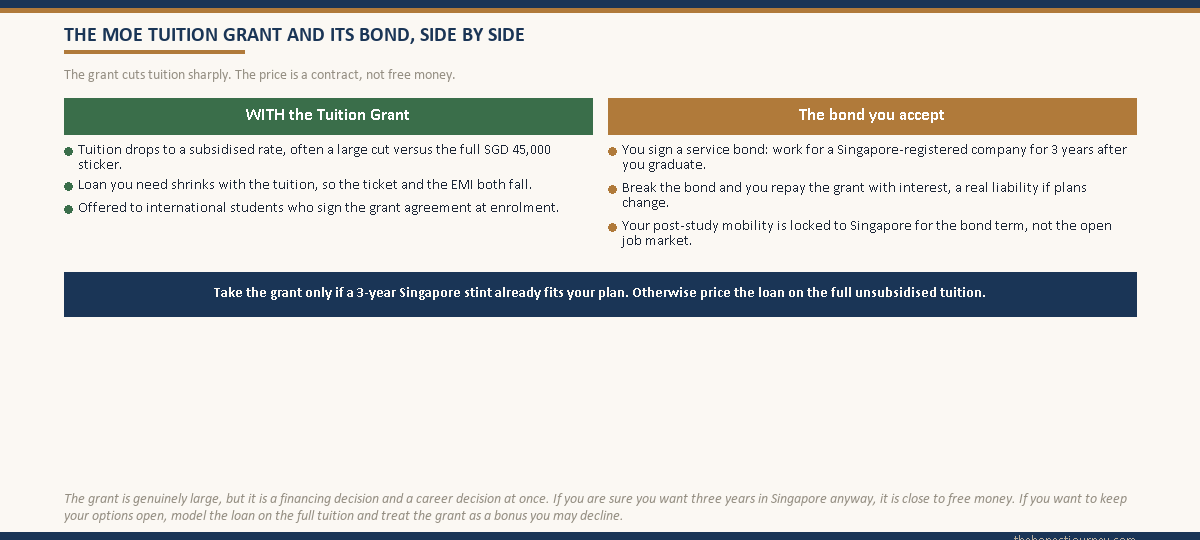
Faz's ruleThe Tuition Grant is not free. The price is three years of your working life committed to Singapore. Sign it only if that stint already fits the plan you would choose anyway.
I have seen students take the grant on autopilot because the tuition saving is obvious and the bond feels far away. Then plans change, a family situation pulls them home, and the repayment with interest lands. Decide on the bond as if the saving did not exist. If three years in Singapore is something you want, the grant is excellent. If it is not, pay full tuition and stay free.
Living, day to day
Singapore is safe, clean, efficient and very international, which makes the soft landing easier than most destinations. English is the working language and the medium of instruction, so there is no language barrier. The flip side is cost. Rent is the big squeeze: university hostel places are limited and competitive, and private rooms in shared flats are expensive. Many students share to keep the monthly number down toward the SGD 1,400 end of the range rather than the SGD 1,800 end.
Public transport is excellent and cheap, food at hawker centres is affordable and good, and the city is compact enough that you do not need a car. The hidden cost is lifestyle creep, because everything tempting is within reach. Students who keep the budget under control treat the SGD 1,400 to SGD 1,800 band as a discipline, not a starting point that drifts upward.
Work rules during and after study
During term, the Student Pass allows limited part-time work, capped at a set number of hours per week, and full-time work during the official vacation periods, subject to the prevailing rules for your institution. Part-time work helps with pocket money and local experience, but it will not meaningfully fund a Singapore degree. Treat it as supplementary, not as a funding plan. The wider reality of working while studying abroad is covered in the guide on whether studying abroad is worth it.
After graduation, if you took the Tuition Grant, you are obliged to work in Singapore for three years to satisfy the bond, which in practice means securing a job and moving onto an Employment Pass or equivalent work pass. If you did not take the grant, you are free to stay and look for work or leave, but staying still requires an employer to sponsor a work pass. Singapore’s work passes have salary thresholds, and those thresholds have been rising, so a fresh graduate needs a genuine offer at a qualifying salary to convert.
The job market, honestly
Singapore is a regional hub for finance, technology, logistics, pharma and professional services, so for the right fields the job market is genuinely strong. Graduates from NUS, NTU and SMU in computing, engineering, finance and analytics are in demand, and salaries are high in rupee terms. That is the real draw, and it is why the loan math for Singapore can work cleanly: a good local salary services an ₹30 to 40 lakh loan comfortably.
The honest caveats are two. First, work passes have salary floors that have tightened, so the bar to convert from student to worker is real, and weaker fields or weaker graduates can struggle to clear it. Second, Singapore is small. The number of roles is finite, competition is intense, and there is a local-hiring priority framework that employers weigh. A strong graduate in a demanded field clears these hurdles. A marginal one may not. Go in expecting to compete, not expecting a guarantee.
Is it worth it?
For the right student, Singapore is one of the cleanest value propositions in study abroad. A one-year degree keeps the ticket below a US two-year programme, the teaching and the brand are genuinely strong, the city is safe and English-speaking, and a good local salary repays the loan fast. If you want to build a career in Singapore or across Asia, the MOE Tuition Grant turns an already reasonable ticket into a bargain.
It is not for everyone. If your real plan is to return to India straight after the degree, the grant’s bond does not fit, and you should fund the full tuition, which makes Singapore a more expensive choice than it first appears. If your field is not one Singapore’s job market rewards, the post-study runway is uncertain. And if you cannot fund the full unsubsidised tuition without the grant, you are leaning on the bond to make the money work, which means the career decision is being made by the budget rather than by you.
The honest frame is this. Singapore works brilliantly when the field, the career plan and the funding all point the same way. When they do not, the grant’s bond papers over a mismatch that will surface later. Scholarships can ease the funding side without the bond; the landscape is in the post on scholarships for Indian students to study abroad, and the full picture of funding sits in the cost and funding guide.
Sorting the visa is the step most people underestimate. The full process, fees and funds proof for Singapore sit in the Singapore student pass guide.
FAQ
How much does it cost an Indian student to study in Singapore?
A one-year non-subsidised Master’s at NUS, NTU or SMU runs roughly ₹38 to 42 lakh all-in at a planning rate of ₹62 per Singapore dollar. That breaks into about ₹27.9 lakh tuition for an SGD 45,000 programme, around ₹11.16 lakh living for twelve months, and roughly ₹1.86 lakh for the Student Pass, insurance and miscellaneous. The MOE Tuition Grant can cut the tuition sharply, but only if you accept its three-year service bond.
What is the MOE Tuition Grant and the service bond?
The Ministry of Education Tuition Grant subsidises tuition for eligible students at Singapore’s publicly funded universities, including international students. For an international student the grant is conditional: you sign an agreement to work for a Singapore-registered company for three years after you graduate. That obligation is the service bond. If you break it, leave early, or decline to work in Singapore, you repay the grant amount with interest, so treat it as a career commitment, not a discount.
Do I need a Student Pass to study in Singapore?
Yes. Every full-time international student needs a Student Pass issued by the Immigration and Checkpoints Authority. Your university sponsors the application through the ICA’s online system once you accept your offer, you receive an in-principle approval before you travel, and you complete formalities and collect the pass after arrival. The process expects evidence that you can fund your studies and living, so prepare your proof of funds early, as the application timeline is tied to your enrolment.
Can I work while studying in Singapore?
The Student Pass allows limited part-time work during term, capped at a set number of hours per week, and full-time work during official vacation periods, subject to the prevailing rules for your institution. It helps with pocket money and local experience but will not fund a degree, so treat it as supplementary. After graduation you need an Employment Pass or equivalent work pass to stay and work, and Singapore’s work passes carry salary thresholds that have been rising.
Which universities should an Indian student target in Singapore?
The three that carry the most weight are the National University of Singapore, Nanyang Technological University and Singapore Management University. NUS and NTU are research heavyweights, strong in engineering, computing, business and the sciences, while SMU is a smaller, city-centre institution focused on business, economics, law and information systems. All three are genuinely selective, so admissions lean on academics, test scores where required, your statement and relevant experience.
Is the job market good for graduates in Singapore?
For demanded fields it is strong. Singapore is a regional hub for finance, technology, logistics, pharma and professional services, and graduates in computing, engineering, finance and analytics are sought after, with high salaries in rupee terms. The caveats are real: work passes carry salary floors that have tightened, and Singapore is small with intense competition and a local-hiring priority framework. A strong graduate in a demanded field clears these hurdles, but a marginal one can struggle.
Should I take the Tuition Grant if I want to return to India?
Probably not. The grant’s three-year service bond requires you to work for a Singapore-registered company after you graduate, so it directly conflicts with a plan to return to India straight after the degree. Breaking the bond means repaying the grant with interest. If your real plan is to come home, fund the full unsubsidised tuition and stay free of the obligation, even though that makes Singapore a more expensive choice than the subsidised figure suggests.
How does the cost compare to the USA or UK?
A one-year Singapore Master’s lands near ₹41 lakh all-in unsubsidised, which is meaningfully less than a two-year US Master’s and broadly comparable to a one-year UK programme in an expensive city. If you take the MOE Tuition Grant and accept the bond, the tuition drops sharply and Singapore becomes one of the cheaper top-tier options. Without the grant, it sits in the middle of the pack, with the advantage of a one-year duration and a strong regional job market.
Faz · The Honest Journey · 2026