Short answer. A sponsorship affidavit for a student visa is a sworn statement, signed by the person funding your studies, declaring they will cover your tuition and living costs abroad. In India it is executed on ₹100 or ₹500 stamp paper and notarised.
On its own the affidavit carries almost no weight: it only works when attached to the sponsor’s income proof, six months of bank statements, and proof of your relationship to them.
The consultant told my cousin the sponsorship affidavit was “just a formality.” Print it, sign it, get it stamped, done. So that is what the family did. One page, a parent’s signature, a notary stamp, and a confident smile. The visa officer read it for about four seconds, asked one question the affidavit could not answer, and the file went into the refusal pile. Nobody had attached the income proof. The affidavit was technically perfect and completely worthless.
A sponsorship affidavit for a student visa is not the document. It is the cover letter to the documents. This post shows you the real format, a sample you can adapt, the supporting papers without which the affidavit means nothing, and exactly how to get it notarised so an officer takes it seriously.
A sponsorship affidavit for a student visa is a sworn statement, signed by the person funding your studies, declaring they will cover your tuition and living costs abroad. On its own it carries almost no weight. It only works when it is executed on stamp paper, notarised, and backed by the sponsor’s income proof, bank statements, and proof of your relationship to them.
For the full guide, read Education Loan in India: The Complete 2026 Guide.
The other paperwork that sits in the loan file: the bonafide certificate education loan post, the education loan interest certificate post, and the demand letter education loan post.
What a sponsorship affidavit actually is
An affidavit of support, sometimes called a sponsorship affidavit or affidavit of financial support, is a legal declaration made on oath. The sponsor states who they are, how they are related to you, what they earn, and that they accept full financial responsibility for your education and stay abroad. It is signed in front of a notary or a first-class magistrate, which is what turns it from a letter into a sworn document.
Here is the part most families misread. The affidavit proves intent, not capacity. It says the sponsor is willing to pay. It does not, by itself, prove the sponsor can pay. The visa officer is assessing both, and capacity is the harder test. That is why an affidavit submitted alone, without the income and bank evidence behind it, reads as an empty promise. The officer has seen thousands of them.
Most countries do not provide a fixed government template for this. The US, the UK, Canada, and Australia all assess your finances and accept a sponsor, but they expect the underlying evidence rather than a specific affidavit form. The affidavit is an Indian convention that ties the package together for the officer and for the university. The countries care about the proof. The affidavit organises it.
Faz's ruleThe affidavit is the promise. The documents are the proof. Officers fund the proof, not the promise.
I have watched perfectly drafted affidavits get refused because the family treated the stamp paper as the deliverable. The officer does not doubt that your father loves you. He doubts the money exists. Attach the bank statements and the income tax returns, every time.
The affidavit of support format
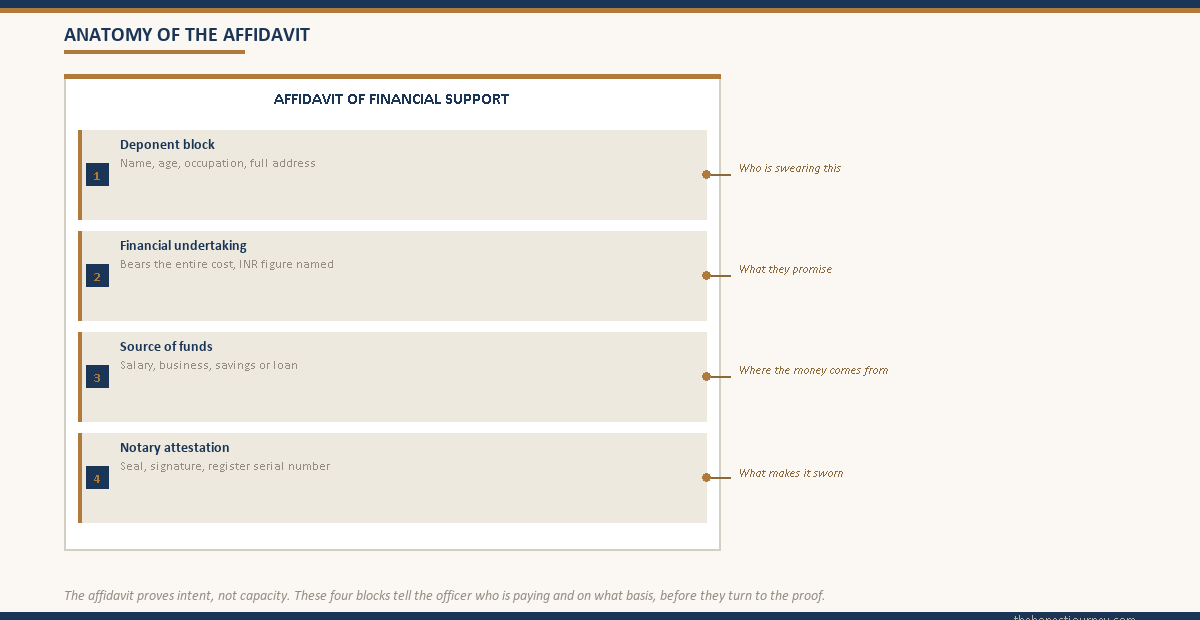
The structure is consistent across most templates a notary will recognise. Your affidavit should contain these elements in roughly this order. Keep it on a single page where possible. Officers reward clarity, not length.
| Section | What it states |
|---|---|
| Deponent details | Sponsor’s full name, age, occupation, full residential address |
| Relationship | Exact relationship to the student (father, mother, brother, uncle) |
| Purpose | The student’s name, the course, the university, the country |
| Financial undertaking | That the sponsor will bear tuition and living costs, ideally with a figure |
| Source of funds | Salary, business income, savings, or a sanctioned education loan |
| Verification clause | That the statements are true to the best of the deponent’s knowledge |
| Signature block | Deponent signature, place, date, and the notary’s attestation |
The financial undertaking line is where families get vague, and vagueness costs you. “I will bear all expenses” is weaker than “I undertake to bear the entire cost of the said course, estimated at ₹35,00,000, including tuition and living expenses, from my income and savings.” A specific figure that matches the university’s cost of attendance signals that the sponsor has actually read the numbers.
A real sample you can adapt
Below is a working sample. Replace the bracketed fields. Do not copy it verbatim with the brackets still in, which sounds obvious until you see how often it happens. The phrasing is deliberately plain because notaries and officers prefer plain.
AFFIDAVIT OF FINANCIAL SUPPORT
I, [SPONSOR FULL NAME], aged [AGE] years, [OCCUPATION], residing at [FULL ADDRESS], do hereby solemnly affirm and declare as follows:
1. That I am the [RELATIONSHIP, e.g. father] of [STUDENT FULL NAME], who has been admitted to [UNIVERSITY NAME], [COUNTRY], for the course of [COURSE NAME] commencing [MONTH, YEAR].
2. That I undertake to bear the entire cost of the said course, estimated at INR [AMOUNT] (covering tuition fees and living expenses), for the full duration of the programme.
3. That the said funds are drawn from my [salary income / business income / savings / sanctioned education loan from BANK NAME], and that I am financially capable of meeting these obligations.
4. That I will not allow my [son/daughter/ward] to become a financial burden on the host country at any time during the said studies.
5. That the statements made above are true and correct to the best of my knowledge and belief.
Deponent: ____________________
Place: ________ Date: ________
(Notarial attestation below)
Notice clause 4. The “will not become a public charge” line matters because it speaks directly to what every immigration officer is screening for. They are not just checking that you can pay. They are checking that you will not draw on the host country’s welfare or healthcare system. That single sentence answers the question they are actually asking.
The supporting documents without which it is worthless
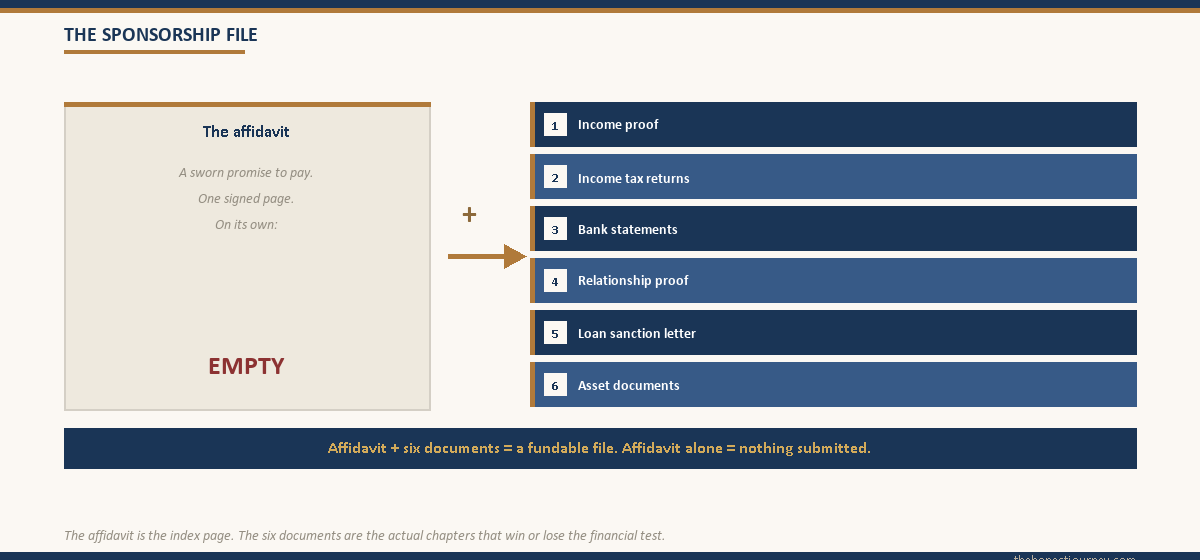
This is the section I would pin to every consultant’s office wall. The affidavit is the index page. These are the actual chapters. Submit the affidavit without these and you have submitted nothing.
| Document | Why the officer wants it |
|---|---|
| Sponsor’s income proof | Salary slips (last 3 to 6 months) or business income documents, proving the income exists |
| Income tax returns | Last 2 to 3 years of ITRs, which corroborate the income claim independently |
| Bank statements | Last 6 months, showing the balance is real, stable, and not freshly parked |
| Relationship proof | Birth certificate, family ration card, or passport linking sponsor and student |
| Loan sanction letter | If funds are loan-backed, the bank’s sanction letter as primary evidence |
| Asset documents | FD certificates or property papers as supporting, never primary, proof |
The bank statement carries the most weight, and it carries a hidden rule. Officers look for seasoned funds, money that has been sitting in the account for a while, not a large sum that landed two weeks before the application. A sudden deposit that exactly matches the tuition figure is one of the most common refusal triggers, because it suggests borrowed or arranged funds that will vanish after the visa is granted. The UK formalises this as the 28-day rule, where maintenance funds must have been held for 28 consecutive days. The principle applies informally almost everywhere. The full picture on what counts and what does not is in the proof of funds for a student visa guide.
If your sponsor is funding through a loan rather than savings, the sanction letter does the heavy lifting and the affidavit simply ties it to the named sponsor. Most embassies accept a loan sanction letter as proof of funds when it states the amount, the disbursement schedule, and the borrower’s name clearly. The affidavit then declares that this loan is the funding source. For what that letter must contain and how each country reads it, see the post on the documents required for an education loan.
Faz's ruleA bank balance that appeared last month is a red flag, not proof. Funds must be seasoned.
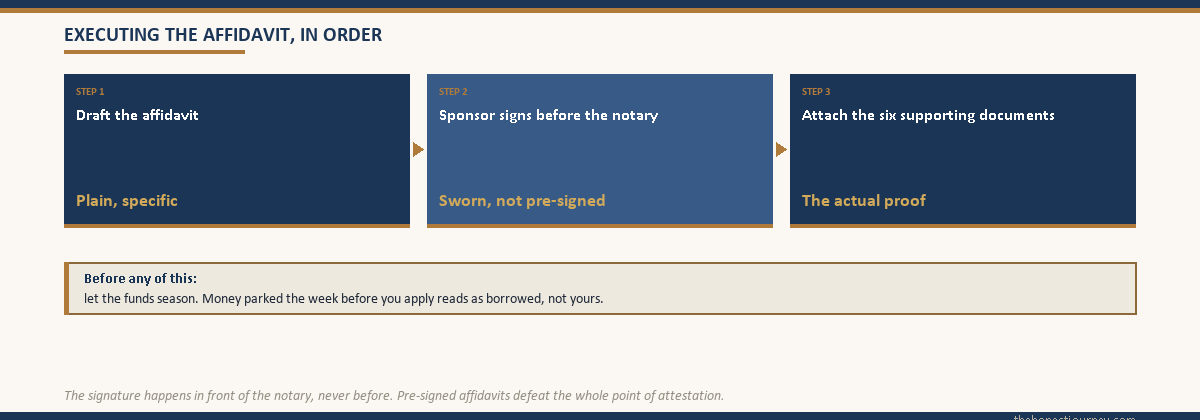
The fastest way to turn a strong affidavit into a refusal is to deposit the tuition amount the week before you apply. Officers are trained to spot it. If the money is genuinely yours, let it sit for a few months and let the statement tell that story.
Who can be a sponsor
The default and strongest sponsor is a parent. Officers expect parents to fund a student, so a father or mother as sponsor raises no eyebrows. The further the relationship sits from the immediate family, the more scrutiny the affidavit attracts, because the officer starts asking why this person is paying for your education.
| Sponsor | Acceptance |
|---|---|
| Parent (father or mother) | Strongest and expected, minimal extra justification needed |
| Sibling or spouse | Generally accepted with clear income and relationship proof |
| Grandparent, uncle, aunt | Accepted but expect questions on why they are funding you |
| Family friend or distant relative | Weakest, often doubted, treated as a possible cover for arranged funds |
A sponsor other than a parent is allowed in most countries, but the affidavit and the supporting file have to work harder to explain the relationship and the motive. If an uncle is funding you, the officer wants to understand why your parents are not, and the bank statements and relationship proof need to absorb that question before it is asked. Multiple sponsors are possible too, for example both parents combining income, in which case each files a separate affidavit and attaches their own income proof.
One practical note on co-funding. If a parent is also the co-applicant on your education loan, the affidavit and the loan documents should tell the same financial story without contradicting each other. A common slip is an affidavit claiming the parent will fund from savings while the actual money is a loan in that parent’s name. Keep the source of funds clause honest and consistent. The mechanics of who shares loan liability are covered in the post on the education loan co-applicant in India.
Notarisation on stamp paper, done properly
An affidavit is not an affidavit until it is sworn. In India that means printing it on non-judicial stamp paper and having it attested by a notary public or a first-class magistrate. The stamp paper value is small and varies by state, typically in the range of ₹10 to 100, and the exact denomination matters far less than the attestation itself. Some families execute it on plain paper with a separate notarial stamp affixed, which most notaries accept. Either route is fine as long as the notary’s seal, signature, and register entry are present.
The sponsor signs in the presence of the notary, not before. That is the whole point of attestation, the notary is certifying that the named person actually swore the statement in front of them. A pre-signed affidavit handed to a notary defeats the purpose and a careful officer can sometimes tell. The notary records the affidavit in a register and assigns it a serial number, which is what gives it legal standing, the same notarised footing relied on by other education documents such as the gap certificate for an education loan.
For US, UK, and some other applications you may not strictly need notarisation at all, because those systems weigh the bank and income documents more than the sworn statement. But notarising it costs almost nothing and removes a possible objection, so the honest advice is to notarise it anyway. Where families do go wrong is over-engineering it, paying for high-value stamp paper or apostille certification that no embassy asked for. Check the specific embassy’s document checklist before spending on attestation you do not need.
Faz's ruleNotarise it because it is cheap insurance, not because the embassy demanded high-value stamp paper.
Most US and UK files do not even require notarisation, yet I still notarise, because removing a free objection is just good sense. What I will not do is pay for apostille or premium stamp paper nobody asked for. Read the embassy checklist before the consultant upsells you.
The honest closing take
The sponsorship affidavit is one of the most misunderstood documents in the entire visa file, and the misunderstanding is almost always the same. People treat the sworn statement as the proof, when it is only the introduction to the proof. The four seconds an officer spends on the affidavit are spent confirming who is paying and who they are to you. The minutes they spend after that are on the bank statements and the income returns, and that is where the visa is actually won or lost.
So get the format right, keep the financial undertaking specific, notarise it because it is cheap, and choose a parent as sponsor if you possibly can. Then forget the affidavit and obsess over the documents behind it. A sponsor with three years of clean ITRs, six months of seasoned bank statements, and an honest source-of-funds line will clear the financial test with a one-paragraph affidavit. A beautifully drafted affidavit with nothing behind it will not clear anything. The proof is the point. The affidavit just points at it.
Who can sponsor you, and how the affidavit is worded, is a country-by-country call. The funds and sponsor rules per destination are in our student visa guides for Canada, the UK, Australia and the USA.
FAQ
What is a sponsorship affidavit for a student visa?
It is a sworn legal statement, signed by the person funding your studies, declaring that they will cover your tuition and living costs abroad. The sponsor states their identity, their relationship to you, their income, and their financial undertaking, then signs it before a notary. On its own it proves only intent. It carries weight only when backed by the sponsor’s income proof, income tax returns, and bank statements. Visa officers fund the documents behind the affidavit, not the affidavit itself.
Who can sponsor my student visa?
A parent is the strongest and most expected sponsor, raising the least scrutiny. Siblings and spouses are generally accepted with clear income and relationship proof. Grandparents, uncles, and aunts are accepted but invite questions about why they are funding you rather than your parents. Family friends and distant relatives are the weakest option and are often treated as possible cover for arranged funds. Multiple sponsors are allowed, with each filing a separate affidavit and attaching their own income evidence to support the claim.
What documents must accompany the affidavit?
The affidavit is worthless without supporting evidence. Attach the sponsor’s income proof such as salary slips for the last three to six months, their income tax returns for the last two to three years, bank statements for the last six months, and proof of your relationship to the sponsor such as a birth certificate or family ration card. If funds are loan-backed, include the bank’s loan sanction letter as primary evidence. Asset documents like FD certificates support the file but should never be the primary proof.
Does the affidavit need to be notarised?
In India, an affidavit is only legally valid once sworn before a notary public or first-class magistrate, who certifies that the sponsor signed it in their presence. For US and UK applications you may not strictly need notarisation, since those systems weigh bank and income documents more heavily than the sworn statement. Even so, notarising costs almost nothing and removes a possible objection, so it is worth doing. Avoid over-spending on apostille or high-value stamp paper that no embassy actually requested.
What stamp paper value is needed for the affidavit?
The stamp paper denomination is small and varies by state, typically in the range of ₹10 to 100. The exact value matters far less than the notarial attestation itself. Some families execute the affidavit on plain paper with a separate notarial stamp affixed, which most notaries accept. What gives the document legal standing is the notary’s seal, signature, and register serial number, not an expensive stamp paper. Do not let anyone upsell you on premium stamp paper that the embassy checklist never mentions.
Can a relative other than a parent sponsor me?
Yes, a sponsor other than a parent is permitted in most countries, but the file has to work harder to explain the relationship and the motive. If an uncle or grandparent funds you, the officer will want to understand why your parents are not, so the relationship proof and bank statements must absorb that question in advance. The further the sponsor sits from your immediate family, the more scrutiny the affidavit attracts. A parent remains the safest choice whenever it is genuinely possible.
Why was my visa refused even though the affidavit was perfect?
Almost always because the proof behind it was missing or weak. A flawless affidavit submitted without income proof and bank statements reads as an empty promise. The most common trigger is unseasoned funds, a large deposit that landed just before the application, which officers treat as borrowed or arranged money. A sudden balance matching the tuition figure exactly is a classic red flag. The affidavit cannot save a file where the underlying funds look manufactured. Let the money sit and let the statement tell an honest story.
Does an education loan count as a source of funds in the affidavit?
Yes, and it is one of the strongest sources you can name. If your sponsor is funding through a sanctioned education loan, the bank’s sanction letter does the heavy lifting and the affidavit simply declares that this loan is the funding source. Most embassies accept a loan sanction letter as proof of funds when it states the amount, the disbursement schedule, and the borrower’s name clearly. Keep the source of funds clause in the affidavit honest, so it does not claim savings while the actual money is a loan.
Faz · The Honest Journey · 2026