Short answer. An education loan EMI bounce triggers a same-day NACH return, a bounce charge of ₹200 to ₹750 from the bank plus a similar penalty from your account bank, a second auto-debit attempt within 2 to 5 days, and a DPD entry on your CIBIL report if the payment crosses 30 days overdue.
Cross 90 days and the loan turns NPA. In rare repeat cases the bank can file a Section 138 case if the EMI was backed by a security cheque. Most bounces are fixable in 48 hours if you act on the first SMS.
The first time my EMI bounced, I did not know it had bounced for almost six hours. The bank’s auto-debit hit my account at 9.04 in the morning, the NACH return came back at 11.17, and the SMS that told me about it was buried between two delivery notifications and a UPI confirmation. By the time I noticed and topped up the account it was late afternoon. Nothing collapsed, the loan was fine, but I learned something that day. The clock on an education loan EMI bounce starts the second the debit fails, and the longer you sit on it, the more boxes the lender starts ticking.
This post is the honest timeline of what happens after a bounce, what it actually costs in rupees, when CIBIL gets touched, and the narrow set of cases where a Section 138 cheque-bounce case becomes a real possibility. If you are reading this because you just got the SMS, scroll to the “how to fix it in 48 hours” section first.
More on managing repayment: the education loan balance transfer india post, the education loan top UP post, and the should you prepay education loan india post.
What actually happens on day zero (the same-day NACH return)
Every Indian education loan EMI bounce begins with the same mechanism. The lender presents an auto-debit request through the NACH (National Automated Clearing House) system run by NPCI. NACH is the rail that moves recurring debits from your bank account to the lender on a fixed date each month. You signed a NACH mandate when you accepted the loan. That mandate is what the lender uses to pull the EMI every cycle.
On EMI day, the presentation typically hits your bank account in the morning batch. If the balance is short by even one rupee, the debit fails. The bank flags it as a “return” with one of NPCI’s standard reason codes. The most common return codes you will see in your statement are:
| Code | Reason | How common |
|---|---|---|
| R01 | Insufficient funds | Most common bounce reason |
| R02 | Account closed | If you changed banks and did not update mandate |
| R03 | No such account | Wrong account number on mandate |
| R09 | Drawer signature differs | Rare in NACH, common in physical cheque |
| ME / Mandate | Mandate not registered or expired | Happens after bank mergers |
The same-day return is automatic. Nobody at the bank picks up the phone to call you. The system fails the debit, posts a return file back to the lender, and both sides log the event. You get an SMS from the lender (and sometimes from your own bank) within a few hours. That SMS is your first and only early warning.
Faz's ruleRead every loan-related SMS the day you get it. The bounce timeline runs on calendar days, not on when you noticed.
Lenders escalate based on the return date, not the date you saw the message. A debit that failed on the 5th is already 5 days old by the 10th, even if you only read the SMS on the 10th. The 30-day CIBIL clock does not care about your inbox.
The bounce charge: what it costs in rupees
A bounced EMI triggers two separate charges, and most students only realise this when they read the next statement carefully. There is the lender’s bounce charge, and there is your own bank’s auto-debit return charge. Both hit the same month.
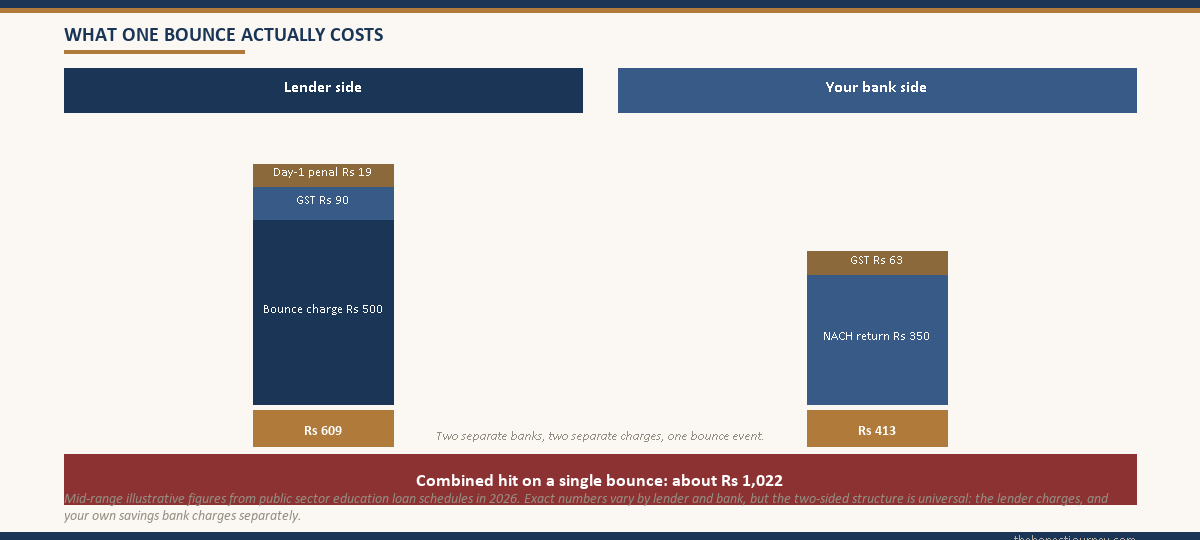
Typical numbers, as of 2026, for education loans from public sector banks and the larger NBFCs:
| Charge | Range | Who charges it |
|---|---|---|
| Lender bounce / penal charge | ₹200 to ₹750 + GST | The education loan lender |
| NACH return charge | ₹150 to ₹500 + GST | Your own savings account bank |
| Penal interest on the unpaid EMI | 2% per month on the overdue amount, pro-rated daily | The education loan lender |
| Re-presentation charge (if applicable) | ₹100 to ₹300 | Some lenders only |
On a typical ₹28,000 EMI, a single clean bounce that you fix the same day still costs roughly ₹500 to ₹1,500 across both banks once GST is added. The penal interest is what bites if the EMI sits unpaid. 2% per month on a ₹28,000 EMI is about ₹19 a day. Trivial for a week, ₹500 over a month, and the kind of thing that creeps into a four-figure annual cost if bounces become a pattern.
One detail worth knowing. The lender’s bounce charge is capped under RBI’s circular on penal charges in loan accounts, which came into effect in 2024 and says lenders cannot treat penal charges as a revenue line item. They must be fair, transparent, and disclosed at sanction. If your lender is charging ₹1,000 or more per bounce, ask them to point you to the policy document. Most have quietly brought the number down to ₹350 to ₹500 plus GST in the last 18 months.
The re-presentation: what the bank tries next
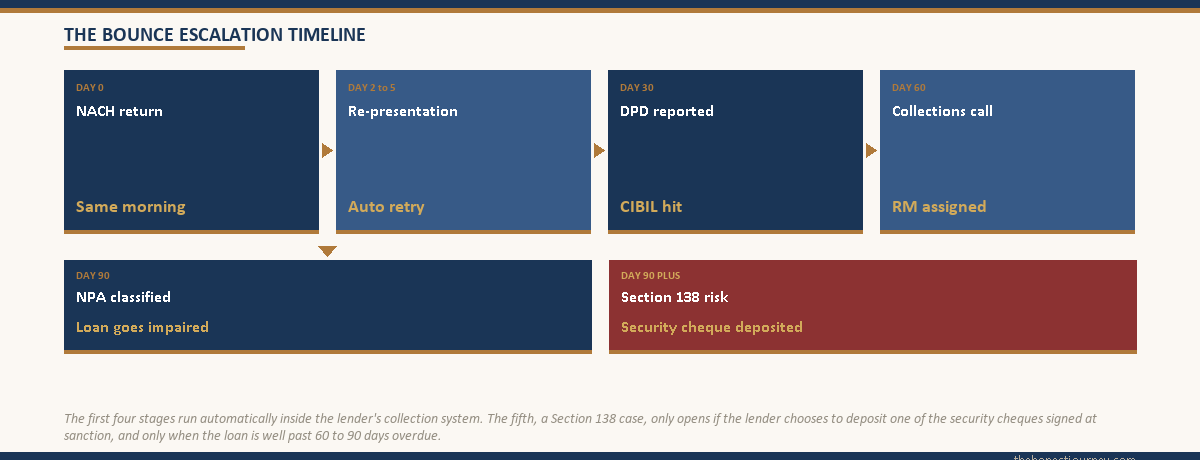
A failed NACH debit is almost never a one-and-done event. The lender’s system typically re-presents the debit within 2 to 5 working days. Some lenders do it the very next working day. Others wait a week. A few try a third time after that. NPCI rules allow up to 3 presentations of the same NACH mandate in a single cycle.
What this means for you. If you top up your account within 48 hours of the original bounce, there is a very high chance the next auto-debit attempt clears, no human interaction with the lender required, and the only damage is the bounce charges from the first attempt. If you ignore the SMS, the second attempt also fails, and now you are looking at two sets of bounce charges, penal interest stacking, and a flag in the lender’s collections system.
The second bounce is where the lender’s relationship manager actually picks up the phone. Up until that point, you are inside an automated workflow. After the second failure, a collections officer is assigned, and they start calling. The conversation at this stage is still recoverable. It is annoying but not damaging. Pay the EMI plus the charges, ask them to re-trigger the debit, and the loan rolls forward.
Faz's ruleFix a bounce inside the second presentation window and there is no permanent record outside your own bank statement.
CIBIL does not pick up isolated NACH failures. It picks up the loan account going DPD (days past due). If the EMI gets paid before the 30-day mark, even after a bounce, the credit bureau record stays clean. The bank’s internal note exists, but no future lender sees it.
The CIBIL impact: the 30-day, 60-day, and 90-day cliffs
This is the part most students misunderstand. A bounced EMI does not immediately hit your CIBIL score. CIBIL only reports what the lender reports, and the lender reports the loan account’s status, not individual NACH failures. The status is reported monthly, on a fixed cutoff date.
The reporting works on DPD buckets:
| Days past due | How CIBIL records it | Score impact (rough) |
|---|---|---|
| 0 to 29 days | “000” or “STD” (standard / current) | None if cleared inside the cycle |
| 30 to 59 days | “030” DPD bucket | Score can drop 40 to 70 points |
| 60 to 89 days | “060” DPD bucket | Score can drop 70 to 100 points |
| 90+ days | NPA, reported as “SUB” (sub-standard) | Score can drop 100 to 150 points, recovery takes 18 to 36 months |
The big break point is day 30. A bounce that gets cured inside the same EMI cycle (you pay before the next month’s debit) typically does not produce a DPD entry. Once you cross 30 days overdue on a single EMI, the loan account moves into the 30-DPD bucket, the lender reports it to CIBIL on the next cutoff, and it sits on your report for 36 months even after you regularise it.
Day 90 is the structural cliff. RBI’s asset classification rules treat any retail loan with an unpaid instalment beyond 90 days as a non-performing asset. The lender stops accruing interest as income, starts treating the loan as impaired, and the bank’s collections process escalates from polite phone calls to formal notices. Recovery from a 90-day DPD on your CIBIL takes years. Recovery from an NPA classification is harder still. The honest framing of how an education loan shows up on CIBIL covers the reporting mechanics in more depth.
Section 138 and the cheque-bounce case scenario
Most students hear “Section 138” and panic. The reality is narrower than the rumour. Section 138 of the Negotiable Instruments Act applies to cheques, not to NACH auto-debit failures. A NACH return on its own does not give the lender a Section 138 case.
But there is a real route to a 138 case in education loans, and it works like this. At sanction time, most lenders operating under the IBA Model Education Loan Scheme take a set of post-dated security cheques (PDCs) or undated cheques as backup. These are not used for monthly collections (that is what NACH is for). They are kept in a file. If the loan goes seriously delinquent (typically once it crosses 60 to 90 days overdue and the borrower is not responding), the lender pulls one of those cheques, fills it in for the overdue amount, deposits it, and waits for it to bounce. The moment that cheque bounces, the lender has the legal basis to issue a 138 notice.
The notice gives you 15 days to pay. If you pay inside the 15-day window, no case. If you do not, the lender can file a criminal complaint in the magistrate’s court of the place where the cheque was presented. The penalty under 138 is up to two years’ imprisonment or a fine of up to twice the cheque amount, or both. In practice, courts settle the vast majority of 138 cases with payment of the dues plus costs. Jail terms in education loan 138 cases are rare. But the case itself is a serious thing to have hanging over you, especially if you are applying for jobs that ask about pending legal matters.
The plain reading: a single bounced EMI does not get you anywhere near a 138 case. A pattern of bounces, no communication with the lender, and the loan crossing 60 to 90 days overdue is the path that opens that door. The fix is to never let it get that far. The broader picture of what unfolds when an education loan is not paid for an extended period walks through the full escalation in detail.
How to fix a bounce inside 48 hours
The recoverable window is short but generous if you act. The playbook that has worked for most students I have spoken to:
Hour 0 to 6. Read the SMS. Confirm the bounce on the lender’s app or by logging into the loan account portal. Note the exact EMI amount and the bounce charge if it is already posted.
Hour 6 to 24. Top up your savings account to cover EMI plus a buffer of ₹2,000 to ₹3,000 for charges. If you can, transfer 1.5 times the EMI to give room for the re-presentation plus any penal interest accrual.
Day 1 to 2. Call or email the lender’s customer care. Quote your loan account number. Ask them to confirm the re-presentation date. Some lenders need you to formally request the re-debit, others run it automatically.
Day 2 to 5. The second NACH attempt typically clears if the balance is there. Check the account at end of day to confirm the debit happened.
Day 5 onward. If the second attempt also fails (rare if you topped up), pay the EMI manually via NEFT or IMPS to the lender’s collection account. Get the receipt. Email it to customer care with a request to update the loan account.
If the bounce was caused by a genuine cash flow problem (job loss, salary delay, family medical event), the answer is not to keep bouncing month after month. The answer is to write to the lender requesting a temporary EMI reduction, a moratorium extension, or a one-time restructuring. RBI’s framework allows banks to restructure education loans for genuine hardship cases. The cleanest route is laid out in the education loan restructuring and moratorium extension guide.
Faz's ruleIf you can see a bounce coming, call the lender three days before EMI date. A pre-emptive request is a different conversation from a post-bounce explanation.
Lenders have far more flexibility before the bounce happens. A pre-emptive call to defer the debit by a week, or to skip one EMI with a tail-end addition, is often granted. The same request after the bounce is a collections conversation, with charges already on the meter.
Restarting the auto-debit after a bounce
Once a NACH mandate fails repeatedly, some lenders mark it as “dormant” and stop attempting auto-debit. From that point you are expected to pay manually every month, which works for one or two cycles but tends to slip eventually. To restart the auto-debit cleanly, you usually have to:
Submit a fresh NACH mandate form to the lender, either physical or e-NACH via Aadhaar / net banking. Confirm the bank account, the IFSC, and the maximum debit amount (set it 10 to 15 percent above the EMI to absorb any future rate revisions). The lender re-registers the mandate with NPCI, which typically takes 5 to 10 working days, and the next cycle’s debit resumes automatically. If you have moved to a new bank account, this is also the moment to make sure the old mandate is cancelled so you do not get a duplicate debit. The full NACH workflow is documented on the NPCI site and is worth a read if your lender is slow to respond.
A practical detail: keep the EMI debit account separate from your main spending account if you can. A dedicated account that you top up on the 1st of the month, with one purpose only (EMI debit on the 5th or 7th), removes 90 percent of bounce risk. The cost is one extra savings account. The benefit is that no UPI spend or sudden bill drain can touch the EMI balance.
The honest closing take
A single bounce is a logistical event. Two bounces in twelve months is a pattern the lender notices. Three or more starts to shape what the bank thinks of you the day you ask for a top-up, a restructuring, or any other concession. None of this shows up in the rate or the EMI. It shows up in how flexible the lender is when you actually need them to be.
The mechanics matter less than the habit. Set up the dedicated debit account, top it up monthly with a buffer, watch the SMS the day of EMI, and the entire bounce timeline becomes theoretical. If a bounce does happen, you have 48 hours of clean recovery, 30 days before CIBIL gets touched, and 90 days before the loan becomes a serious problem. The window is wide enough that nothing has to spiral if you act on the first SMS.
And if the bounce is a symptom of something larger (the EMI is genuinely beyond your monthly cash flow), the bounce is information, not the problem. The actual problem is the loan sizing or the income trajectory, and the fix is a restructuring conversation, not a hope that next month’s debit goes through. The guide on honest education loan repayment in India covers the long-game playbook for staying ahead of the EMI rather than chasing it.
FAQ
What happens immediately when my education loan EMI bounces?
On EMI day, the lender’s NACH debit request hits your bank account. If the balance is short, the debit fails the same day with an NPCI return code (most commonly R01 for insufficient funds). You get an SMS from the lender and often from your own bank within hours. The lender’s system schedules a re-presentation within 2 to 5 working days. No human intervention is involved at this stage. The clock on charges, penal interest, and the 30-day CIBIL window starts immediately, even if you have not seen the SMS yet.
How much is the bounce charge on an education loan EMI?
The lender charges ₹200 to ₹750 plus GST per bounce, and your own savings account bank charges a separate ₹150 to ₹500 plus GST as a NACH return fee. So a single bounce typically costs ₹500 to ₹1,500 in combined charges. On top of that, penal interest at roughly 2 percent per month accrues on the unpaid EMI until you pay it, which works out to about ₹19 per day on a ₹28,000 EMI. RBI’s 2024 circular on penal charges has pushed most lenders to keep these numbers in the lower end of the range.
Will one bounced EMI hurt my CIBIL score?
Usually no, provided you pay the EMI inside the same cycle. CIBIL reports the loan account’s days-past-due status, not individual NACH return events. If the EMI clears (via the re-presentation or a manual payment) before it crosses 30 days overdue, the account stays in the standard / current bucket and CIBIL records nothing unusual. Cross 30 days overdue and the lender reports a 30-DPD entry to CIBIL, which can drop your score by 40 to 70 points and stays on the report for 36 months.
When can the bank file a Section 138 cheque bounce case?
Not on the NACH return itself. Section 138 of the Negotiable Instruments Act applies to physical cheques. The route to a 138 case in education loans is via the security cheques you signed at sanction. If the loan crosses 60 to 90 days overdue and you are not responding, the lender can fill in and deposit one of those cheques. When it bounces, they issue a 15-day notice. If you pay inside 15 days, no case. If you do not, they can file a criminal complaint. A single missed EMI almost never reaches this stage.
When does the bank re-present a bounced NACH debit?
Most lenders re-present within 2 to 5 working days of the first bounce. Some retry the very next working day, others wait a week. NPCI rules allow up to three presentations of the same NACH mandate in one EMI cycle. If you top up your savings account inside 48 hours of the first bounce SMS, the second attempt typically clears automatically with no further action needed beyond paying the bounce charges. If the second and third attempts also fail, the mandate is often marked dormant and you have to pay manually.
Can I request the bank to restructure my education loan after repeated bounces?
Yes. RBI’s framework permits banks to restructure education loans for borrowers in genuine financial hardship (job loss, prolonged salary delay, family medical emergency, course extension). The lender can extend your tenure, reduce the EMI, or grant a fresh moratorium period. The trade-off is that restructured loans are reported to CIBIL with a “restructured” flag, which future lenders see. It is still a much better outcome than letting the loan slide to NPA. The earlier you ask, the more flexibility you get.
How do I restart the auto-debit after a NACH mandate goes dormant?
Submit a fresh NACH mandate form to the lender, either physical at the branch or via e-NACH using Aadhaar plus net banking. Provide the bank account number, IFSC, and a maximum debit amount set 10 to 15 percent above your EMI to absorb future rate revisions. The lender re-registers the mandate with NPCI, which typically takes 5 to 10 working days. The next cycle’s debit then resumes automatically. If you have switched bank accounts since the original mandate, also cancel the old mandate so you do not face a duplicate debit attempt.
What is the safest way to avoid future EMI bounces?
Keep a dedicated savings account just for the EMI debit, separate from your main spending account. Top it up on the 1st of every month with the EMI amount plus a buffer of 15 to 20 percent for charges and rate revisions. Set a calendar reminder for two days before EMI date to confirm the balance. If you anticipate a cash flow problem (a salary delay or a large planned expense), call the lender three days before EMI date and request a debit deferral. A pre-emptive request is treated very differently from a post-bounce explanation.
Faz · The Honest Journey · 2026